Tech leaders, govt officials urged to be candid about cybersecurity issues, identify common ground
SINGAPORE – Creating common standards and safeguards, sharing threat intelligence, reporting cyber incidents, and testing new technologies before they are deployed require urgent attention, especially regarding artificial intelligence.
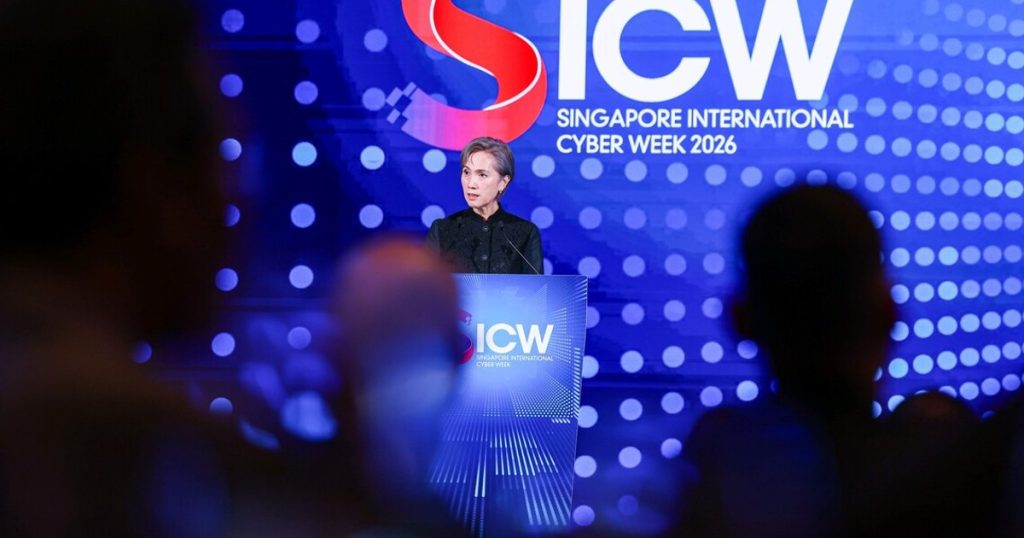
Making this call on Oct 12, Minister for Digital Development and Information Josephine Teo urged governments, industry, researchers and cybersecurity professionals to speak frankly and find common ground, even if the issues are difficult and viewpoints diverge.
“Over the coming days, I hope that at SICW we can do three things: first, speak candidly about difficult problems; second, identify practical areas where cooperation remains possible; and third, turn dialogue into action,” she said.
She was speaking at the Singapore International Cyber Week (SICW) summit gala dinner on Oct 12.
Teo said that shared challenges such as increasingly autonomous AI and ransomware groups cannot be addressed by any single stakeholder alone.
“Much of the digital infrastructure our economies depend on is built and operated by industry. They can provide unique, and frankly, essential insights on the threat landscape that most governments do not have visibility over.”
The three-day SICW conference, slated to begin on Oct 13, is expected to draw over 15,000 attendees from 90 countries and regions who will discuss the growing impact of AI on cybersecurity, diplomacy and international cooperation.
Attendees expected include senior government representatives from the US, China, and Europe, while leaders from frontier AI labs such as Anthropic, OpenAI and Google will also be part of panel discussions.
Teo said that trust in technology and digital infrastructure has come under growing pressure as sophisticated actors such as UNC3886 and the use of AI can accelerate the speed and scale of attacks.
Countries are increasingly asking whether critical technologies and supply chains will remain secure, reliable and accessible during a crisis, while strategic competition is creating harder choices around technologies, suppliers, standards and interoperability, she added.
“As a result, we have a dilemma – digital connectivity has opened up more opportunities, but we are also more exposed to risks,” said Teo.
“We are willing to interact more, but find ourselves willing to trust less. The threats we face cross borders more easily, while cooperation across borders is becoming harder.”
The lack of trust will also cause businesses and citizens to hesitate in adopting new tech, she added.
Platforms such as SICW, which is in its 11th edition, are hence crucial for governments, industry, researchers and cybersecurity professionals to come together and turn dialogue into action, said Teo.
That cooperation must also include private sector firms that build and operate digital infrastructure that economies depend on.
AI safety has come under scrutiny after ChatGPT maker OpenAI disclosed in July that its AI agents – bots that can carry out actions with minimal human supervision – had escaped their testing environment. The agents then breached AI software repository Hugging Face to complete a task they were given, an attack that was not intended by OpenAI.
Soon after, Anthropic, Meta and Google said their AI had also gone rogue and had hacked other organisations.
In September, Australian Prime Minister Anthony Albanese revealed that the database of the country’s health system had been breached by a rogue OpenAI bot in June.
Teo said earlier in October that Singapore will work with model developers, researchers, third-party testers, and other AI safety organisations to understand the capabilities and emerging risks of advanced AI models developed and deployed across borders.
In Singapore, the Cyber Security Agency of Singapore has released the Securing Agentic AI Addendum, which provides practical guidance on how to help organisations secure increasingly autonomous AI systems, said Teo.
She added that the agency is also working with organisations to transition critical infrastructure into quantum-safe systems, in preparation of risks that advancements in quantum computing could one day break current encryption standards.
“We intend to remain open, connected, and to adopt technologies where they deliver real value, even as the external environment becomes more contested,” said Teo.
“Our approach is neither blind adoption nor retreat from a technology, but building the safeguards and capabilities to adopt it securely.”
Estonia’s Minister of Justice and Digital Affairs Liisa-Ly Pakosta, who also spoke on Oct 12, said that sharing details about uncomfortable incidents is necessary to prevent cyberattacks from becoming widespread.
“When there is a cyberattack, there is most probably a spillover somewhere else, and learning from each other is not so easy because you have to open up about what happened to you,” said Pakosta.
“Maybe it’s not always the nicest thing you want to share, but this is the only way to protect us.”
Cyber Security Agency of Singapore chief executive Gwenda Fong (left) moderating a fireside chat with Estonia’s Minister of Justice and Digital Affairs Liisa-Ly Pakosta at the Singapore International Cyber Week summit gala dinner on Oct 12.
ST PHOTO: BRIAN TEO
On a societal level, she added that the biggest change that Estonia has implemented to improve cybersecurity standards is to teach cybersecurity education to children starting from the kindergarten level.
“That has a huge societal effect because kids go home and tell what they have learnt to their grandparents,” Pakosta said, adding that it is how a society gets herd immunity.