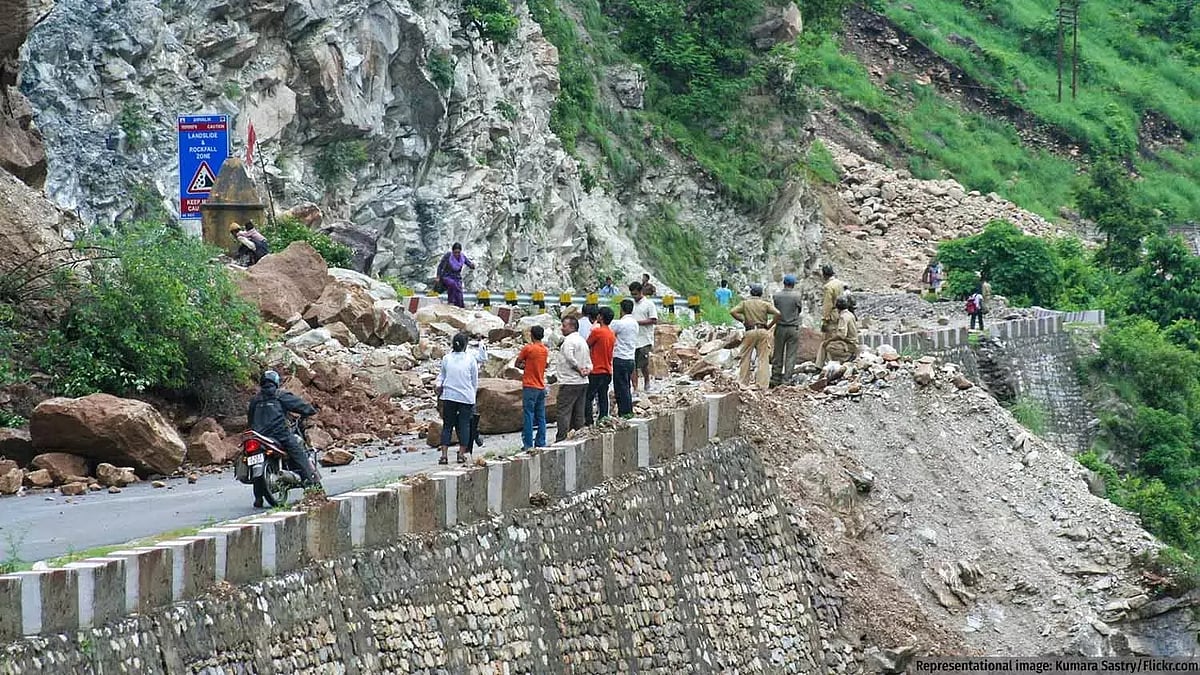
The climate trouble on India’s roads
The challenge with implementation
Making note of the challenge in developing climate-resilient roads in the geologically fragile Himalayan region, Union Minister of Road Transport & Highways Nitin Gadkari, in April 2026, announced a policy shift to prioritise slope stabilisation before starting the construction of roads in addition to existing initiatives for specialised landslide treatment, geo-hazard mitigation and geological investigations and data sharing.
Sanjay Nirmal, former director general of the Ministry of Road Transport and Highways (MoRTH), told ISignal that MoRTH’s intensifying focus on slope stabilisation comes as steeper hill cutting is creating slopes of increasing heights, and the treatment options are expanding to modern methods such as geo cells (cellular structure to bind and strengthen loose soil) and geo grids (a grid used to bind loose hillside soil). “Modern methods used to be very expensive but as they become more competitively priced, their deployment is poised to increase,” he said.
It’s not as if India lacks technical guidance for addressing slope instability and erosion in road construction. Detailed hill road guidelines exist as do recommendations to strengthen embankments and roadside slopes, and design road drainage.
Besides, Deol pointed out, the Indian Roads Congress has begun moving in a new direction. For instance, it has laid out retrofitting guidelines specifically for protecting road systems from rainfall, waterlogging, and flooding, which is itself an admission that older designs need revisiting.
Practically, he said, this should translate into asset management systems that flag risk exposure rather than just design compliance at the time of construction.
But translating this foundation into consistent implementation remains a key challenge.
Decades-old codes and standards explain slope stabilisation methods such as stone pitching, turfing, benching, etc., Nirmal explained. And these used to be included in tenders and were made compulsory (stone pitching) for embankments taller than six metres. But, “their implementation remained a concern and their maintenance wasn’t prioritised”, he added.
“Road engineering essentials are sometimes dropped under pressure of access, deadlines and milestone payments,” said Das. “Stabilisation is deferred to the end, and slopes are sometimes left to ‘settle naturally’ over two monsoons only to necessitate the raw face to meet the monsoon unprotected. Field decisions are also made without thinking through consequences.”
A common example she cited was dumping excavated material against an existing retaining wall for want of a dumping yard. In the monsoon, the saturated dump imposes heavy, unplanned pressure on a wall designed for another condition, and the wall fails.
In particular, Das said, “Unprecedented construction rates compress investigation, and agencies new to complex terrain miss early warning signs.”
In the Himalayas alone, the Border Roads Organisation has constructed about 4,595 km of mountainous roads between 2020-21 and 2024-25, at a cost of approximately Rs 23,625 crore.
While the Border Roads Organisation’s 2022 Technical Instruction on road classification and geometric standards explicitly recognises hazards associated with Himalayan terrain and requires its technical officers to follow prescribed standards for slope stabilisation, drainage, erosion control and landslide protection, Kukreja questioned “whether the stabilisation philosophy is being applied sufficiently early and comprehensively across the entire road network.”
“In a Himalayan road, slope stability cannot be treated as a remedial engineering package after the road has been cut,” he said. “Alignment, drainage, excavation geometry, retaining structures, vegetation, muck disposal and slope treatment need to be conceived as one system.”
The need for continuous monitoring
Slope stabilisation isn’t a one-time task, it needs to be monitored, said Nirmal.
Where bioengineering and other slope stabilisation methods have been used in both national and state projects supported by the World Bank Group, such as Green National Highways Corridor Project and Himachal Pradesh State Roads Transformation Project, project monitoring and field observations indicate that these interventions have performed effectively, with upgraded road sections remaining stable through successive monsoon seasons, without major slope failures or significant damage on the treated stretches.
For instance, both the civil engineering structures (retaining and breast walls) and bio-engineering (including brush layers, slip plantation, bamboo crib walls, hydroseeding and jute netting) on a 33.1-km stretch of the Baddi – Sai – Ramshahar road and a 27-km stretch of the Mandi – Rewalsar – Kalkhar road, both roads that were severely disrupted during the 2025 monsoon, showed no signs of distress after the season, the World Bank in India told ISignal.
World Bank-supported hill road projects such as the Mizoram State Roads Project and the Himachal Pradesh State Roads Project explicitly used bioengineering measures for slope stabilisation and promoted them as a cost-effective and environmentally sound component of hill-road development, noted Kapur. “What matters is that those projects recognised slope stability as a core engineering requirement rather than a post-construction maintenance issue.”
“Data-driven planning should continue beyond the design stage, with monitoring and periodic reassessment throughout the infrastructure’s service life,” said Pandey.
Technology is now adding another important layer to monitoring by picking up essential data as AI-enabled predictive models, remote sensing, GIS, IoT-based sensors and real-time monitoring can help identify vulnerable slopes and detect changes in ground movement, rainfall, soil moisture and other risk parameters before they translate into a major failure, explained Deol.
For example, an AI-enabled landslide early-warning system developed by the Indian Institute of Technology, Mandi has been deployed at high-risk sites in Himachal Pradesh, while MoRTH has also moved towards InSAR-based monitoring to detect subtle ground movements along vulnerable stretches of the Char Dham route.
Solutions for climate-resilient roads
Going forward, Das proposed making hazard and hydrological evidence a mandatory design gate, and plugging design-to-site gaps by drafting more realistic guidelines.
Evidence-led alignment using geological mapping, geophysics, LiDAR and InSAR, with drone and remote-sensing surveys where access is difficult would ensure better design, she said. “So would mandating structures instead of deep cuts—viaducts, cantilever and half-bridge sections—tunnels where geology justifies them, and narrower formations in sensitive stretches.”
Pandey said measures should be based on local geological and hydrological conditions, rather than relying on a uniform treatment for all slopes.
Typically, those who execute rarely write the codes, Das observed, and those who write them rarely face site constraints. So, getting code writers and field engineers to draft guidelines together, supported by hands-on workshops would also help new methods reaching team supervisors.
She said construction could be made more secure with progressive stabilisation, cutting in a series of gentle slopes (called benches) and stabilising each before the next. Controlled excavations would also be gentler on the geology.
Mandating engineered stabilisation would ensure this critical procedure isn’t bypassed. Planning designated muck disposal yards before excavation would help ensure it is never dumped against retaining structures. Enforcing monitoring-based construction using measuring devices would help identify weaknesses. Tying payment to stabilisation and drainage would ensure speed does not reward skipped steps.
In the instance of failures, the industry needs independent geotechnical reviews and third-party audits with real consequences, according to Das. “Publicly releasing failure investigation reports would help agencies learn from each other; otherwise the lessons stay in a closed circle, the mistake recurs, and another investigation begins,” she said.
This report is republished with permission from ISignal, formerly IndiaSpend, a data-driven, public-interest journalism non-profit. It has been lightly edited for style and clarity.