
ICE deported her from CT. Now, she parents from Mexico.
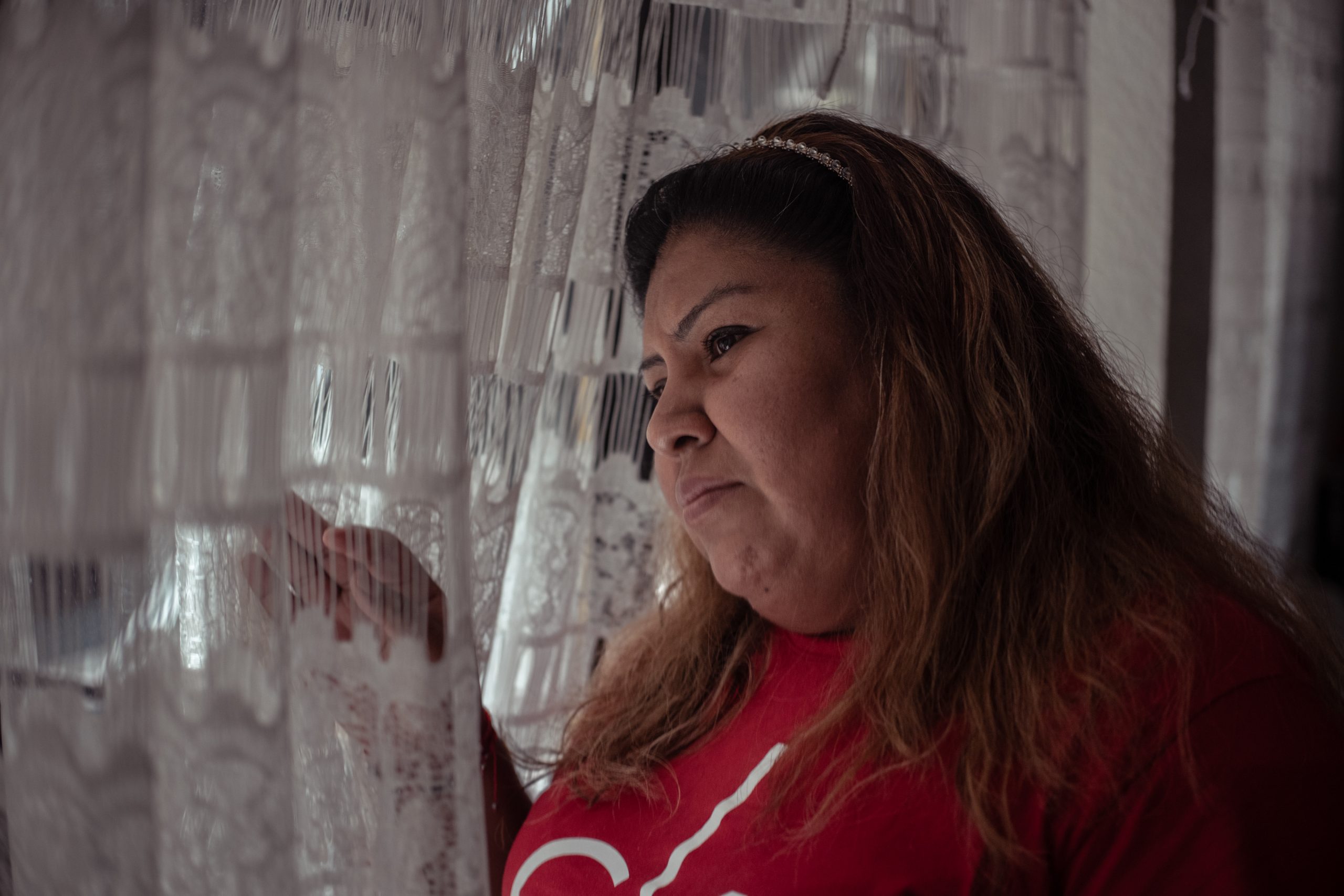
Most days, Nancy Martinez hauls a small tent and stacks of carefully folded clothing to a thoroughfare near her home in Naucalpan de Juárez, Mexico. As she’s selling a pair of shoes or a dress, a New Haven number lights up her cellphone. It’s a call from her son’s school. He’s inconsolable again and Martinez’s voice is the only thing that will soothe him.
“It doesn’t matter what I’m doing: I rush to talk to my kids. I’m always there for them,” she said.
Martinez talks with her 9-year-old son and 14-year-old daughter before school, after school and at bedtime every day. But it’s not enough for the children whose mother used to pack them homemade meals for lunch because they didn’t like the food in the school cafeteria and who insisted on leaving phones and tablets off the table at mealtimes.
It’s not enough for the mother whose hands no longer fold her kids’ clothes but instead stack T-shirts into neat piles to sell to strangers.
Martinez’s son has autism spectrum disorder. Though he’s usually reserved, lately thoughts about his mom bubble up. “I just want my mom,” he’ll say to a teacher, a stranger, a relative. On a few occasions, he’s walked up to a security guard in the hallway of his school, demanding to know why they took his mother away.
The trauma her children experienced on June 9, 2025 when U.S. Immigration and Customs Enforcement agents detained her in front of their home — and all they’ve experienced since — motivated Martinez to file a lawsuit against the federal government this summer. She filed with the backing of the Yale Law School Worker and Immigrant Rights Advocacy Clinic.
The family had been headed to school during the last full week of classes before summer break. After she dropped the kids off, Martinez had planned to attend a court appearance.
But before she could pull away from the curb, three vehicles boxed the family in. As ICE agents yelled at Martinez, who does not speak English, to get out of the car and handcuffed her, her teenage daughter — referred to in court documents as M.A.M. — asked the officers why her mother was being arrested.
There was a warrant for Martinez’s arrest, the agents told her, though no warrant was shown to the family, according to Martinez’s lawsuit.
“Her children, helpless, witnessed their mother’s abduction,” the complaint says.
Martinez was among roughly 100 people arrested by ICE in Connecticut that June, according to arrest data provided by ICE and published for public use by the Deportation Data Project. She joined the thousands of others who last year were separated from their U.S.-born children as the Trump administration began to fulfill its pledge of mass deportations.
In a Department of Homeland Security statement sent to The Connecticut Mirror, the department said Martinez was in the country illegally and has a criminal history that includes arrests for assault and breach of peace.
According to Martinez’s lawsuit, the charges stemmed from an argument with her sister-in-law over babysitting. Martinez’s attorneys, Michael Wishnie and Armando Ghinaglia-Socorro, said the state agreed to drop the charges if Martinez attended anger management classes, which she began to do in May 2025. Prosecutors filed to dismiss the case when she was deported, they added.
As Martinez’s son, who is referred to as U.A.M. in court documents, cried on the sidewalk on that June morning, ICE agents pulled Martinez’s hands behind her back. She frantically spoke in Spanish to her daughter as she was handcuffed and put in the back of a black vehicle where, according to the lawsuit, she had her first ever panic attack.
Martinez’s mother, who was visiting from Mexico at the time, came out of the house when she heard Martinez yelling ‘Mamá!’ She stayed with the children, though the lawsuit alleges that ICE officers never spoke to her or ensured that the children were in appropriate care.
The lawsuit says it was a breach of duty when ICE forced Martinez into an unmarked vehicle and then “drove off, leaving M.A.M. and U.A.M. standing in the street without a known legal guardian.” The lawsuit says that ICE ignored Martinez’s mother, “refused to tell the children’s father their location” by phone, and “showed little concern for M.A.M. and U.A.M.’s safety and well-being as they took Ms. Martinez away.”
The DHS statement denied this allegation, calling the claims in the lawsuit “blatantly false.”
“Before departing the scene, officers confirmed that Martinez’s mother was home and would be able to look after her children,” the statement said.
A month later, Martinez was deported to Mexico.
Her lawsuit seeks financial damages for the family’s treatment, which it calls “abusive” and “reckless.” But even a victory in that case would not allow Martinez to return to her husband and children in the U.S.
Family separations
It’s now been more than a year since Martinez was deported. When she was arrested, her children joined the other 145,000 U.S. children estimated to have been affected by the detention of a parent in the period between January 20, 2025 and April 9, 2026, according to data analyzed by nonpartisan think tank Brookings Institution.
Tara Watson, one of the Brookings researchers, said most of those detained have been deported. When ICE agents took Martinez, it was part of a larger pattern of family separation being replicated across the U.S., Watson said.
“A parent is arrested or detained or deported, and there’s literally no one in any government who is responsible for making sure their child is OK, or even knows who their child is,” Watson said. “The government itself is not collecting this information. They are supposed to ask, and we think it’s only happening sometimes.”
ICE does have a policy — the Detained Parents Directive — that guides agents when they remove parents from children. But the 2025 version of that policy, advocates say, reduces ICE’s responsibilities to keep families together through shifts in language and policy. For example, the previous directive required agents to place detained parents at a facility near their children, whereas under the new directive parents can be moved anywhere.
There’s no single federal agency that’s responsible for the kids that are left behind.
Kica Matos, president of the National Immigration Law Center
Kica Matos, president of the National Immigration Law Center, affirmed that while ICE may have guidance for how to care for children when parents are detained, “there’s no single federal agency that’s responsible for the kids that are left behind,” she said. “In practice, no one is clearly accountable.”
The state’s Department of Children and Families does not typically have a role in these cases because parents and children are not being separated due to abuse or neglect.
Matos is among those encouraging families to proactively plan, including by completing Connecticut’s standby guardian designation form, to ensure that children go to the caretaker of a parent’s choosing in such a situation. Connecticut has created a webpage to give families more information on the process, and some immigrant advocacy organizations are also holding trainings to guide families on what documents they might need if parents are separated from their children. When a family chooses to transfer guardianship because a parent has been deported, that arrangement can also be formalized through probate court proceedings.
In March, U.S. Sen. Richard Blumenthal, D-Conn., co-authored a report, “Cruelty is the Point: How Trump’s Immigration Agenda Endangers Children,” which reviewed 128 cases of children “who have been injured, left unattended, or otherwise put at direct risk of harm as a result” of DHS actions. The report includes an instance of a 1-year-old girl left alone in her car seat by ICE agents who detained the child’s father, and another instance of children watching their father get detained as he was taking them to school.
Blumenthal said Martinez’s case in particular has struck a nerve because of “the absolute cruelty of seizing her while taking her children to school without any notice or warning,” he said. “But also then listening to her, as we did at the press conference, and hearing her heartbreak, as well as her confusion and her loneliness. I mean, just absolutely crushing sadness that I felt during her talk about how much she misses her children and her family.”
In its statement after Martinez’s arrest, federal officials said ICE “does not separate families.
“Parents are asked if they want to be removed with their children or ICE will place the children with a safe person the parent designates,” the statement said. “This is consistent with past administration’s immigration enforcement.”
But Martinez told the CT Mirror that she was not asked if she wanted to be removed with her children when she was detained or during her time in a detention center.
DHS also said the U.S. offers money — $2,600 — and a free flight to people who came into the country illegally to self-deport. “We encourage every person here illegally to take advantage of this offer and reserve the chance to come back to the U.S. the right legal way to live the American dream. If not, you will be arrested and deported without a chance to return,” the statement said.
At a press conference about ICE activity on Oct. 1 in New Haven, Glenn Formica, a Connecticut attorney with the American Immigrant Legal Clinic, said that in his experience, DHS isn’t making good on that promise.
“They will promise them money, and then the money for leaving never shows,” he said. “It’s just deceit.”
DHS did not respond to CT Mirror’s recent questions about its policies.
In a September letter to Department of Homeland Security Secretary Markwayne Mullin, U.S. Sen. Chris Murphy , D-Conn., pressed for information about whether ICE agents were in fact following the Detained Parents Directive during each arrest.
“If so, what evidence can you provide that arresting agents/officers followed such policy? If not, provide a written rationale for such deviation,” he wrote.
Murphy has also authored bills that would prohibit ICE from conducting operations at locations where children are present, like school bus stops and day care centers.
Martinez’s case has remained top of mind for advocates like Matos.
“The way that Nancy was detained was a real crystallization and an affirmation of the brutality of this administration’s deportation agenda,” Matos said. “Never before had we seen what we saw that day — which is what we had heard was happening around the country — manifested in New Haven. ICE blocking people in their cars, wearing masks in people’s neighborhoods, handcuffing people and taking them away in the most frightening way possible.”
Shattered dreams
After she was arrested, Martinez spent about a month in detention at the Wyatt Detention Facility in Rhode Island before she was deported to the border city of Matamoros. From there, she got on a flight to Mexico City, and returned to her family home in nearby Naucalpan de Juárez, in a neighborhood called El Universal.
“When I came back to Mexico, all of my dreams were shattered,” she said. Upon returning to her native country, “I didn‘t think about the sounds or the smells, I spent my time weeping,” she said.
She returned to a family home and was reunited with her two oldest children for the first time in more than a decade.
Martinez had cared for her oldest kids as a single mom in Mexico. But she reunited with her first love in her early 20s and the couple decided to move to the U.S., in hopes of building a better life. “I couldn’t provide for my children’s needs
in Mexico’s economy,” Martinez said of her decision.
But she said the trip into the U.S. would have been dangerous for her oldest children, who were 3 and 5 at the time. “I didn’t want to cross the border with them because of how many things can go horribly wrong on that journey,” she said.
She said she also had no one to care for them in the U.S. while she and her partner worked so she “entrusted them to the care of my mother and grandmother so that I could go provide for them.”
Martinez sent money back to her family in Mexico for the children’s needs and so they could attend private school.
In Connecticut, Martinez had her two youngest children. But even as she missed the children she left with family in Mexico, she was intent on making her sacrifice meaningful.
“I don’t regret it. I’ve been asked if I would do it again — and yes I would. It was a better life,” she said.
After her deportation, the National Immigration Law Center helped fundraise to buy tickets for U.A.M. and M.A.M. to fly to Mexico and spend this past summer with Martinez. During their visit, four generations of the family were together under one roof.
Martinez’s family home, constructed on land her grandmother purchased, is large enough to house extended family. Martinez has her own area of the house on the second floor where she keeps her inventory of clothes to sell. Downstairs, Martinez’s mother has a small shop where she sells soda, snacks and basic household supplies.
“This is a humble neighborhood,” Martinez said. “There’s a lot of poverty — too much.” Around 40% of the Naucalpan de Juárez’s residents live in poverty, which Martinez sees plainly from the door of her home. People struggling with substance use live under tents within view of a ravine that’s sometimes used as a dump site for trash.
The home is full of framed family photographs and Catholic iconography: an image of the Virgen de Guadalupe looks out on the hallway in front of Martinez’s bedroom and a shrine with a crucifix and angelic dolls dressed in white satin is tucked into another nook. In a spare room where Martinez stores her inventory of clothing and accessories, framed portraits show the family at key moments over decades: weddings and quinceañeras, the 15th birthday celebration for girls from many Latin American countries that’s celebrated with an elaborate party and a colorful ballgown with a voluminous skirt.
Martinez herself never wanted a quinceañera. But her daughters — one in Mexico and one in the U.S. — did. Now, years after missing her eldest daughter’s quinceañeñera in Mexico, she will miss her younger daughter’s celebration in Connecticut when M.A.M. turns 15 in January.
Since her mother was deported, M.A.M. has struggled to focus on her schoolwork and has taken on significant responsibilities to help raise U.A.M, according to Martinez’s lawsuit. “Shouldering the weight of being a growing teenager and now a caregiver has taken its toll,” the lawsuit states. “Following her mother’s abduction, M.A.M. became a shell of herself, uncharacteristically irritable, reticent and withdrawn.”
M.A.M.’s has long dreamed of a quinceañera party, but after her mother’s deportation, it was hard to imagine celebrating anything. The details were overwhelming too: there was the question of the cost, and the logistics of planning a party on the scale of a wedding — with music, food, choreographed dances and the magnificent dress — without Martinez there to help. When they first discussed it, Martinez’s husband said it wouldn’t work. But after the shock of deportation wore off, her conviction grew: “I told him, ‘no — we can’t take this dream away from her.’”
When the children visited Mexico this summer, Martinez and M.A.M. worked on planning the party. Even as she organizes the details, it’s precisely the type of milestone that hurts most for Martinez to miss.
We need our mom. I’m only 13 — I’m not going to be able to handle this all alone.
Nancy martinez’s teenage daughter
At least some of those moments have come unexpectedly in the year since Martinez was detained. Just days after Martinez’s arrest, M.A.M. stood before a crowd in downtown New Haven and spoke through tears about her mother.
“We need our mom. I’m only 13 — I’m not going to be able to handle this all alone,” she said, speaking quickly. “You’re not just doing this to my family, you’re hurting other immigrant families who need their parents back home. You’re causing a lot of pain to these families by taking them away.” Her face crumpled with tears as Matos embraced her.
From inside a detention center, Martinez heard a TV broadcasting her daughter’s voice. “That’s my daughter, she’s the one who’s talking!” Martinez remembered saying. “Oh wow, she expresses herself so well.”
It’s one of the qualities in M.A.M. that Martinez has always been proud of.
When the lawsuit was announced in June of this year, M.A.M. and U.A.M. sat in a room at Yale Law School for another press conference. On a screen at the front of the room, Martinez spoke through an interpreter, telling the story of how ICE took her a year earlier, explaining the cognitive dissonance of that day.
“As a mother, I take pride in being a planner, coordinating my work schedule around teacher conferences, doctor’s appointments and sports matches, but nothing, absolutely nothing could have prepared me for what I saw looking out the window: there were my children clinging to their grandma and crying out for me as I got farther and farther away,” she said.
Since that moment, Martinez said, she has longed to hold her children through moments of “heartbreak, confusion and loneliness.”
Then, it was M.A.M.’s turn to speak. She walked calmly to the podium and read from prepared comments, rushing through as if trying to outrun the emotion of the moment.
“No one should have to go through what my family and I have gone through the past year,” she said quietly. “When ICE took away my mom, they took away my best friend. My confident and hardworking parent. My provider and my safety.”
M.A.M. has taken on responsibilities beyond her years, the lawsuit says. It details how in the summers, she now sells flan and chocolate-covered strawberries to help support the family. She also soothes her brother when he wakes up from nightmares, no longer able to sleep in his own bedroom “out of fear that someone will also take his sister away.”
U.A.M. sat in the audience and watched his big sister speak. She told the attorneys and TV cameras of her worries for him.
“He is still young, and everything has been so rough on him,” she said. “He is constantly scared, and now never wants to leave my side.”
Thousands of miles away, Martinez watched the press conference until the livestream shut off.