
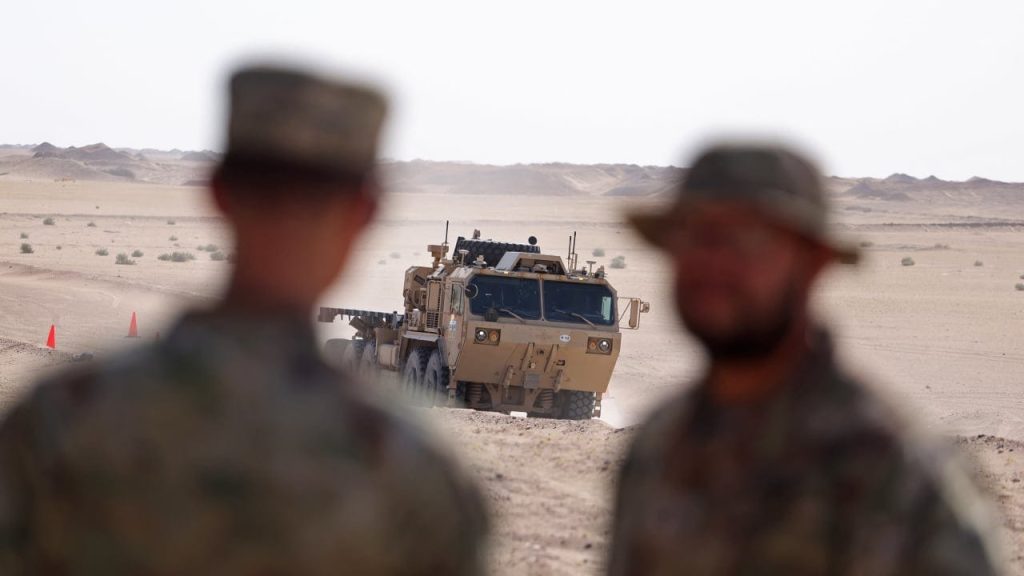
Iran strikes drove US troops from Camp Buehring -report
A group of US soldiers who remained at Kuwait’s Camp Buehring after a prewar evacuation eventually left the installation amid repeated Iranian attacks and ammunition shortages, CBS News reported Wednesday.
The network’s investigation combines newly obtained footage of strikes and damage with accounts from personnel who served at the base during the opening stages of the war.
Most of the approximately 7,000 troops stationed there had been moved before fighting began, sources told CBS.
More than 100 stayed behind, with service members describing fears that they lacked the resources to manage an attack causing large numbers of casualties.
“We had to abandon the base,” one source told CBS anonymously, citing military restrictions on speaking to the media.
Soldiers moved to remote desert positions
According to CBS, the remaining troops took equipment with them in vehicles and departed at night for the Kuwaiti desert, where they established forward operating bases.
Their departure followed attacks involving ballistic missiles and drones, as well as what three service members identified as Iranian F-5 aircraft. NBC News had reported the accounts of fighter jets in April.
CBS also reported a critical shortage of .50-caliber ammunition at Camp Buehring. An Army logistics official working elsewhere in Kuwait corroborated concerns about ammunition supplies and other defensive resources.
The footage provides a visual record of the attacks and their consequences for the installation. CBS said it checked the recordings’ metadata and compared them with photographs of damage to establish their authenticity.
CENTCOM declines comment on soldiers’ accounts
CENTCOM declined to comment to CBS. The Pentagon referred the network to Defense Secretary Pete Hegseth’s March 4 explanation of the military’s efforts to move personnel away from vulnerable locations.
Hegseth said more than 90% of Americans previously stationed at US bases had been moved beyond the range of Iranian fire while the military built up its offensive forces.
The soldiers interviewed by CBS nevertheless described continued risks after leaving Camp Buehring. Two were struck by lightning during desert sandstorms in late April, suffering burns and a ruptured eardrum, respectively, officials told the network.
CBS reported that commanders had sought to relocate the troops before those incidents but had not completed the move in time. The personnel transferred to Camp Arifjan in May before receiving further assignments inside and outside the Middle East.
No soldiers were killed by enemy fire at Camp Buehring or the desert positions, according to CBS, although several were injured.
Damage and supply shortages across US bases
Camp Buehring has supported US military deployments across the Middle East for more than two decades. The CBS investigation adds detail to earlier reporting about the vulnerability of American installations during the war.
The Jerusalem Post reported in September that a Pentagon inspector general assessment documented damage to hundreds of buildings and structures at US bases across the region, including Kuwait.
The assessment covered February 28 through June 30, estimated equipment losses at $3.7 billion and identified ammunition shortfalls and supply-chain bottlenecks.
The Pentagon disputed those findings in a response to the Post, saying the inspector general lacked access to all relevant information and rejecting claims that US munitions were depleted.