
More support for people with disabilities in S’pore by 2030
SINGAPORE – Persons with disabilities (PWDs) will get more support across key life transitions, such as moving from school to employment, with upcoming measures to be rolled out by 2030.
Students in special education (SPED) schools, the Institute of Technical Education (ITE) and polytechnics will be trained in workplace and soft skills and given more work exposure.
National disability agency SG Enable will expand its career services with a new Employment Support Office at the Enabling Village in Lengkok Bahru, to help PWDs and employers navigate employment matters. It will be fully operational in the second half of 2027.
Other measures include support for future care planning, training all front-line polyclinic staff to attend to people with intellectual disability and autism, and expanding community services.
These were among the recommendations in a 67-page report by the Taskforce on Assurance for Families with Persons with Disabilities released on Oct 4.
The task force was formed in December 2025 to review support for PWDs across life stages. Its recommendations, based on engagements with more than 200 individuals including caregivers and service providers, span three areas – planning for the future, finding and growing in a job, and living well in the community.
Over the next five years, the Government is committed to spending up to an additional 60% on average on a PWD to strengthen support for them and their families, said the report.
For many families, the period after graduation known as the “post-18 cliff” is a source of uncertainty. They worry whether their loved ones can find and keep a job, live independently and stay connected to their communities, the report said.
The report builds on Singapore’s plans for an inclusive society, including the Enabling Masterplan 2030, which aimed for stronger post-SPED school support.
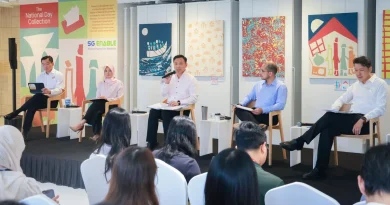
At a press conference at the Enabling Village ahead of the report’s release, Senior Minister of State for Social and Family Development Goh Pei Ming said there is support in schools, workplaces and disability facilities, but gaps remain in between. “It’s always the transitions where perhaps expectations may fall short, where the family or the person with disability feels a little bit lost, and I think this is where we feel that we can do a bit more,” said Goh.
Goh leads the inter-agency task force with four other political office-holders. They are Rahayu Mahzam, Minister of State for Health; Eric Chua, Senior Parliamentary Secretary for Social and Family Development; Shawn Huang, Senior Parliamentary Secretary for Manpower; and Syed Harun Alhabsyi, Senior Parliamentary Secretary for Education.
Job woes and support
Employment continues to be a challenge for the community. Currently, 34.7% of Singapore’s residents with disabilities are employed. The Republic aims to hit 40% by 2030.
Some PWDs said they found it difficult to build workplace skills such as communication, while others struggled to find relevant opportunities.
To address this, the Ministry of Education (MOE) will introduce structured applied learning and work exposure – such as learning journeys to workplaces and job tasters – in SPED schools for students with autism that offer the national curriculum, like Pathlight School.
MOE said these schools have done well in building academic foundations, but have limited opportunities to develop work-related skills.
Transition support programmes will be introduced as more SPED graduates move on to ITE and polytechnics. MOE said that between 2023 and 2025, students with disabilities formed about 2% of these institutions’ total enrolment on average each year.
Lydia Wong, 19, a final-year Higher Nitec student in ITE studying retail and online business, felt that work exposure opportunities built her confidence for future employment.
ST PHOTO: NG SOR LUAN
Lydia Wong, 19, a final-year Higher Nitec student in ITE studying retail and online business, felt that work exposure has built her confidence.
With impaired speech and motor functions, she finds it hard to handle stress or complete tasks quickly. A job coach and an understanding supervisor eased her transition into an internship as a retail assistant.
“At times, the store gets very busy, and I get very stressed out… (but my supervisor) told me not to stress out and just do things slowly, step by step,” said Wong, who hopes to enrol in an early childhood education polytechnic course.
Keeping PWDs in jobs is another concern. Data from the Ministry of Manpower as at 2025 shows that only about one in four employed residents with disabilities worked for the same employer for at least one year. The proportion drops to 2.2% for those who do so for at least seven years.
Retention is higher among participants in SG Enable’s School-to-Work programme, which offers customised training pathways and work options for SPED school graduates. Over three in four stay in their role for at least a year.
To add more structured pathways, SG Enable will expand its Sector Train-and-Place programme – it was piloted in 2025 to train PWDs for jobs in the hospitality sector – to five more sectors, including food and beverage and info-communications and technology. A total of 800 PWDs are expected to gain employment between 2026 and 2030 through this scheme.
Meanwhile, the new Employment Support Office will go beyond SG Enable’s current job placement services to provide longer-term skills and career support.
A 95% course fee subsidy under the SG Enable Training Grant – which currently applies only to courses specifically customised for PWDs – will extend to eligible mainstream courses offered by training providers accredited by the Skills and Workforce Development Agency, including in-demand courses like AI.
New grants for employers
To help employers, the Employment Support Office will work with industry stakeholders to develop playbooks for sectors with strong potential to hire PWDs, such as retail trade and finance and insurance services. The guides will cover how to identify suitable roles and redesign jobs.
The task force also found that employers faced a cumbersome process in applying for grants. Three existing schemes – the Open Door Programme Job Redesign Grant, Open Door Programme Training Grant for Employers and Employer Development Grant – will hence be merged into a single Enabling Employment Grant.
This grant will have a wider scope, including offsetting costs for employers to customise in-house training for PWDs. The three existing schemes helped about 100 employers in 2025, said the Ministry of Social and Family Development (MSF).
Enterprises that hire a “significant proportion” of PWDs with moderate needs – which MSF defines as those who require ongoing, structured support to stay in a job – can also tap a new Supported-Enterprise Enabling Grant.
With this, firms can use the funds to hire training officers, therapists and psychologists to support these employees. MSF said more details on the grant requirements will be shared at a later date.
The Enabling Employment Credit (EEC), which offsets wages for PWDs earning below $4,000 monthly, will raise its income ceiling, and also increase the amount and duration for the temporary wage offset. More details will be released later in 2026.
The number of employers who received the EEC rose from about 6,400 in 2021 to 6,800 in 2025, added the spokesperson.
OCBC Bank’s head of group human resources Lee Hwee Boon said the initiatives will help companies to start inclusive hiring.
The bank’s biggest challenge in this was convincing managers to take the first step, as some were worried about providing the right support or how well the new employee would adapt, said Lee.
But their perceptions shifted when they saw it could be done. OCBC partnered with SG Enable in March 2023, and had access to job redesign and training support, and partners such as the Autism Resource Centre.
The bank now hires people with autism whose strengths include attention to detail and consistency. Many have been placed in technology and human resource-related roles.
A sense of belonging
Senior Minister of State for Social and Family Development Goh Pei Ming (right) meeting TOUCH client Sherman, who has an intellectual disability, deafness, cerebral palsy and epilepsy, and his mother Wu Ping at Enabling Village on Sept 17.
ST PHOTO: JASON QUAH
Families will get more help to think ahead in areas like finances, housing and health, with future care planning made available progressively in all adult disability services such as day activity centres and sheltered workshops.
They will also pay less for such services by 2028, while more spaces will be added to day activity centres and sheltered workshops by 2030.
More broadly, the report said there is a need to move beyond care arrangements and help PWDs live more independently in the community.
Among its recommendations are eight more Enabling Services Hubs to make community support more accessible. A Health Communication Passport will be introduced at selected polyclinics so individuals can convey what they need to healthcare staff.
The report also outlined efforts to strengthen disability inclusion in schools and workplaces, create inclusive spaces and encourage meaningful interaction between the public and PWDs.
The goal is to create a society where PWDs feel a strong sense of belonging, said Goh. “We hope that Singaporeans from all walks of life will also journey together with us and welcome our persons with disabilities warmly into our communities, into our workplaces and into our hearts.”
While the task force’s work does not address areas like healthcare cost challenges and support for senior PWDs, Goh said the ministries will continue looking into these issues. “The report is the start. The work to implement it starts from this point,” he said.