Proposition NN explained: Colorado TABOR refunds would be sent to K-12
Colorado voters will decide in November whether to give K-12 public schools billions more dollars using money that taxpayers would otherwise get back in state refunds through the Taxpayer’s Bill of Rights.
Proposition NN, authored by public education advocacy groups and Democratic state lawmakers, was referred to the ballot earlier this year by the legislature when it adopted Senate Bill 135 along party lines.
The proposal represents the largest push by education advocates to raise new tax dollars for public schools since an unsuccessful effort in 2018. And if it succeeds, it would be the first time voters have passed a statewide measure to fund K-12 since Amendment 23 in 2000, which required the state to spend more on education — but didn’t provide any new money to do so.
If it passes, it would eliminate the refunds owed under the Taxpayer’s Bill of Rights indefinitely, all but removing a restriction on state government spending that has sent billions back to taxpayers since 1992.
Here’s what the measure would do, who has thrown their support behind it and who stands against it.
What Proposition NN would do
Proposition NN aims to pump billions of additional dollars into K-12 education, specifically to help schools manage class sizes, expand career and technical education programs, boost teacher pay and find ways to retain teachers.
The measure, if successful, would increase the TABOR cap on government growth and spending by the highest annual amount the state has spent on K-12 funding in previous years. That’s currently about $4.6 billion, but the measure is unlikely to generate that much money in a given year for at least the next decade, according to legislative forecasters.
The TABOR cap limits how much money state lawmakers can spend to the state’s annual growth in inflation and population. Any money collected over the cap must be refunded to taxpayers.
If voters approve the measure, taxpayers would give up their TABOR refunds so the state can spend that money on education.
The dollars generated by the measure would first be used to increase school funding by 2% annually, or about $107 million in the first year.
For the next decade, the state would spread any other dollars from the TABOR surplus among K-12 education and other programs targeting children, mostly early childhood programs like preschool access and childcare.
At least half of all the money retained by the state in a single year would support K-12 schools. For example, if the state keeps $500 million in TABOR surplus and a 2% increase in K-12 spending accounts for $100 million, another $150 million would go to school districts while the remaining $250 million could go toward other programs for kids.
After a decade, the state would still be required to increase K-12 spending by 2% annually, but the other funding restrictions expire, allowing the legislature to spend the rest of the money on anything it chooses.
Should voters give Proposition NN the green light, it isn’t expected to generate anything close to $4.6 billion annually for schools for the foreseeable future.
For one thing, the state isn’t collecting enough tax dollars right now to have that large of a TABOR surplus. Legislative staff estimate the state will exceed the current TABOR cap by about $464 million this fiscal year.
Moreover, the measure keeps in place a few other programs that would get TABOR surplus dollars before K-12. The first $200 million or so in TABOR refunds are used to reimburse local governments for the cost of a property tax break for seniors. In years when the state budget grows fast enough, Colorado also provides two tax credits for low-income families that would leave less money for education.
As a result, Proposition NN is only expected to generate $329.9 million for schools this budget year, and $521 million in 2027-28. In Year 1, that would reduce taxpayer refunds by $28 for a single filer making $100,000 a year, or $56 for joint filers. In the second year, taxpayers would miss out on $68 in individual refunds and $96 if they file jointly.
Nonetheless, the measure could fundamentally reshape the state’s tax policies and its budget for a generation or more.
Who is behind Proposition NN and why
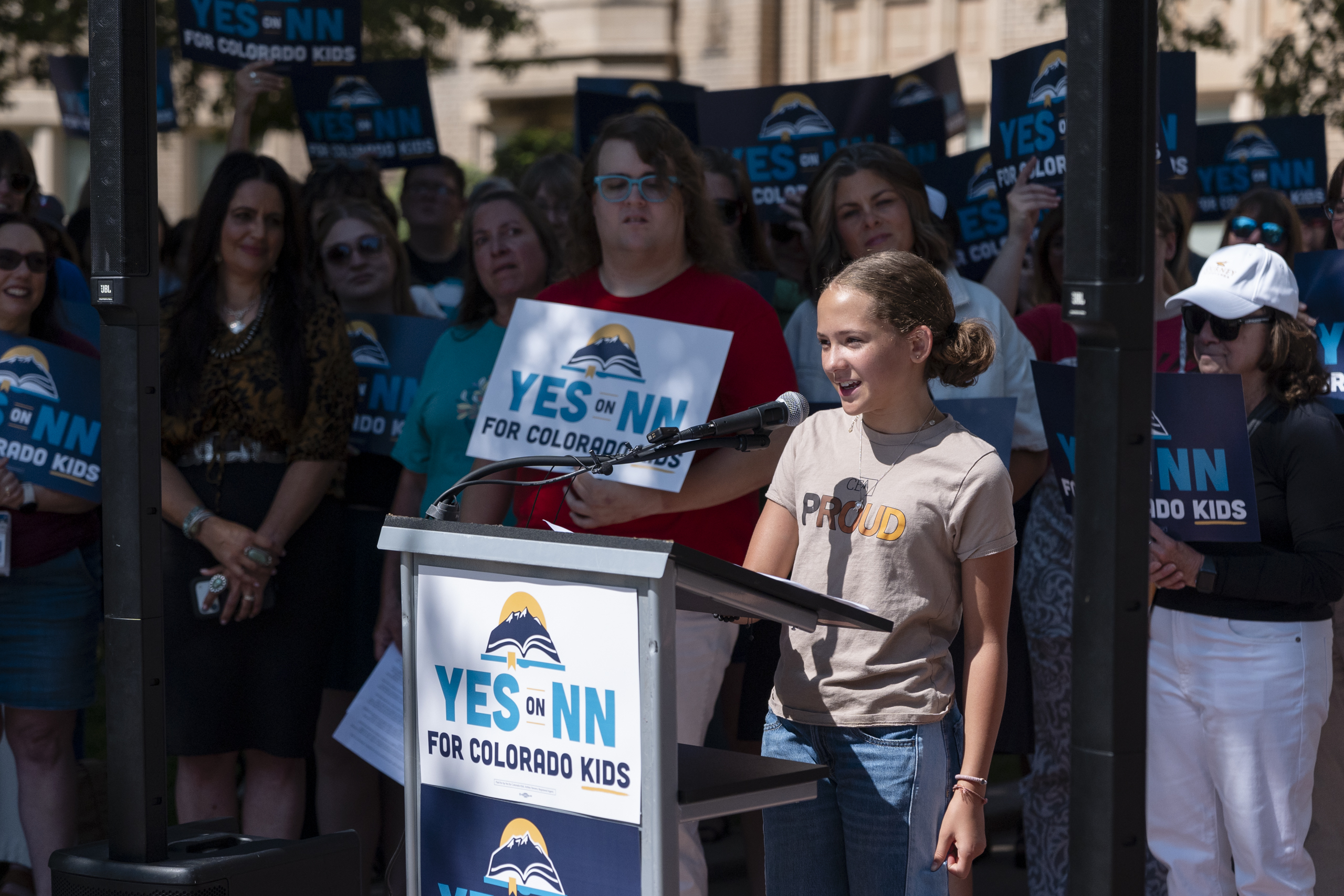
The Colorado Education Association, the state’s largest teachers union, is leading the “Yes for Colorado Kids” campaign in support of Proposition NN. The group has long been working to get an education funding measure in front of voters, arguing the state falls short of properly funding public schools.
Backers of the measure say Proposition NN will allow the state to ramp up spending closer to the true cost of educating kids today — more than three decades after Colorado voters enacted strict limits on state spending when they passed TABOR in 1992.
They point to two studies commissioned by the legislature in 2023 that found the state is underfunding schools by $3.5 billion to $4.1 billion a year.
In the pie that is the state budget, K-12 schools get a huge slice of funding — $5.6 billion for operations in the most recent year, second only to healthcare. Local communities also help fund their schools. Between state and local dollars, the total budget for K-12 schools this year is $10.2 billion — an amount that has increased incrementally year over year.
School leaders celebrated a turning point in education funding in 2024, when state lawmakers repealed a policy that had allowed the state to cut school funding in the wake of the Great Recession. Known as the budget stabilization factor, the policy allowed lawmakers to pay schools $10 billion less than the state constitution required over the 15 years it was in effect.
More recently, the state enacted a new school funding formula that promises to deliver schools an additional $500 million once it’s fully implemented. Still, educators and public school advocates say Colorado continues to lag behind other states in education funding.
Another source of tax dollars for schools is critical as Colorado tries to weather repeated state budget deficits and as schools struggle to keep teachers in classrooms, said Kevin Vick, president of CEA.
Schools have “been far below where they should be funded for a long time,” Vick said. “That’s really what brought on the urgency for this year. We are at a tipping point right now where if we’re cutting things for kids any further, we’re really doing them a disservice, even though educators are making their best efforts with what they have.”
The committee supporting Proposition NN has raised more than $2 million in campaign donations as of Sept. 16, most of it from two groups. Gary Advocacy LLC, a political nonprofit tied to Gary Community Ventures, a charitable foundation that promotes education and childcare initiatives, gave $1 million, while the Colorado Education Association’s campaign fund, Colorado Fund for Children and Public Education, contributed $950,000.
Who is opposing Proposition NN and why
Conservative political activists and business groups have launched a number of campaigns to defeat Proposition NN, arguing that it would eventually cost taxpayers billions of dollars and exacerbate the state’s cost of living crisis.
Geoff Sakala, executive director of the Your Family’s Future Alliance, called it part of a coordinated effort, alongside another tax ballot measure, Amendment 87, to “dismantle” the protections offered by TABOR.
“TABOR belongs to Colorado taxpayers,” Penn Pfiffner, the group’s chairperson, who also leads the conservative TABOR Foundation, said in a statement. “These measures would permanently alter the Taxpayer’s Bill of Rights and cost taxpayers billions of dollars in future refunds. Once those protections are gone, they will be difficult to restore.”
Total spending on K-12 has risen about 25% since 2021, thanks to rising property taxes at the local level and legislative efforts to unwind the state budget cuts made during the Great Recession. In that same period, enrollment has fallen by about 2%, according to state enrollment data.
Opponents of Proposition NN aren’t convinced school districts even need more money — but if they do, conservatives argue, the state should pay for it within its existing budget, by cutting other expenses that are growing more rapidly, like healthcare.
Conservatives have formed a number of committees to fight the measure, though only one had reported raising much money as of Sept. 16.
One committee opposing Proposition NN, Brighter Colorado, had raised more than $306,000. The group is also supporting a number of other conservative ballot measures and opposing another backed by Democrats — Amendment 87, which would implement a graduated income tax system that raises taxes on higher earners.
The majority of the campaign’s funding so far has come from conservative political nonprofits: Common Sense America and Advance Colorado. The Colorado Sun considers both of them dark money groups because they don’t disclose their donors.
Your Family’s Future Alliance had raised $15,000.
Affordable Colorado, Let’s Go Colorado, Keep Colorado Affordable, and Don’t Price Us Out have also been registered in opposition to the measure, but have not reported any contributions to date.
How Proposition NN appears on the ballot
Shall state investment in K-12 public education increase two percent each year for the next ten years, with investments used to increase teacher pay, improve teacher retention, lower class sizes, and increase access to career and technical courses, without raising taxes but instead funded by raising the annual limit on state fiscal year spending only by the amount spent on public K-12 education as a voter-approved revenue change, and requiring an annual publicly released, independent audit to show how the new investments are spent?
Read the nonpartisan state ballot guide analysis of the measure here.