Five Artists Who Treat the Earth as Both Medium and Beneficiary
Environmental art encompasses many practices. Artists have moved mountains, built jetties and constructed forms from nature’s detritus, and that’s just in the modern era. The goal is usually more than aesthetic; it’s also to highlight the need for conservation and to open up conversations. The five artists below go further, creating installations that benefit the ecosystems in which they exist and giving back to the lands they temporarily occupy.
It’s work that naturally and intentionally blurs boundaries. Mary Mattingly’s installations have included
Creating climate-friendly art, especially at great scale and in public spaces, is daunting, complicated and often draining. It isn’t collectible, nor is it the kind of work that gets a gallery opening. “These projects are definitely not the easiest way to sustain an art practice. They require fundraising, maintenance, permits and a lot of invisible labor,” Mattingly reflected. “But they allow me to learn alongside collaborators and visitors to make something that can have a life beyond the object itself. It’s exciting and affirming to build together and realize something out of the ordinary, a rupture in daily life.”
The artists below have substantial careers, make a living from their work and have been shown and collected by major museums. Still, they choose to create works that help the planet.
Agnes Denes
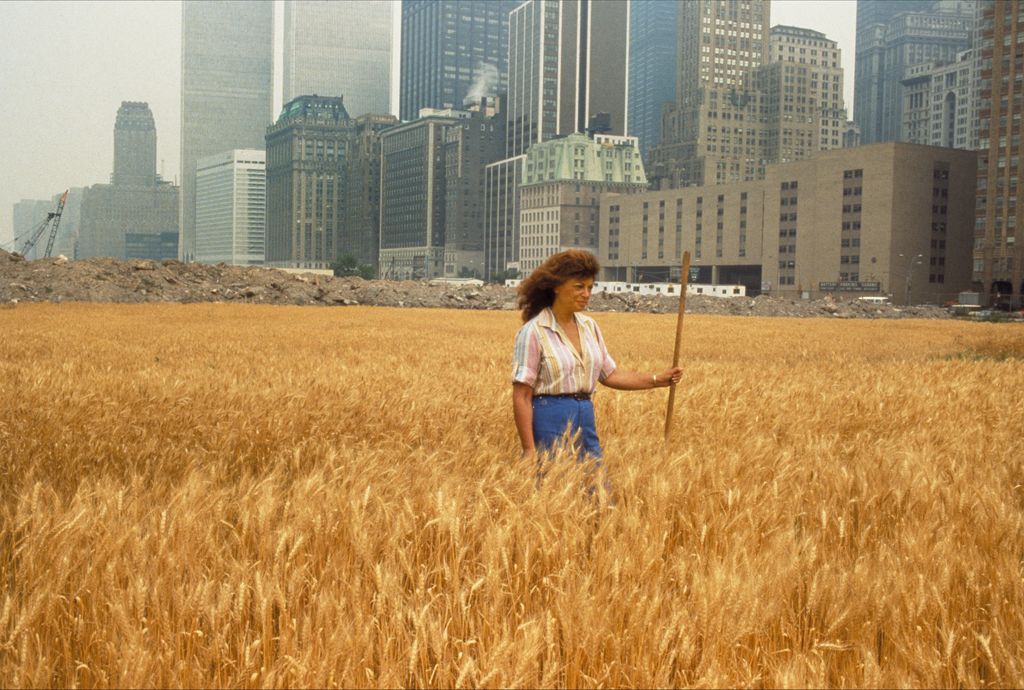
In 1982, 34 years before Swale, Agnes Denes planted wheat in downtown Manhattan as part of an exhibition presented by the Public Art Fund. She was less interested in the crop yield than in making a statement, so much so that she titled the piece Wheatfield—A Confrontation. Questioning the value of the land (estimated at more than $4 billion even in the early ’80s) and its use for corporate enrichment, while also responding to food insecurity and climate change, Denes spent four months planting, tending and harvesting grain that was then distributed and replanted around the world. It remains her best-known work, but it was far from her last.
In 2015, Denes’s Living Pyramid rose 30 feet over Socrates Sculpture Park in Queens. Several tons of soil were stacked into a four-sided structure covered with grasses. The project was participatory and public: volunteers came to plant the seeds, and as the grasses and wildflowers matured, the wind carried countless seeds into the surrounding area. Now in her 90s, Denes continues to exhibit. In 2024, she reprised her wheatfield as Wheatfield—An Inspiration at Tinworks in Bozeman, Montana, and a version of Living Pyramid is currently on view in Desert X AlUla 2026 in Saudi Arabia.
Meg Webster
Meg Webster’s Concave Room for Bees, commissioned by Socrates Sculpture Park in 2016, used 300 cubic yards, or several hundred tons, of soil to create an amphitheater-shaped hill; the soil was later spread across the park to replenish its land. The flowers, herbs and grasses planted there were meant as a multisensory experience for visitors, an invitation to pollinators and a healing intervention. The six-foot-high walls of the 70-foot circular structure were held in place by metal mesh and left open so that the layers, structures and functions of growth could be seen. For Webster, soil is more than just a material, and her creation moved beyond the usual relationship between viewer and object. As she told Hyperallergic at the time, “I’m trying to do it for the bees and the butterflies, not for the people.”
Mary Mattingly
Mattingly’s current project, Floating Garden, now making its way down the Erie Canal as part of the 2026 Medina Triennial, provides pollen, oxygen, moisture and cooling, but it is very much meant for people. “I make work about things I’m trying to understand, and increasingly that means thinking through how we live together as a city and what kinds of systems we depend on, like
Grappling with those questions led to her participatory sculptural work. “I care deeply about form, material, scale, and what it feels like to encounter something physically. So, I don’t think of the projects as demonstrations of research or models but as proposals or possibilities,” she said, adding that “the relationships and skills people bring help the work to unfold in unexpected ways.” And with fruit trees, berries and herbs on offer, she noted, “usually everyone finds something they would like to eat.”
Courtney Leonard
Courtney Leonard, a Shinnecock artist from Long Island, also turned to planting for her 2023 exhibition at Planting Fields Arboretum, “BREACH: Logbook 23 | ROOT.” Shinnecock translates to “people of the stony shore,” and indeed, Leonard’s work has always been shaped by her relationship to
The resulting structure was roughly the size of one of the dozens of whales that had washed up on Long Island’s shores in the preceding years. The cellar stayed cool and dry, offering a carbon-neutral way to store food. The mound covering it was planted with goldenrod, which has traditional medicinal uses, and milkweed, which supports the life cycle of monarch butterflies, an endangered species as classified by the International Union for Conservation of Nature. The plants had fully matured by the time the exhibition closed.
Maya Lin
“Throughout the world, climate change is causing vast tracts of forested lands to die off,” Maya Lin wrote at the start of her artist’s statement for Ghost Forest, her 2021 exhibition in Manhattan’s Madison Square Park. “They are being killed off by rising temperatures, by extreme weather events that yield saltwater intrusion, forest fires, infestation by insects whose populations thrive in these warmer temperatures and trees that, overstressed from these rising temperatures, are more susceptible to beetles.”
Lin created a temporary site-specific installation that was monumental, haunting, beautiful and replenishing. She gathered a stand of dead and dying Atlantic white cedars that had perished from saltwater flooding caused by Hurricane Sandy, choosing a nearby native species to minimize the carbon footprint of transportation. The site they came from was already slated to be cleared for replanting, and she had each trunk inspected for insect infestation.
Then she “planted” them on the park’s open lawn, filling the space between living trees with her ghostly visitors. Walking among them was curious, calming and concerning all at once. Casting dappled shadows and offering a pleasant place to lean, they seemed like any other trees in the park. Except they weren’t. When visitors looked up, the branches were bare—a portent of what may come.
Not content to stand at a distance and point, Lin also offered a form of solution. After the exhibition, she had the ghost trees turned into mulch or building materials and, in conjunction with the Natural Areas Conservancy, planted more than 1,000 trees and shrubs across New York’s five boroughs. As she noted, “We are faced with an enormous ecological crisis— but I feel that we have a chance to showcase what can be done to help protect species and significantly reduce climate change emissions by changing our relationship to the land itself.”