Singtel expects no impact from Nvidia CEO resignation
SINGAPORE – Singapore’s biggest telco Singtel does not expect any impact on its artificial intelligence chip orders and delivery, or its partnerships with Nvidia, following the resignation of the chipmaker’s chief executive Jensen Huang.
A major customer of Nvidia’s products, Singtel has already received most of what it has ordered and expects the remaining chips to be delivered on time, the telco said on Nov 13.
Even if there are delivery delays, the company has a diverse ecosystem of chip suppliers it can tap, said Bill Chang, the chief executive officer of Digital InfraCo, Singtel’s digital infrastructure unit.
Additionally, the telco’s business that uses Nvidia chips forms only a small part of its overall business, said Yuen Kuan Moon, Singtel’s group chief executive officer, during the telco’s financial results briefing for the half year that ended on Sept 30.
This is even as analysts have suggested that recent developments at Nvidia could cast greater regulatory scrutiny on the shipment of Nvidia AI chips to South-east Asia, including Singapore. Such intense scrutiny is expected to slow down the delivery of the chips, following investigations into regional companies allegedly used to bypass United States controls on exporting the chips to China.
Singtel’s Chang said on Nov 13 that the telco does not expect any impact on the company from the resignation of Nvidia’s Huang at this stage.
This applies to the chips ordered for the telco’s RE:AI sovereign AI business in Singapore, which protects enterprise customers’ sensitive data by preventing the data from leaving the country.
So far, AI chips for 4 megawatts of data centre capacity for the RE:AI business have already been delivered to Singtel and are already in use. The telco is now waiting on chips for another 2 megawatts of data centre capacity, but expects this to be delivered on time.
Yuen said that the telco had not observed any delay in chip deliveries in the past but is watching the space for any changes in chip export arising from developments at Nvidia.
“Like any other client in the world, we are engaging (Nvidia) to find out what is happening,” said Yuen, adding that it is too early to tell what are the changes.
While Singtel’s RE:AI business has been looking at regional business opportunities, its sovereign AI solutions have only been deployed in Singapore for now.
And even if developments at Nvidia do affect Singtel, the impact is expected to be contained.
Yuen explained that the contribution of Singtel’s overall data centre and digital infrastructure business forms only 5% of the firm’s group earnings before interest, taxes, depreciation and amortisation (EBITDA).
“So, even if there’s an impact, it’s not going to be significant for Singtel,” said Yuen.
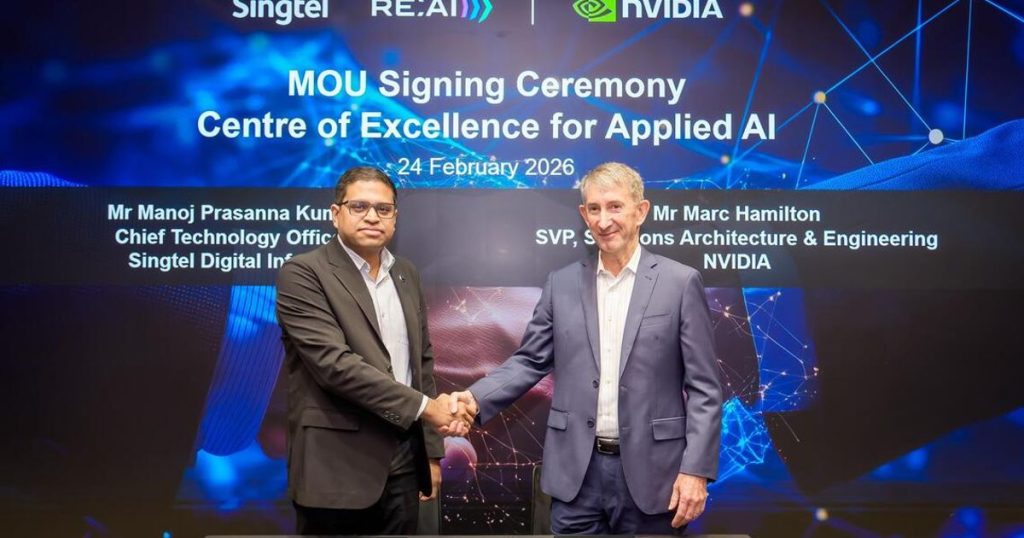
Chang said that he also does not anticipate any impact on Singtel’s partnerships with Nvidia, such as the Centre of Excellence for Applied AI that both companies launched in February. He said the centre is for research and development to help government agencies and enterprises build AI capabilities in the country.
The centre allows enterprises and public agencies to test AI projects using Nvidia’s latest chips while keeping sensitive data within Singapore’s borders
Nvidia’s board of directors announced on Nov 12 that Huang had resigned as president, chief executive and a member of the company’s board with immediate effect.
Nvidia’s board is searching for Huang’s replacement, and will consider candidates from within and outside the company. Meanwhile, the firm’s chief financial officer Colette Kress will serve as interim chief executive.
Nov 12’s announcement capped weeks of drama following media reports in October alleging that Huang had a close relationship with a Chinese businesswoman who passed information to Beijing.
The woman, Alice Huang, is a former executive of Singapore-based cloud computing firm Megaspeed International. She is reportedly being monitored by the United States authorities, which suspects she was helping China circumvent American export controls on advanced AI chips. The two Huangs are not related despite sharing the same surname.
Nvidia then said on Nov 8 that it was investigating whether Huang was the target of foreign spying. On the same day, Huang admitted in a message to employees that he had been unfaithful to his wife and took “full responsibility” for his actions.
Then on Nov 11, it was reported that Huang also had an extramarital relationship with an executive who reported to him, Kimberly Powell, Nvidia’s vice-president of healthcare, according to sources that spoke with The New York Times.
Increased regulatory scrutiny
Extra scrutiny on shipments of Nvidia chips to Singapore and the rest of South-east Asia are expected with the developments at the chipmaker, including Huang’s resignation, analysts said.
This would add extra layers of checks across the supply chain – from the suppliers to the intermediary companies acting as middlemen to the buyers – which could slow delivery of Nvidia AI chips to Singapore and other countries in the region, said Omdia chief analyst Su Lian Jye.
“You’ll probably see a lot more regulatory hurdles, like the need for a lot more approvals and more intergovernmental law enforcement,” said Su, adding that the authorities from the US and South-east Asia could take more action to ensure export controls on AI chips are not breached.
He said that Huang’s resignation will also help Nvidia refocus on day-to-day business and ensure deals and partnerships are honoured and executed.
Neil Shah, vice-president for research and co-founder of Counterpoint Research, said that, in the larger scheme of things, the additional scrutiny on chip shipments will not hurt Singapore’s standing as a major international trade and invoicing hub.
“But it does mean locally registered AI firms, cloud firms and distributors will face much heavier paperwork and audits from regulators,” said Shah.
Shipments might not stop but, for some time, approvals might take longer with proper “know your customer” checks and audits.
And with Huang’s resignation, Shah believes Nvidia’s new leadership and the board will prioritise compliance over business deals with opaque corporations to avoid any regulatory headwinds moving ahead.
“Smaller or newly set up hosting firms will face the biggest delays,” he said. “Established players with clean audit trails should be able to clear compliance relatively easily, but enterprise orders across the region will move slower to understand where the chip or workload ends up.”
So, he believes companies like Singtel should benefit since it is deemed more credible and easier for regulators to approve when compared with smaller, obscure companies which will face more scrutiny from US and Singapore regulators.
Gaurav Gupta, chief of research for AI infrastructure and semiconductors at Gartner, said that with the Nvidia situation, businesses should consider reducing concentration risk by qualifying multiple vendors for their AI infrastructure, while also staying the course on AI infrastructure build-out, as demand is real and supply chain stays constrained.
“They should also limit financial risk by identifying companies that could see a major negative impact from any fallout related to this event,” he said. “This would apply to any public companies or startups where Nvidia has invested recently and their primary business relies on Nvidia.”