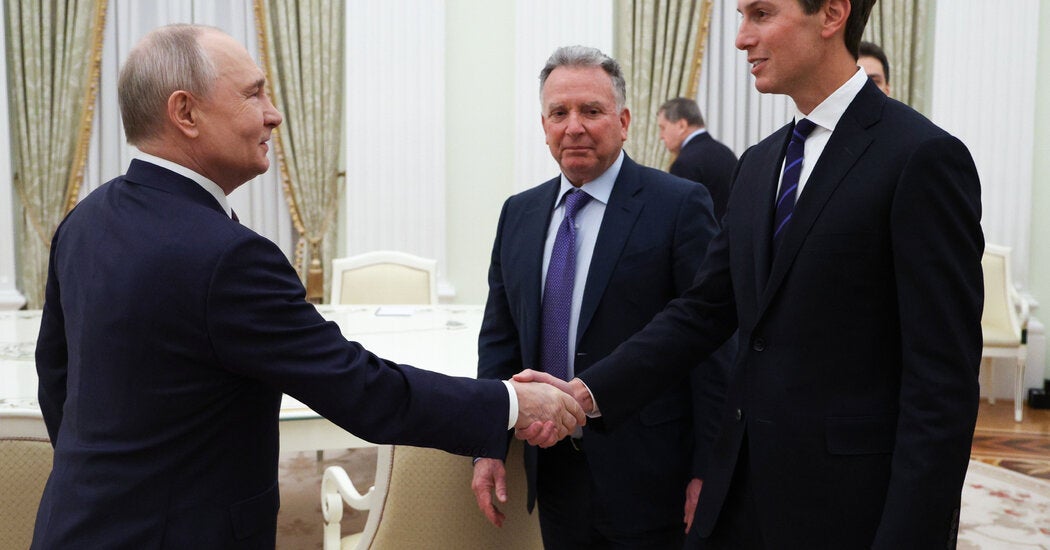
In Moscow, Witkoff and Kushner Ask Putin to Include Europe in Peace Talks
President Trump’s envoys went to Moscow on Thursday to seek agreement from President Vladimir V. Putin to bring Europe into talks on the war in Ukraine, as the Kremlin pushes to widen the negotiations to overhaul European security arrangements.
The envoys, Steve Witkoff and Jared Kushner, arrived in Russia one day after mediating peace talks in Abu Dhabi between Russian and Ukrainian representatives, who spoke directly for the first time in nine months. After meeting with Mr. Putin in the Kremlin, the envoys were scheduled to travel to Dublin to meet with President Volodymyr Zelensky of Ukraine.
Mr. Witkoff and Mr. Kushner are pressing to involve Europe in the talks as Russia makes clear that it will not consider a cease-fire until its broader demands to redraw the European security architecture are addressed.
The Trump administration, seeking a foreign policy win after Republicans’ drubbing in the midterm elections, is making another push for peace even as Russia gives no indication that it will stop the war anytime soon, and in fact appears to be hardening some of its positions.
Russia has intensified attacks on Ukrainian cities ahead of a winter bombing campaign, taking advantage of Ukraine’s lack of air defenses. On Thursday, Mr. Zelensky said that the Ukrainian armed forces were again facing restrictions on Starshield, the military version of the satellite internet network Starlink, and had asked the United States for information.
For Europe, getting involved in direct negotiations with Russia over Ukraine would be a departure from its long-held position that Russia must stop fighting first. But European officials also insist that the continent must have a seat at the table if talks expand to include crucial questions of Europe’s security.
In his opening remarks at the Kremlin, Mr. Putin told Mr. Witkoff and Mr. Kushner that he was eager to hear their assessments from “a European perspective” after their meetings with representatives of “united Europe.” The two Americans have held a series of meetings with European officials in recent weeks, including in Abu Dhabi.
Mr. Putin has vented at European nations as they have replaced the United States as Ukraine’s biggest backer, asserting that it is Europe, not Russia, that wants war. On Thursday, Mr. Putin signaled to the American envoys that he was not ready for an easy compromise with Europe and that if Russia spoke with its representatives, the negotiations would be tough.
“We would very much like you, distinguished gentlemen, and the American administration as a whole, to work with your European allies so that they finally make up their minds on the question of what they want: peace or war in Ukraine,” Mr. Putin said.
The Americans struck more hopeful notes. Mr. Kushner said that the American side had seen “a big change with the Europeans” and that “there is strong momentum and desire to engage together.” Mr. Witkoff said that the American delegation was optimistic that “we can announce shortly” the next trilateral meeting, which “will include the Europeans.”
On Thursday, President Alexander Stubb of Finland said that “there is a real possibility that the Europeans will be around the table, and I think that would be progress in and of itself.” Last month, Mr. Putin held a call with Mr. Stubb and his Norwegian counterpart that some other European leaders denounced as endangering unity on Russia. Europe has struggled to decide who would represent the continent in negotiations.
If Europe joins the talks, said Tatiana Stanovaya, a senior fellow at the Carnegie Russia Eurasia Center, it could be interpreted by Mr. Putin as a sign that his tactic of waiting the Europeans out until they begin offering concessions is working.
On Wednesday, speaking at a security conference in Moscow, Aleksei Drobinin, a senior Russian diplomat, outlined a series of proposals that he said could satisfy Moscow’s security demands regarding Europe.
Mr. Drobinin said that Russia could sign bilateral agreements with European states that, “in substance, meet the criteria of mutual nonaggression pacts,” or reach “political agreements on mutually refraining from supporting each other’s adversaries in the event of aggression.” He compared these potential accords to agreements that Russia has signed with Belarus, Iran and North Korea.
The Americans are seeking a sweeping agreement on Ukraine that would bundle questions of a cease-fire, security and territory. Speaking at the Kremlin, Mr. Putin dismissed Ukrainian assertions that he was being fed inflated claims about how much territory Russian troops controlled in Ukraine.
Mr. Putin offered to conduct a humanitarian mission in the Ukrainian city of Kostiantynivka, control of which has been contested by Russia and Ukraine. The effort would be similar to the recent cease-fire around the Russian-occupied town of Oleshky. Brokered by the U.S. first lady, Melania Trump, that mission was the longest localized cease-fire since 2022 and helped evacuate hundreds of civilians from the town.
The Russian leader said such a mission would also prove a point on Russia’s territorial gains. “At the same time,” Mr. Putin said, “we will see who controls that settlement.”