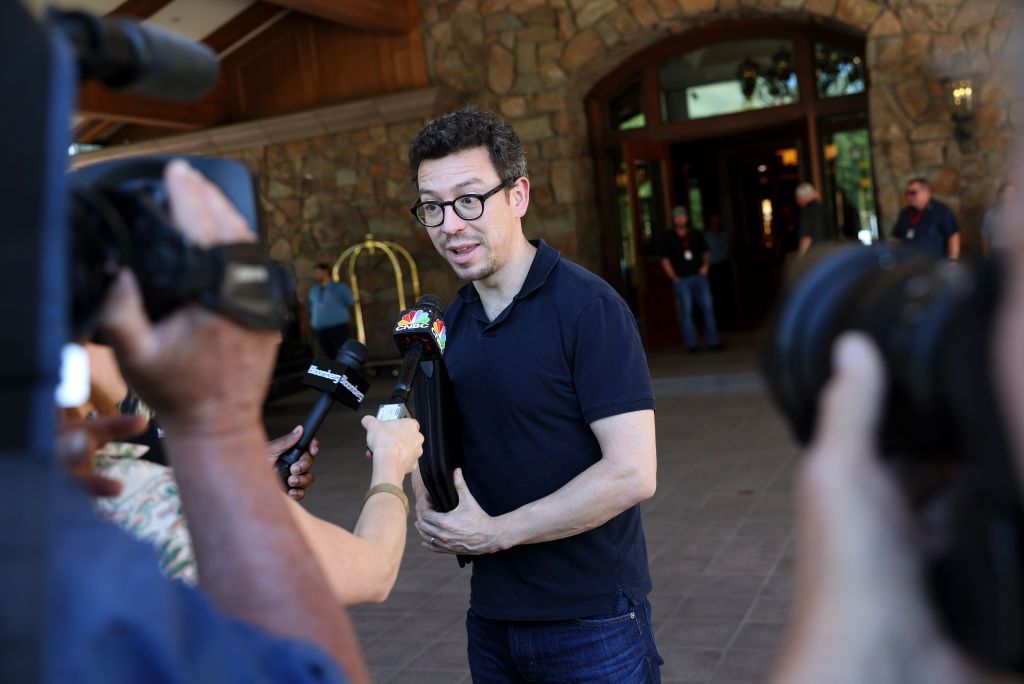
Duolingo’s Luis von Ahn Phases Out Max, Expands A.I. Calls
Duolingo CEO Luis von Ahn approved killing off the owl in February 2025. Duo, the language-learning app’s green mascot, met his fictional end under a Cybertruck, drawing condolences from avid reader, polyglot pop star and renowned globetrotter, Dua Lipa. Users were then asked to complete lessons to bring him back.
He was, thankfully, resurrected, but now von Ahn is giving another character a bigger role in the business: Lily, a purple-haired goth teen with an exaggerated eye roll. She’s the animated conversation partner in Video Call, Duolingo’s A.I.-powered speaking-practice feature, and he wants more subscribers talking to her.
As the cost of those conversations falls, von Ahn is phasing out Duolingo Max, its highest subscription tier, and bringing unlimited Video Call to all Super subscribers by year-end. The aim is to give more learners a reason to pay for an app they can otherwise use for free.
Duolingo’s Nov. 3 results revealed revenue of $309 million for the three months ended Sept. 30, an increase of 14 percent year over year.
Out of the company’s bookings of $316.1 million, which were up 12 percent year over year, $278.4 million came from subscription bookings. Bookings measure amounts received; subscription revenue is recognized over the subscription’s life. Duolingo’s user base is also growing, with daily active users averaging 64.9 million, up 29 percent year over year. Paid subscribers reached 13.1 million at the end of September, up 14 percent year over year.
“Our user growth this year in every region of the world and in every subject we teach reinforces our belief that we still have an enormous opportunity ahead of us. Our ambition is to ultimately reach one billion learners and build a much larger business over time. The more people we can teach, the bigger that opportunity becomes,” von Ahn said in the company’s Nov. 3 shareholder letter.
A broader paid plan
The company plans to stop selling new Max subscriptions in November and move individual Max subscribers to a Super family plan at the same price. It is still considering options for legacy Max family subscribers, which it plans to address in 2027.
“Duolingo is constantly balancing what needs to stay free to attract learners against what delivers enough extra value to justify a paywall. Because management is so committed to protecting the free tier, the paid product has to work much harder,” Julie Geller, principal research director at Infotech, a technology research and advisory firm, tells Observer. “Phasing out Max and bringing unlimited A.I. conversations into Super fits right into that strategy. As conversational A.I. becomes widespread, users treat it as a baseline feature rather than a premium addition. But there’s a bigger play: offering real speaking practice ties the subscription directly to the main goal learners care about, becoming confident speakers.”
The platform is also looking for more ways to drive engagement, with von Ahn highlighting in the shareholder letter Junior’s Toy Hunt, a limited-time event which users could participate in to complete lessons and unlock new avatar outfits. He said the event was “one of our biggest experiment wins for getting learners to complete more lessons,” and showed how collection events could grow in-app purchases over time.
In terms of monetization, von Ahn highlighted that new learners expand the audience that can be monetized, and subscriptions remain the company’s largest monetization opportunity, which the company aims to grow by teaching users better. The free version of Duolingo includes learning content and courses with ads, whereas the Super version adds additional features like unlimited energy and personalized review without ads.
While generative A.I. has been impactful to the organization, with previous offerings like Duolingo Max using OpenAI’s GPT-4 to enable real-time conversations, its A.I. journey has also proved controversial in the past. CNN reported in January 2024 that the company had cut around 10 percent of its contract workforce at the end of 2023 as it relied more heavily on A.I. The company said not all the cuts were due to the technology.
The cost of engagement
As with any company embracing a freemium model, there is a pressure to convert free users into paid users to sustain the product. Beyond events, Duolingo has aimed to maintain user engagement through gamification, giving users XP for completing challenges, as well as encouraging users to maintain streaks.
“Duolingo uses a freemium model, because that’s how it attracts users, and the CEO has drawn a firm line against making the basic product worse. Features move into paid tiers based on what they cost to run and what testing shows people will pay for,” Keith Kirkpatrick, vice president and research director at Futurum, tells Observer.
Open-weight models appear to be playing a part in its cost efficiency. Asked what A.I. is costing the company, Kirkpatrick says: “Much less than a year ago. An A.I. video call cost about 30 cents at launch and now costs well under a penny, largely because Duolingo switched to cheaper open-weight models.”
On the Nov. 3 earnings call, von Ahn forecast single-digit millions of dollars in live A.I. inference costs—the expense of running the models—for free users in 2027.
However, others are more critical of Duolingo’s user experience. In an Oct. 4 article for Android Authority, Marvin Velasco criticized the app for being “bloated,” featuring more ads and offering features unrelated to language learning, and pushing paid subscription tiers like the Super version.
On its path to one billion learners, Duolingo will also have to convince users that its courses are a better way to learn a new language than interacting with A.I. assistants like ChatGPT and Google’s Gemini. In an Aug. 17, 2025, interview with The New York Times, cited by Observer, von Ahn said, “Just having conversations in French on something like ChatGPT gets pretty boring after a while,” adding, “The thing that differentiates us for learning a language—or learning anything—is the engagement.” The long-term challenge will be convincing users to feel the same.