Germany marks fateful date of November 9
Aigner says she is a candidate of the ‘strong center’
Bavarian politician Ilse Aigner has said she wants to fight political polarization and the growth of fringe movements if voted in as German president.
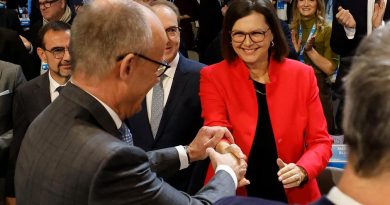
Speaking alongside Chancellor Friedrich Merz at a press conference, Aigner said she was in politics “to overcome divisions, to bring people together and to reach those who perhaps have the feeling of being left out.”
“Our country and our democracy, they are under attack from the inside and outside,” she said.
“Extreme positions are celebrating triumphs and ideologies are booming. Division is being driven forward, and consensus is being mocked,” according to Aigner.
The conservative politician said she wanted to be a counterweight to these developments.
“My attitude is clear and opposes every attack on human dignity. I try to make decency a benchmark and revive trust — with both heart and intellect,” she said.
Merz, in turn, said Aigner would be a president “with dignity and feeling.”
Aigner’s candidacy has been backed by her own CSU, Merz’s CDU, and the SPD, which make up the ruling coalition. She has also received support from the opposition Greens, paving the way for her to be elected in parliament on January 30.
But the far-right Alternative for Germany (AfD) and Left Party say they will put forward their own candidates.
Edited by:Kieran Burke
https://p.dw.com/p/5PFit
Vodafone to slash one-fifth of jobs in Germany over next two years
Telecommunications company Vodafone on Monday announced that it would be slashing some 2,300 jobs in Germany over the next two years as part of a new cost-cutting program.
Vodafone Germany CEO Marcel de Groot on Monday informed employees that one-in-five of them would be losing their jobs. Their positions will either be made redundant or outsourced, or turned over to AI.
The Düsseldorf-based company currently employs about 12,000 people in Germany.
De Groot said the cuts are essential to making Vodafone competitive again as it continues to lose customers.
“We have stabilized our business, are regaining momentum in the business customer segment and are constantly improving our products, networks and services,” he said.
Still, de Groot said that is not enough to remain competitive as the telecommunications market undergoes “fundamental change at a pace we have never experienced before.”
Edited by:Darko Janjevic
https://p.dw.com/p/5PGlp
Merz, CDU politicians ‘self-congratulatory’ over naming Aigner presidential candidate — DW’s chief political editor
“Once again, Merz seemed late to his own political party,” DW’s chief political editor Michaela Küfner wrote after the German chancellor announced he would be backing the nomination of Ilse Aigner for Germany’s first female president.
“His own state premiers already declared Ilse Aigner as the right woman for the role,” Küfner said.
“Now, [Merz] felt self-congratulatory about not having blocked her path,” she added.
After attending the announcement at the party headquarters of Merz’s CDU, Küfner noted politicians leaving the event “shared the self-congratulatory mood of their chancellor and party leader.”
“Many perceive her non-academic background as a helicopter technician who entered politics as even more revolutionary than the fact that she is a woman,” according to Küfner.
“For Merz, the nomination of the highly popular Aigner from his CDU‘s Bavarian CSU sister party also means less competition for his own job.”
Edited by:Kieran Burke
https://p.dw.com/p/5PFiO
Rioters disrupt opening of Dortmund kebab shop
The owners of a newly opened kebab shop in the western city of Dortmund were forced to call in the police on Sunday after a crowd of people wanting to take advantage of a cheap inaugural offer became unruly.
However, the arrival of the police caused even more violence, with officers attacked by rioters, some of them children, throwing bottles, stones, fireworks, an electric scooter and a chair.
A police car was also damaged by stones during the fracas.
Several people have been charged with offenses including disturbing the peace, vandalism and insult.
Police are also looking into whether the owners held some responsibility for inciting the violence with the special offer.
Some social media videos initially said the offer also included a chance to win a trip to Umrah in Saudi Arabia and an iPhone. This was later withdrawn.
While the owners had employed their own security guards, they were quickly overwhelmed by the situation, police said.
Edited by:Kieran Burke
https://p.dw.com/p/5PFgx
IN DEPTH: Who is Ilse Aigner, Germany’s potential next president?
Bavarian lawmaker Ilse Aigner looks set to become Germany’s first female president, with support expressed by all coalition parties and the opposition Greens.
But she would also represent a first for German in other ways, as this DW portrait article shows: Who is Ilse Aigner, leading candidate for Germany’s next president?
Edited by:Kieran Burke
https://p.dw.com/p/5PFhd
CDU names Ilse Aigner as candidate for president
Chancellor Friedrich Merz’s Christian Democrats (CDU) on Monday confirmed that they would be putting forward Ilse Aigner as a candidate to be Germany’s next head of state.
Aigner’s own CSU, the CDU’s Bavarian sister party, already supports her candidacy — and the federal coalition partners the Social Democrats have also made clear they would endorse her nomination if the conservatives agree on it.
This means the 61-year-old has a good chance of taking up the largely ceremonial role when the special committee that elects a German president convenes in late January.
While Angela Merkel famously served as the country’s most powerful politician for more than a decade, Germany has never had a female head of state.
Read our full report here.
Edited by:Kieran Burke
https://p.dw.com/p/5PFiQ
Hamburg’s famous Miniatur Wunderland gains new attraction
One of Germany’s most popular tourist sites, the model railway system Miniatur Wunderland, has opened a new section devoted to South America after four years of construction.
Over 175 square meters (1,883 square feet) in size, the section shows, among other things, rainforests, parts of the Andes and the Atacama Desert.
It is so far the largest part of what is, according to the Guiness Book of Records, the largest model railway network in the world.
The rainforest scene is also so far the most extravagant project carried out by the operators and was constructed jointly with a family of model-builders from Buenos Aires.
The South America section was opened with a small ceremony attended by a Peruvian representatives of the Incas, who put down the last “holy” stone meant as a symbol of a link between the former Inca center of Cusco in Peru and Hamburg.
Miniatur Wunderland is run by two brothers, Frederik and Gerrit Braun, who now head a 120-person team.
It was founded in 2001.
Edited by:Kieran Burke
https://p.dw.com/p/5PFQN
WATCH: Germany’s fraught relationship with its flag
Germany has a complicated attitude to patriotism resulting from the aggressive and deadly nationalism that marred part of its history.
Now, national football coach Jürgen Klopp has called on the country to “reclaim its flag,” triggering a debate that is additionally heated by the resurgence of the far right in the form of the Alternative for Germany (AfD) party.
DW looks at the issues involved in this video featuring two experts:
Edited by:Kieran Burke
https://p.dw.com/p/5PEyC
German exports bounce back higher than expected in September
Germany’s exports are continuing their uneven path to recovery, unexpectedly rising 2% on a monthly basis in September, data from the Federal Statistical Office (Destatis) showed on Monday.
Economists had predicted 0.5% growth.
The September growth reverses a 0.4% decrease in August and was the quicket rise since February.
Imports also climbed, by a whole 4.2%, much surpassing the 0.6% rebound a month ago. Economists had forecast a 0.5% increase.
Exports to EU countries grew by 3.5% compared to August, and imports from these countries rose by 4.9%.
On a yearly basis, growth in exports climbed to 7.6% from 7% in August.
Annual growth in imports also jumped to 8.7% from 6.4%. Exports to the United States were 10.3% higher, data showed.
Edited by:Kieran Burke
https://p.dw.com/p/5PEvU
Social Democrats’ executive committee supports Aigner nomination
The executive committee of the center-left Social Democrats (SPD), the junior partner in Germany’s conservative-led coalition government, supports the nomination of Bavarian parliamentary speaker Ilse Aigner as next German president, according to the AFP news agency, citing party sources.
Aigner is “an experienced, down-to-earth politician and possesses the important ability to bring together people over party and social boundaries,” according to the quoted sources.
Aigner, 61, who is a member of the center-right Christian Social Union (CSU), the Bavarian sister party of Chancellor Friedrich Merz‘s Christian Democratic Union (CDU), already has the support of both her party and the CDU.
Members of other parties, such as the Green Party, have also said they are in favor of Aigner, who, if elected in a vote by the Federal Convention on January 30, would become Germany’s first female head of state and the first CSU member in the position.
Edited by:Kieran Burke
https://p.dw.com/p/5PEjq
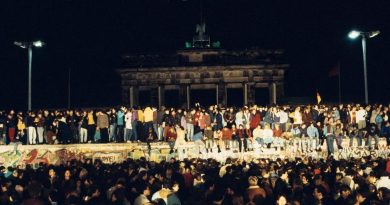
Commemorations of Berlin Wall opening
People across Germany are remembering the events of November 9, 1989, when the Berlin Wall separating the part of the city in former communist East Germany from that in West Germany was breached, paving the way to German reunification in 1990.
One main ceremony of commemoration is to be held at the Berlin Wall Memorial in the German capital.
President Frank-Walter Steinmeier is also to meet with former East German civil rights activists in the Goethe House in Weimar, the birthplace and childhood home of famous German writer Johann Wolfgang von Goethe.
In the eastern city of Cottbus, the premier of the state of Brandenburg, Dietmar Woidke, is also to host a ceremony in remembrance of the events 37 years ago.
The Berlin Wall encircled West Berlin for 28 years, separating it from East Berlin and surrounding East Germany, known as the German Democratic Republic (DDR).
Its main purpose was to prevent East Germans from escaping from their repressive country to the West, though authorities in the Soviet Bloc cast it as a defense against “fascism” coming from outside.
Edited by:Kieran Burke
https://p.dw.com/p/5PEah
Trial continues of suspected neo-Nazi ‘Saxon Separatist’ members
The trial of eight people suspected of belonging to a militant neo-Nazi group, the “Saxon Separatists,” continues in Dresden on Monday.
The men are accused, among other things, of “preparing a traitorous endeavor” as part of their involvement with a terrorist organization.
Prosecutors believe the group, which uses the abbreviation “SS” — like that used by the paramilitary “Schutzstaffel” that operated in the Nazi era — planned to overthrow democracy in Germany, starting with an armed takeover of the eastern state of Saxony.
The eight men were arrested in November 2024 during international raids conducted in Germany, Austria and Poland and have been remanded in custody since then.
The trial, which began in January, is scheduled to last until December
Edited by:Kieran Burke
https://p.dw.com/p/5PEbn
Merz calls for defense of democracy, freedom
Chancellor Friedrich Merz has used the November 9 anniversary of several important dates in German history to call on people in Germany and Europe to stand up for democracy and liberty.
November 9 was the day in 1918 that the monarchy fell, in 1938 a day of antisemitic violence known as the November pogroms, and in 1989 the day when the Berlin Wall opened, paving the way for the reunification of Germany.
Writing on X, Merz said, “November 9 stands for the darkest and the happiest hours of our history: for antisemitism and persecution, for the beginning of democracy and the fall of the Wall.”
“Freedom and democracy can never be taken for granted. Let us defend them — in Germany and Europe,” he wrote.
Edited by:Kieran Burke
https://p.dw.com/p/5PEZc
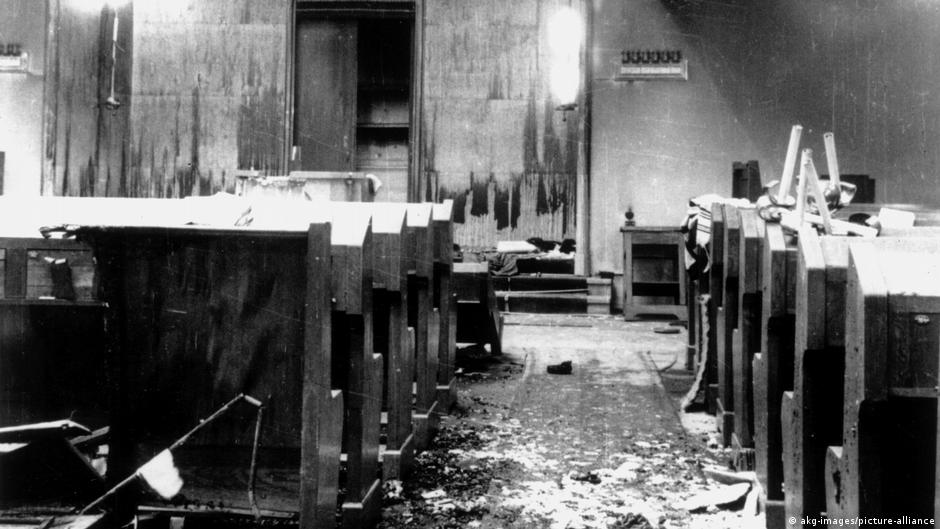
Germany marks November pogroms anniversary
Commemorations are to be held nationwide to commemorate the Nazi pogroms of November 9-10, 1938, when mobs went on an antisemitic rampage, killing at least 91 Jewish people, ransacking Jewish businesses and burning down hundreds of synagogues.
President Frank-Walter Steinmeier is to attend events in the eastern city of Weimar, where he is due to lay a wreath and hold a speech at the memorial site established at the site of the former Nazi concentration camp of Buchenwald.
The Jüdische Gemeinde zu Berlin is to have all the names of Jewish Nazi victims read out over the day in commemoration of the pogroms.
Chancellor Friedrich Merz will be attending a ceremony marking the 20th anniversary of the Ohel Jakob Main Synagogue in Munich, which was opened 68 years to the day after the main synagogue in the city was destroyed in the pogroms.
The pogroms are sometimes known as “Reichskristallnacht” or “Night of Broken Glass,” but this name has fallen out of favor as underplaying the horrors of what happened.
Edited by:Kieran Burke
https://p.dw.com/p/5PEYc
Welcome to our coverage
Guten Tag from DW’s newsroom on the banks of the Rhine in Bonn!
November 9 is known as the “day of destiny” in Germany, a day that has in the past seen both horrific events and others that have shaped the country in a more positive way.
Into the first category come the November pogroms of 1938, in which the Nazi regime unleashed a wave of antisemitic violence that led to the deaths of dozens of Jewish people and the burning of hundreds of synagogues.
Events will be held nationwide to commemorate the 88th anniversary of the pogroms, including some in Weimar attended by German President Frank-Walter Steinmeier.
Chancellor Friedrich Merz will also attend a ceremony marking the 20th anniversary of the Ohel Jakob Main Synagogue, which opened 68 years to the day after the destruction of Munich’s main synagogue in the pogroms.
But November 9, 1989, also saw the opening of the Berlin Wall, when thousands of East Berliners unexpectedly crossed into the west of the city, an event that eventually led to the reunification of Germany.
Read on here for more on these and other stories connected with Europe’s largest economy.
Edited by:Kieran Burke
https://p.dw.com/p/5PEV3