Inside the card-grading empire shaping the price of Pokémon cards
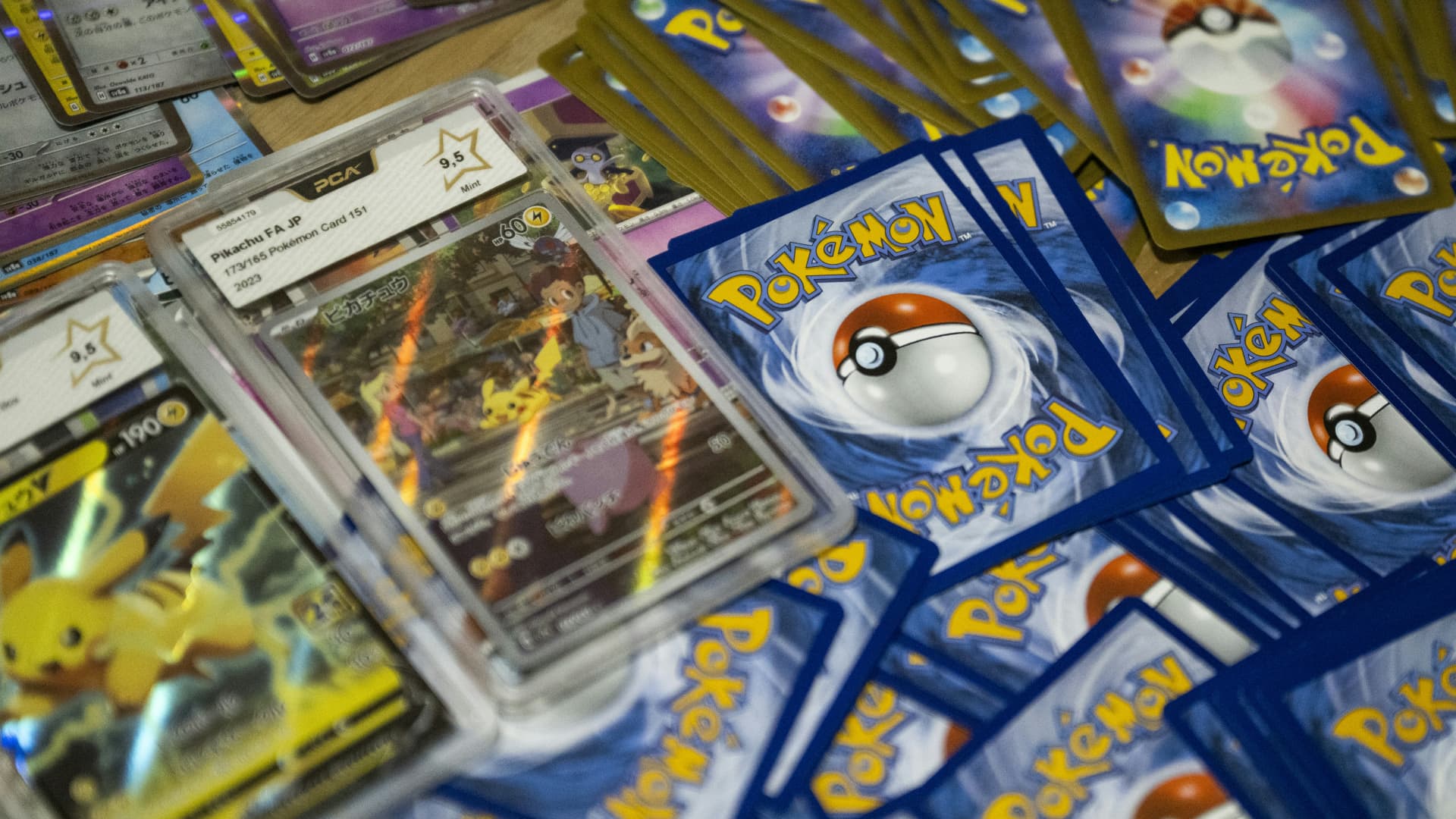
This photograph shows displayed collectible cards from the Pokemon Trading Card Game (TCG) including mint rated cards featuring Pikachu graded by French card grading service PCA at an amateur collector’s appartment in Paris on March 11, 2026. Pokemon cards, bearing “little monsters” that attract children as well as adult superfans, have soared in value in recent years. Collecting Pokemon cards has become a form of investment beyond collecting, trading or playing. (Photo by Martin LELIEVRE / AFP via Getty Images)
Martin Lelievre | Afp | Getty Images
Collectors may have more grading options than ever, but many still turn to Professional Sports Authenticator, or PSA — even as the industry leader works through a backlog of millions of cards.
Demand for grading — an act of verifying a card’s authenticity and condition — has grown as collectors increasingly treat trading and vintage sports cards as alternative investments.
PSA reported a backlog of 7.2 million items on Oct. 20, down from 12.4 million in July. The company suspended cheaper submission services in June to ease the backlog before reopening its Value service on Oct. 29.
Even so, some sellers would rather wait for a PSA label than send their cards to a competitor, dealers told CNBC.
“It really all comes down to secondary market values,” said Geoff Wilson, founder and CEO of CardsHQ, which operates one of the world’s largest sports card shops.
PSA-graded cards typically command higher prices than equivalent grades from competitors, Wilson said, giving collectors and investors an incentive to choose PSA in hopes of a stronger return.
The financial difference can be substantial.
A 1999 Base Set Charizard graded PSA 9 sold for about $3,440 on eBay on Sept. 29, compared with roughly $1,890 for a CGC 9 copy sold the same day, according to CNBC’s review of PriceCharting records.
That pricing gap reinforces PSA’s lead and gives its decisions about fees and submission services considerable influence over the resale market.
PSA had not responded to CNBC’s detailed questions at the time of publication. In published updates, the company has attributed service restrictions and pricing changes to demand exceeding capacity, and outlined investments intended to reduce the backlog.
The ‘gold standard’
Grading companies verify a card’s authenticity, assess its condition and seal it in a protective plastic case, known as a slab. PSA uses a 10-point scale, with its highest grade, Gem Mint 10, reserved for cards it describes as “virtually perfect.”
Like a credit rating in bond markets, a card grade gives buyers and sellers a common benchmark for assessing condition.
That can reduce friction in transactions by giving both sides a reference point based on past sales of the same card at the same grade.
That capability has helped open the trading-card market to more global participation and made cross-border transactions easier, according to an unnamed spokesperson for Singapore-based submission dealer Oxley Grading.
MISSISSAUGA, CANADA – NOVEMBER 07: Sports trading cards are checked and graded at the Sports Card Expo at the International Centre on November 07, 2025 in Mississauga, Ontario, Canada. (Photo by Bruce Bennett/Getty Images)
Bruce Bennett | Getty Images Sport | Getty Images
The spokesperson attributed PSA’s position as the industry’s “gold standard” to its early start, brand recognition and extensive history of completed sales.
“They’ve just built up such a strong branding and a lot of sales records,” the spokesperson said.
They estimated that roughly 90% of the graded cards offered to Oxley Grading for purchase carry PSA’s label.
The dominance creates a self-reinforcing cycle: buyers seek out PSA-graded cards, giving sellers an incentive to use the company. The abundance of PSA slabs in shops and online marketplaces further reinforces the brand’s visibility and demand.
For a seller choosing a grader, that established resale demand can outweigh a competitor’s lower fees or faster turnaround times.
The collectible empire
PSA sits within a larger collectibles business.
Its parent company, Collectors, also owns rival grading brands Beckett and SGC, pricing-data platform Card Ladder, the PSA Vault and financial services. The vault links storage with selling through external marketplaces, including eBay.
Together, those businesses span much of a card’s commercial journey — grading, pricing, storage, sales and even financing against collectibles.
Collectors’ three card-grading brands accounted for roughly 71% of August grading volume among the major firms tracked by industry analyst GemRate. PSA alone represented about 65%, while the next-largest player, CGC, represented about 28%.
Collectors’ consolidation has also drawn legal scrutiny.
A proposed class action filed in April challenges Collectors’ acquisitions of SGC and Beckett, alleging that the deals unlawfully reduced competition in card grading. The allegations have not been proven in court.
Collectors has defended the Beckett acquisition as a way to strengthen a trusted brand while preserving collectors’ ability to choose the grading service that best suits their items.
“We believe that strong, well-supported brands help grow access to the hobby,” Collectors CEO Nat Turner said in the company’s 2025 acquisition announcement.
Cost of market dependence
For sellers who prioritize PSA’s resale premium, changes to its fees and submission services can alter the economics of grading a card.
PSA raised fees across several existing tiers in February, including Value Bulk from $21.99 to $24.99 and Value from $27.99 to $32.99. It also lengthened estimated turnaround times for some services, saying the changes would help balance submission demand with grading capacity.
The suspension of cheaper tiers in June further narrowed affordable options, while higher costs have made customers more selective about which cards they submit, according to Oxley Grading’s spokesperson.
Meanwhile, Wilson said the restrictions have particularly affected collectors and dealers who buy cards ungraded, send them to PSA and then resell them at a higher price.
For cards worth a few hundred dollars or less, that strategy has become harder to justify, he said.
“You’re seeing more raw cards bought and sold at card shows,” Wilson added, using the industry term for ungraded cards.
PSA has acknowledged that customers are waiting too long.
In an Oct. 28 update, the company said submissions in April and May were 2.5 times the volume received in the same months a year earlier. It also announced shorter turnaround estimates for Standard and Priority services, while saying new Value submissions would be processed behind existing orders.
“We have added an incredible amount of capacity, but we still have work to do,” Ryan Hoge, president of PSA and grading at Collectors, said in the statement.
For Wilson, those investments in capacity are part of PSA’s appeal.
“They’ve made the collector experience better by doing that,” he said.
City of Industry, CA – November 29: Various signed Professional Sports Authenticator graded cards of Dodger’s pitcher Yoshinobu Yamaoto on display for sale in the Gemini Sports Card & Memorabilia booth at Frank and Son’s Collectable Show on Saturday, Nov. 29, 2025 in City of Industry, CA. (Photo by Ronaldo Bolaños/Los Angeles Times via Getty Images)
Ronaldo Bolaños | Los Angeles Times | Getty Images
Limited bargaining power
The leading graders’ dominance may leave collectors with little room to push back.
Collectors’ preference for PSA’s resale value can make switching graders less attractive, the Oxley Grading’s spokesperson said, adding, “PSA’s lead comes from resale demand and liquidity, and other labels are still building that.”
Overseas customers can face fewer practical grading options as many major graders are based in the U.S., Amber Chuah, operations manager of trading-card platform TCG Marketplace, told CNBC.
The complaints she hears most often involve long waits and disappointment when cards receive lower grades than customers expected.
Challenging a grade can require another round of shipping and waiting, discouraging some collectors from disputing the result, she added.
“If you’re really keen on selling, that’s a lot of time.”
PSA did not respond to CNBC’s questions about the sources’ claims.
PSA’s terms allow customers to request a paid review of disputed grades, with customers responsible for grading and applicable shipping fees. The company also offers defect notes for eligible submissions to provide more detail on how a grade was determined.
CardsHQ’s Wilson said some variation between assessments is an inherent challenge in a process that involves human judgment.
Challenging PSA
Wilson pushes back against the suggestion that PSA’s position leaves customers without alternatives.
“First of all, there are alternatives,” he said, pointing to CGC, Beckett and smaller grading firms such as TAG.
CGC’s grading volume in August was more than double its level a year earlier, according to GemRate, showing that rival graders are attracting business. Beckett also recorded strong growth, although it is owned by Collectors.
Oxley Grading’s spokesperson said there may be room for lower-cost services aimed at collectors who care more about a card’s artwork, sentimental value or preservation than maximizing its resale value.
Competing for sellers focused on the strongest financial return remains more difficult.
Building comparable resale acceptance would require substantial investment, with no guarantee that buyers would ultimately value a newcomer’s label as highly as PSA’s, the spokesperson said.
For Wilson, broader acceptance in the resale market is key to shifting that balance.
“If the market as a whole starts to respect the value of the other grading companies’ cards more, then collectors will increasingly submit to those companies,” he said.