S’pore media must be credible and trusted observer, interpreter of developments: President Tharman
SINGAPORE – The role of Singapore media is to be a credible and trusted observer and interpreter of developments for the country, the region and the wider world, said President Tharman Shanmugaratnam.
This means being fact-based, thorough, impartial, and looking below the surface, he added.
The President noted that China is now more important to the world – economically, technologically and geopolitically – but the understanding of the country around the world is now weaker than two or three decades ago.
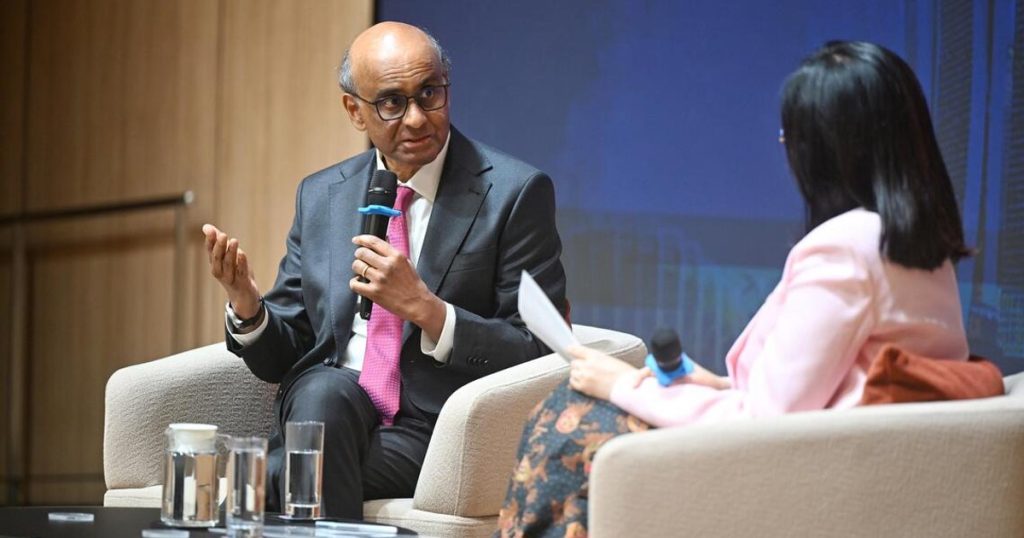
With the need for a credible, trusted perspective of developments in China now greater than ever, the media in Singapore can perform a very useful role in bridging gaps in understanding, he said at a fireside chat on Nov 5 at the launch of Chinese daily Lianhe Zaobao’s English edition.
“The Singapore media, in a sense, because of Singapore’s peculiarities of being a small country, with a relatively short history, and not being monocultural domestically, is well placed to play this role as a bridge-builder,” he said.
President Tharman said the media’s first task is not to project a Singaporean voice or Singaporean views.
“It is to provide a credible and trusted source of information and analysis that will provide a bridge in thinking and understanding in a world that is becoming more divided,” he said during the fireside chat held at the SPH Media auditorium and moderated by Chow Yian Ping, editor of Lianhe Zaobao’s English edition.
The understanding of China has weakened because scholarship on the country has declined and there are fewer interactions between it and the West, particularly the United States, he said.
There are far fewer students from the West in China, fewer academic exchanges and less frequent meetings between officials.
President Tharman said that in general, reporting on China in international media tends to elevate the “grand systemic differences: cultural, sometimes even civilisational, ideological, and governance differences”.
While there are differences, there are also many similarities in terms of governance and policy challenges as well as the struggles and aspirations of people within the US, within China and in other regions of the world, he added.
“So, respect differences, but respect similarities, to get a true understanding of a society,” he said, noting this applies not just to China but and but also Southeast Asia and India, where the understanding is also quite superficial.
“There’s a need for more of an inside-out perspective, not just an outside-in perspective,” he said. “And the task of the high-quality media is to delve into a society, the flow of thinking at all levels of society.”
On the role of the media in building social cohesion, the President said they should not merely connect different communities, but create within each community that flexibility and openness of mind that helps evolve the Singapore identity.
Asked about the implications of the rising competition between the US and China for Singapore’s cohesion, President Tharman said one has to accept that cultural affinity does “lean people a little more towards the views of a country with a similar culture”.
Singapore has to work gently against that as it is an issue where the heart is connected to the mind, he said, adding that the Singapore identity has become more multicultural over time.
“I do not think this is a large problem,” he said. “But it’s one that, as a matter of governance, as a matter of social and community leadership, we have to keep working against.”
Responding to a question on how Singapore can adapt its approach to multiculturalism as its society becomes more diverse, President Tharman said there is a strong, pragmatic reason to why people are identified by race for various purposes such as education and housing.
“If we are blind to race… We will not be able to integrate people deliberately and consciously, and we will not be able to make sure that everyone is being uplifted together,” he said.
The Chinese-Malay-Indian-Others (CMIO) administrative framework will become a more “clumsy construct” over time because of intermarriages and new immigrants, he noted.
“Part of that messiness or porosity is to be encouraged, particularly in culture and in ways of thinking, and certainly in the way we interact with each other.”
The President also spoke on the importance of learning and reading in the era of artificial intelligence.
While all education systems want to encourage everyone to become an active and thoughtful user of AI, it will probably be more easily said than done, he said.
By providing information, answers and analysis, AI will free up learners to focus on developing independent thinking and being capable of thinking originally – the ultimate goal in education.
However, AI is also cheap and fast, which works against allowing the mind to develop through effort and some struggle, he said.
At the end of the day, school and education systems have to decide how much AI should be used at different ages and stages of learning because there is a trade-off, he added.
President Tharman also highlighted the importance of slow reading, where there is a very deliberate engagement with text including re-reading the text, recognising ambiguities and the emotional tone of the original human author.
Learning different languages is also crucial even if AI can power translations between languages, he said.
“Because words don’t ever convey fully the meaning and the emotional norms of the original, and certainly we know that in the case of the Chinese language,” he said. “So, having the language ability does give you a pair of eyes on reality, on views, and on emotions, that is different from simply reading a translation.”