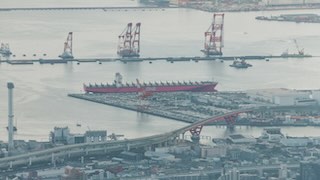
How Automated Port Cranes Are Reshaping Japan’s Logistics Industry
Japan’s ports have long been the backbone of one of the world’s most export-driven economies.
But as labor shortages deepen and cargo volumes grow, the country is turning to automated port cranes to keep its supply chains moving — and the transformation is accelerating faster than many expected.
Japan’s Port Sector Under Pressure
Japan handles hundreds of millions of tonnes of cargo annually across major hubs including Yokohama, Nagoya, Kobe, Tokyo, and Osaka. These ports connect Japanese manufacturers to global markets, making their efficiency a matter of national economic importance.
Yet the sector faces a structural challenge that technology alone may not solve overnight: a shrinking workforce. Japan’s logistics industry is confronting a severe labor shortage, a problem intensified by new working-hour regulations introduced in April 2024 that limit overtime for truck and port workers. The result is growing pressure to automate repetitive, labor-intensive tasks — and port crane operations sit near the top of that list.
According to market research, Japan’s logistics automation market reached USD 1,805 million in 2024 and is projected to grow at a 9.4% compound annual growth rate (CAGR) through 2029, outpacing the global average of 8.4%. Port crane automation is one of the core drivers of that growth.
What Automated Port Cranes Actually Do
Traditional port cranes require skilled operators to manually control the movement of Ship-to-Shore (STS) cranes and Rubber-Tired Gantry (RTG) cranes — the two most common types found in container terminals. These operators work in elevated cab positions or ground-level booths, often in demanding conditions around the clock.
Automated port cranes change this equation significantly. Key capabilities include:
– Remote operation: Operators control cranes from onshore control rooms using camera feeds and sensor data, removing the need for physical proximity to the crane.
– Automated Guided Vehicles (AGVs): Ground-level container transport between ship and yard is handled by driverless vehicles that coordinate with crane systems.
– Automated RTGs (ARTGs): Rubber-tired gantry cranes in the container yard move and stack boxes with minimal human input, guided by optical sensors and positioning systems.
– Anti-sway and precision positioning: Advanced software reduces the pendulum effect of suspended containers, improving placement accuracy and reducing cycle times.
– Predictive maintenance systems: Remote monitoring platforms track crane performance in real time, identifying potential failures before they cause costly downtime.
Together, these technologies allow terminals to operate more containers per hour, with fewer staff, and with greater consistency across shifts.
Milestone Projects Across Japan’s Major Ports
Nagoya: Japan’s First Fully Automated Container Terminal
The Port of Nagoya’s Tobishima Pier South Side Container Terminal stands as Japan’s most advanced example of port crane automation. The facility operates six gantry cranes capable of handling 22 container rows, combined with an integrated system of Automated Remote-Controlled RTGs (ARTGs) and Automated Guided Vehicles — making it Japan’s first terminal to fully integrate both technologies.
Mitsubishi Heavy Industries (MHI) supplied 12 remote-controlled automated RTGs and three quayside cranes to Tobishima Container Berth Co., reflecting the scale of investment required to automate a modern terminal. The terminal is now also certified under Japan’s port decarbonization program, combining automation with sustainability goals through inverter systems and LED yard lighting.
Nagoya’s autonomous crane market is projected to grow at a 6.0% CAGR through 2035, supported by ongoing infrastructure expansion in the region.
Yokohama: First Remote Crane Trial
In October 2025, Yokohama Kawasaki International Port Corp. (YKIP) and JFE Engineering launched what Japan International Freight Forwarders Association (JIFFA) confirmed as Japan’s first trial of remote crane operation at scale. The trial involves a large gantry crane at Minami Honmoku Pier — a crane capable of handling 24 bays and nine tiers of containers.
Cameras and sensors feed real-time data to onshore control teams, who monitor container positions and ship alignment remotely. The goal is not just to demonstrate the technology, but to identify practical gaps that current systems still need to address before full commercial deployment. Yokohama ranks as one of the world’s most efficient container ports, recording just 1.1 minutes per container move according to the World Bank Container Port Performance Index.
Kobe: Port Crane Heritage Meets Modern Automation
Kobe holds a symbolic place in Japan’s port crane history — it was where Mitsui E&S delivered Japan’s first Ship-to-Shore crane in 1967. Today, Mitsui E&S has supplied over 470 Portainer cranes and 1,700 Transtainer cranes worldwide, and the company is now a major force in remote and automated crane development.
In August 2025, Konecranes deployed hybrid cranes at Kobe to support offshore wind farm construction, reflecting how automation technology developed for container ports is finding applications across the broader maritime industry.
The Technology Driving the Shift
Several converging technologies are making automated port cranes more practical and cost-effective than ever before:
IoT and Real-Time Monitoring Modern cranes are equipped with hundreds of sensors that feed data to centralized Terminal Operating Systems (TOS). These platforms coordinate crane movements, vehicle dispatching, and gate operations simultaneously, reducing the bottlenecks that slow conventional terminals.
AI-Assisted Operations Artificial intelligence is beginning to play a role in optimizing crane scheduling — predicting the most efficient sequence of container moves based on vessel stowage plans, yard occupancy, and outbound transport connections. Nagoya Port Authority has explicitly flagged AI-based terminal worker support tools as a near-term priority.
Hydrogen and Electric Power Japan’s port crane sector is moving aggressively toward zero-emission operation. In 2024, Japan initiated its first cargo handling using a hydrogen-fueled Rubber-Tired Gantry crane at Oi Container Terminal. Mitsui E&S is developing NZE Transtainer cranes designed to run on hydrogen once supply infrastructure matures. The Japan smart port market — currently valued at USD 103.7 million in 2025 — is projected to reach USD 346.6 million by 2030, growing at a remarkable 27.3% CAGR.
Remote Monitoring and Predictive Maintenance Companies like Mitsui E&S offer Crane Advance Remote Monitoring Systems (CARMS) that allow maintenance engineers to assess crane health from anywhere. Combined with drone inspection services that generate automated 3D flight routes, these systems reduce the need for manual inspections in hazardous elevated environments.
Where Port Terminals Source Automated Crane Equipment
As Japan’s ports accelerate their automation programs, procurement teams are evaluating a broader pool of global crane suppliers — not just domestic manufacturers. Chinese crane makers in particular have become a significant part of the conversation, having built extensive track records delivering Ship-to-Shore cranes, RTGs, and full terminal automation systems to ports across Asia, the Middle East, and Europe.
Among the suppliers increasingly active in the Asia-Pacific market is HT Crane, a specialist manufacturer of port cranes and heavy lifting equipment. HT Crane’s product range spans Ship-to-Shore container cranes, Rail-Mounted Gantry cranes, Rubber-Tired Gantry cranes, and harbour mobile cranes — covering the core equipment categories that automated terminal upgrades in Japan typically require. For port authorities and terminal operators evaluating crane procurement as part of a broader modernization program, suppliers with this kind of full-range capability offer practical advantages when it comes to system compatibility and long-term service coverage.
The competitive landscape for crane supply into Japan has shifted meaningfully over the past decade, and procurement decisions increasingly weigh lifecycle cost, digital integration capability, and after-sales support alongside unit price. That broader evaluation framework creates openings for capable international manufacturers to win business alongside — or in place of — established Japanese and European suppliers.
The Business Case: Efficiency, Safety, and Labor
The economic argument for automated port cranes in Japan is compelling. A modern automated quay crane represents an investment of approximately USD 5 to 15 million, not including terminal modifications. That is a significant capital outlay — but for ports handling millions of TEUs annually, the return on investment comes through multiple channels:
– Higher throughput per shift: Automated systems operate continuously without fatigue, break requirements, or shift handovers affecting performance.
– Reduced labor costs: Fewer operators are needed per crane, and those who remain focus on supervision and exception handling rather than routine movements.
– Improved safety: Removing workers from crane cabs and active vehicle zones significantly reduces workplace accident risk — a priority for Japan’s port authorities.
– Consistent performance: Automated systems maintain the same operating standards regardless of time of day or weather conditions.
Japan’s cargo handling equipment market reached USD 1,845.92 million in 2024, with automation and robotics upgrades cited as a primary driver of ongoing investment.
Challenges That Remain
Despite the momentum, Japan’s port automation journey faces real obstacles.
Legacy infrastructure is a major constraint. Many berths at Yokohama, Kobe, and other established ports were designed for conventional crane operations, and adapting them for automated systems requires substantial civil engineering work alongside the equipment investment.
Regulatory certification adds time and cost. Japan’s Ministry of Land, Infrastructure, Transport and Tourism (MLIT) requires engineering certification and safety inspection for large crane installations, meaning new automated systems cannot simply be switched on after delivery.
System integration complexity is another factor. Automated cranes must communicate seamlessly with TOS platforms, AGV fleets, gate systems, and vessel planning tools. Integration failures can create new bottlenecks that offset the gains from automation.
Finally, workforce transition requires careful management. While automation reduces headcount for repetitive tasks, it creates demand for skilled technicians, systems engineers, and remote operations specialists — roles that require significant retraining investment.
What This Means for Japan’s Trade Competitiveness
Japan’s port sector is under competitive pressure from regional hubs including Shanghai, Singapore, Busan, and Hong Kong — all of which have invested heavily in automation over the past decade. The risk of falling behind is not abstract: delays and capacity constraints at Japanese ports translate directly into higher costs for exporters and importers, and potentially into cargo being diverted to competing hubs.
The good news is that Japan’s government and port operators are clearly committed to closing the gap. The Port of Nagoya’s medium-term execution plan explicitly targets higher productivity through next-generation terminal investment. Japan’s autonomous crane market is on course to reach USD 758.6 million by 2035 at a 6.1% CAGR, reflecting sustained industry confidence in the direction of travel.
For manufacturers and logistics operators that depend on Japan’s port network, the automation of port cranes is not a distant scenario — it is already underway at the country’s most important terminals, and the pace of change is accelerating.
Conclusion
Automated port cranes are doing more than changing how containers are moved. They are reshaping the economic model of Japan’s maritime logistics sector — reducing dependence on a shrinking workforce, improving throughput consistency, and positioning Japanese ports to remain competitive in an era of larger vessels and faster supply chain expectations.
The trials at Yokohama, the operational milestones at Nagoya, and the investment pipeline across Kobe and Tokyo Bay all point in the same direction. Japan’s port automation story is still being written — but the direction is clear, and the infrastructure investments being made today will define the country’s logistics capabilities for decades to come.