Domestic violence victims called 911. They were sent to jail.
COLORADO SPRINGS
On a perfect June day, Rebecca Varney wore a flowy dress to Colorado’s Garden of the Gods to marry a man who’d charmed her fast.
The intimate ceremony among the park’s towering red rocks made her feel small and safe.
Three months later, in their home, her new husband shook her face in his hands and said, “I could f—ing kill you” after an argument that started when he couldn’t find his shoes, according to claims she made in a 2020 police report. He pushed her against a wall and kicked her in the abdomen.
Varney dialed 911 afraid for her life.
But when Colorado Springs officers arrived, her husband, who called police just after she did, showed them red scratches on his face and denied hurting her.
The next thing Varney knew, she was handcuffed.
Police cited a state law that requires arrests “without undue delay” when there is probable cause in domestic violence cases and noted that unlike her husband, she had no visible markings.
A pale purple bruise would later bloom around her eye, but it was too late. She was going to jail.
“I was so angry that this was happening to me,” she said, her hands shaking as she remembered. “It was very hard not to blame myself for calling.”
Across the country, domestic violence survivors say they were wrongly arrested in their time of need, misidentified by police as offenders instead of victims.
Desperate calls to 911 for help made matters worse.
Laws in about half of the U.S. pressure police to make an arrest in domestic violence incidents, a unique mandate faced by no other crimes.The goal is a noble one: prevent violence from escalating. More than 11,400 people — mostly women — were victims of domestic violence-related murders from 2020 to 2024 alone, according to the FBI.
But as cops are required to make arrests on the scene of complex, volatile cases — often without the time, training or oversight to ensure the right person is held accountable — the laws have failed dozens of victims, a yearlong investigation by Bloomberg Law has found.
As a result, vulnerable people are ensnared in the criminal justice system, often because of defensive wounds or false allegations from abusers. In at least 85% of the cases examined, charges were dropped, primarily due to lack of evidence or findings of innocence, according to court documents.
Still, the arrests of 911 callers can have serious consequences, eroding survivors’ trust in law enforcement and emboldening their abusers. Some said they lost jobs and custody of their children because of false arrests. In more than a dozen cases, people said they were injured by responding officers during their arrest — the second time they had been physically hurt by someone that day.
Allegations made in 47 federal civil rights lawsuits filed in pro-arrest states over the past decade, supported by police reports, interviews and medical records, reveal laws that have harmed victims seeking help:
In California, a woman belly crawled to her laptop and messaged a friend to call the police after her boyfriend broke her leg. She was treated in the hospital for a broken fibula, ankle and torn ACL. An officer identified her as the instigator, believing her boyfriend’s retelling of events. She was sent to jail, reeling in pain.
In Tennessee, a woman told police her partner ripped her clothes off, raped her and had a gun. She was arrested despite bruises on her thighs. He showed officers marks on his face that he said were from her, wounds she said were from a fight he got into that day with a man. The charges were dropped but the arrest resulted in her being detained by Immigration and Customs Enforcement and separated from her children for months.
In Washington state, a woman said she suffered a traumatic brain injury after her boyfriend punched her so hard that it “felt like being hit by a big semitruck.” She managed to escape after calling 911. An officer interviewed her boyfriend first, who had a small wound on his arm from her self-defense key chain. She tried to explain that she had fought for her life, but she was arrested despite severe injuries.
Even in states where the law does not mandate arrests, some local police departments have adopted requirements on their own.
Since the laws started cropping up in state legislatures more than 30 years ago, many researchers and domestic violence advocates agree that mandatory arrests lead to criminalizing victims. But those concerns have been ignored.
“These laws are a relic of a past time, and they are doing a significant amount of damage to the people they were meant to protect,” said Leigh Goodmark, an attorney who directs the Gender, Prison and Trauma Clinic at the University of Maryland law school.
A risky call
Varney’s night in the El Paso County Criminal Justice Center was just the beginning of a web of abuse that felt impossible to escape.
Over the years, her husband allegedly raped her, attempted to strangle her and hit her small dog, according to a protective order she filed in 2021.
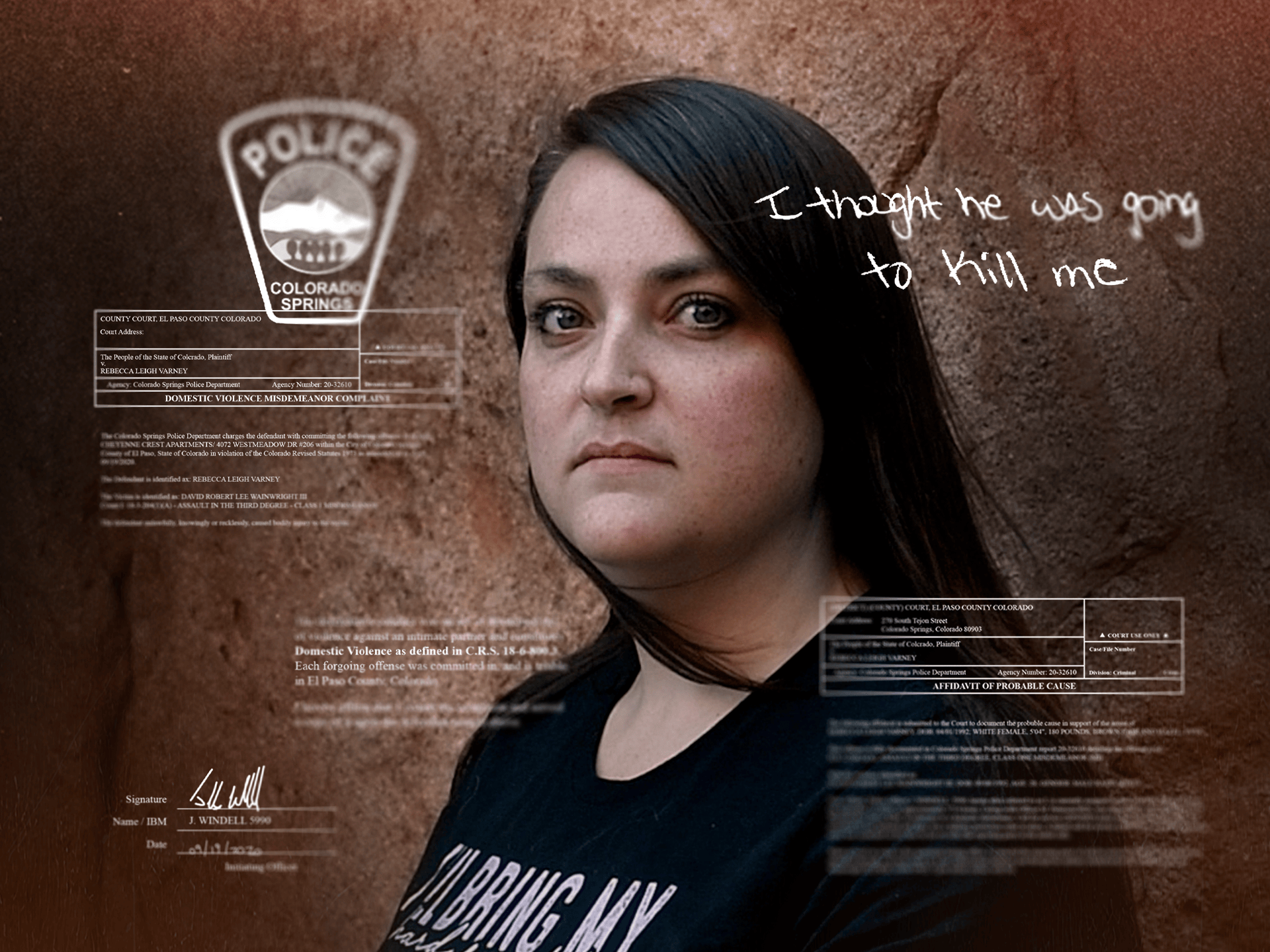
“I thought he was going to kill me,” she wrote to the county court.
The multiple military protective orders Varney filed against her husband, a member of the Army, never kept him away for long.
Slowly and methodically, she developed an exit plan. But it wasn’t easy: He wouldn’t allow her to work and earn her own money, she said. She lost friends, who, frustrated with her forgiveness for his actions, walked away, plunging her further into isolation.
Her ex-husband denied the allegations and declined to comment.
Less than a year after her arrest, Varney needed help again.
But now calling 911 was risky.
She had a record: an assault charge from the scratches to her husband’s face, for which she accepted a plea deal, a decision she now regrets. After her arrest, she lost faith in the criminal justice system. Taking the plea deal eliminated the possibility of jail time and guaranteed the charge would be dropped.
But the charge triggered an automatic restraining order under Colorado law. Legally, her husband needed protection — not her, even though she told police the marks were made in self-defense.
When officers arrived, she showed them a house in disarray: chairs were flipped, glass was shattered.
Officers noted that while the restraining order filed against Varney had been watered down at the request of her husband, it still forbade harassment.
This time her husband had sexually assaulted her — an accusation he denied — and fractured her wrist, Varney told police.
Cops reviewed a video of him repeatedly smashing her arm in a door as she reached in from the opposite side. However, it was used as proof that she was harassing her husband.
In an interview with police, he said that the argument started because Varney said words “you don’t say to your husband.” He slammed the door to keep her out because “I could feel myself starting to get angry again,” he said.
Police questioned why Varney wanted in the room. She said she was trying to save her dogs, Chloe, Tanzy and Gabriel, because he had threatened to snap one of their necks before, according to a lawsuit she filed against the city of Colorado Springs and officers.
It didn’t matter. Varney, her arm in a splint, was sent back to jail.
“That was when I realized this was never going to end,” she said through tears. “I needed to take control of my life.”
Varney’s lawsuit claimed, among other things, that police maliciously prosecuted her. Her husband later told police to drop the charges, claiming he did not feel harassed and that officers intimidated him into saying that he did.
The Colorado Springs Police Department declined to comment on her case.
The complaint was dismissed by a judge who in part found that officers arguably had probable cause to arrest her.
Probable cause, the legal standard that requires police to have reasonable grounds in order to make an arrest, can be tricky in domestic violence cases. It is often based on interviews in chaotic moments after the fact. Even physical violence is hard to measure: Some injuries may not be noticeable for days, while self-defense marks such as scratches are immediate.
Josh Golson, an attorney in South Carolina, is representing a Black man who says that when he called police because his ex, a white woman, allegedly smashed the window of his car with him in it, they arrested him instead, according to a lawsuit filed last year. He believes the laws are diminishing a constitutional promise.
“You’re just making decisions based on a purported policy provision — not probable cause,” he said. “When you’re taking away that discretion, or officers think they have to arrest somebody by virtue of their training, that creates a big problem.”
The man’s ex accused him of abuse, which he denied. A deputy told him that policy required an arrest and that he had zero discretion, according to the lawsuit. His career was ruined even though the charge was dismissed, Golson said.
America had a problem
No other crime — not child abuse or murder — forces law enforcement action like domestic violence.
Police in 23 states are mandated by law to make an arrest on domestic violence calls if they have probable cause, including Connecticut, Kansas, Mississippi and Ohio. Six other states encourage arrest as the preferred response but stop short of a mandate.
Mandatory arrest laws gripped the country at a time when police treated domestic violence with a hands-off approach — not as a crime, but as none of the government’s business.
“We’ve gone from total inaction to a response that is endangering survivors,” said Jane Stoever, director of the University of California Irvine School of Law Domestic Violence Clinic. “It’s a really dangerous practice because once you are arrested as a survivor of abuse seeking help, you won’t see the police as a safe resource to return to.”
Activists in the 1970s protested police inaction, demanding that law enforcement treat intimate partner violence as they would any other assault.
In 1983, Tracey Thurman, who had repeatedly asked police for protection from her estranged husband, was stabbed 13 times and kicked in the head as a Torrington, Connecticut, officer did nothing. Her husband broke her neck, paralyzing her. She won in a landmark court decision that cost the police department millions and sparked a pioneering law requiring arrests.
Around the same time, a young researcher was working on a study in Minnesota, aiming to find a fix to what was proving to be a deadly challenge.
Lawrence Sherman co-authored the Minneapolis Domestic Violence Experiment in 1984, finding that mandatory arrest was effective in reducing repeated domestic violence offenses in the city.
He warned that it would be premature to mandate arrests everywhere, though. Subsequent studies did not back up his findings and showed that victims could be harmed by mandatory arrests, especially Black women living in poor neighborhoods.
But America had a problem and it needed a solution.
Lawmakers started drafting bills citing the study.
By 1994, Congress had promoted mandatory arrest as part of the watershed reforms of the Violence Against Women Act, offering grants to police departments that cracked down on domestic violence.
Sherman, now chair of the Cambridge Centre for Evidence-Based Policing, has tried and failed since then to get the laws repealed, regretful of how his research was used. The laws are driven by retribution, he said, and that desire has “blinded us” from rational judgment.
“We need to get rid of mandatory arrest,” Sherman said. “It’s backfiring for women.”
Betrayed by the law
Jess believes she would have never gone to jail if not for California’s version of the law.
On Valentine’s Day weekend, her ex-boyfriend threatened to kill her and her family and took a knife from the kitchen and demanded she stab him with it, according to claims she made in a 2025 police report.
Standing a foot taller than her and outweighing her by more than 200 pounds, he pushed her against a wall and launched a beer can at her head, hitting her near the temple.
When an officer with the Irvine Police Department arrived and spoke to her ex-boyfriend, though, he identified Jess, who asked that her full name not be used in this story for fear of retribution, as the dominant aggressor, noting she had no injuries.
Jess had admitted to breaking her ex’s glasses, and he had a small cut on his finger, less than an inch, the officer wrote in the report. But she said she wasn’t to blame.
The officer told her he would lose his job if he didn’t arrest someone that night, according to a lawsuit she filed against the police department. California’s law explicitly encourages the arrest of domestic violence offenders when there is probable cause.
She was sent to jail for a domestic violence charge punishable by up to four years in prison in California.
From jail, she tried to prove her innocence.
She showed an officer bruises on her arms and a scratch on her back she believed was from being slammed into a radiator in her home. The officer wrote in a police report that the bruises were inconsistent with grab marks and suggested the scratch was from her pet cat.
Her ex told Bloomberg Law that he stands by the statements he made to police and said that officers made the right decision that night.
An Irvine police spokesman declined to comment on the case. Attorneys for the responding officer have denied Jess’s claims in court as she sues for false arrest.
The charge was dropped after the Orange County District Attorney’s Office declined to prosecute due to a lack of evidence.
But for Jess, the damage was done. She has panic attacks, and worries that the arrest will pop up when applying for jobs. She moved out of state and is trying to leave it all behind her.
“I did what we were always told to do. I called the police,” she said. “I thought that they would protect me.”
Supporters of mandatory arrest, like Andy McCurdy, the police chief in Sumner, Washington, say it’s tempting to blame the law for response failures. But the danger is not in the law itself, it’s a lack of support for victims, police training that allows for comprehensive follow-ups and community services.
“The danger arises when arrest decisions are driven by visible injuries alone, made without careful investigation, or are influenced by organizational pressures or culture that reward quick resolution over careful assessment of the broader context,” said McCurdy, who provides trauma-informed training to officers. “Arrest alone does not prevent future violence, but neither does eliminating arrest as an option.”
Detecting Abuse
Police handbooks attempt to take on the crime, instructing officers to interview parties separately on the scene, conduct lethality assessments and connect victims to resources such as shelters. But many departments do not require in-depth training on the dynamics of domestic violence and how to identify signs of abuse and trauma that are not always obvious.
Requiring arrests in the absence of that training is a recipe for disaster, said Nikhita Ved, chief programs officer at the National Domestic Violence Hotline.
“The officers that I’ve worked with, they want to be the helpers overall. They want you to reach out,” she said. “If you’re going to make arrests mandatory, you better know what you’re doing.”
Domestic violence calls are considered among the most dangerous for police to respond to.
The violence often happens behind closed doors and escalates over time. Abusers can be convincing, while victims can be emotional or uncooperative and may not actually want their partners to go to jail.
Advocacy groups have long urged more police training to combat gender and racial biases as they respond to victims who may not act the way they think they should or downplay events out of fear or shock. Research has shown that the male-dominated police force itself has a problem committing domestic violence.
All of those issues can be compounded when police feel they must take someone to jail no matter what.
Two months after Vanessa Huffman filed for divorce in 2021, she called 911 from her home in the Phoenix, Arizona, suburbs to report that her husband choked her after an argument over the TV remote.
He came up behind her and squeezed her neck until she “saw stars,” she told police.
“I can’t do this anymore,” she said, crying and grabbing at her throat on officer body camera footage. “I couldn’t breathe.”
Then officers went to speak to her husband.
Standing on the front porch, he calmly showed them a bite mark on his forearm and offered up an audio recording of their argument he had on his phone.
In the recording, an angry Huffman is heard shouting and cursing. Then, a brief moment of a struggle and silence.
“Bite me, go ahead, bite me!” her husband shouts.
“You choked me,” she wails afterward. “And I’m calling the cops.”
He denied choking her. Instead, he told police she bit his arm in an attempt to steal his phone. She had made false claims against him before, he said.
An officer thanks him for his help then discusses with other cops on the scene.
“There’s no marks around her neck. She’s talking fine, she’s just crying,” the officer says. “She’s saying her windpipe is damaged.”
Huffman is asked to put her hands behind her back. She questions why.
“He’s got a significant bite mark on that arm,” an officer says.
“Yes he does,” says Huffman. “He was choking me.”
In Arizona, an officer must make an arrest on domestic violence calls in cases where a physical injury has occurred.
Days later, as Huffman said she was having trouble swallowing, an exam conducted by a forensic nurse showed nine signs of strangulation including bruises on her shoulder, an enlarged vessel in her ear and red spots on her neck caused by capillaries bursting under intense pressure, according to police documents.
She said a detective apologized to her with tears in her eyes. The Phoenix Police Department declined to comment on the case but pointed to city domestic violence programs and said it is “committed to ensuring the safety of victims of all crimes.”
Huffman’s assault charge was dismissed, and her now ex-husband was arrested for felony strangulation instead.
Her ex denied the allegations and suggested to Bloomberg Law that she choked herself. His charge was never officially filed.
They were married for more than 35 years. She has complex post traumatic stress disorder from experiencing domestic violence growing up and believes that made it harder for her to realize the problems in her relationship — and harder to leave.
“I loved that man but he was a danger to me,” she said. “I guess in some twisted way, my brain kind of normalized a lot of what I was going through.”
No easy answers
Domestic violence remains a problem even as legislation has worked to enforce protective orders and restrict gun ownership for offenders. Nationally, 1 in 3 women and 1 in 6 men experience intimate partner violence, according to the Centers for Disease Control and Prevention.
A report released this year by the FBI shows that the percentage of violent crimes involving domestic relationships has increased since 2020.
Some blame a lack of police intervention in domestic violence situations for the deaths of loved ones or credit officers with saving them from abuse. But studies show mandatory arrest policies do not actually reduce such incidents and could have unintended consequences including escalating abuse, landing victims in jail or resulting in the loss of child custody.
While the laws remain on the books, support has waned. Reauthorizations of the federal Violence Against Women Act quietly stopped incentivizing it. Major domestic violence organizations that once heralded the laws shifted away from it.
Police officers themselves have voiced concerns about the laws.
An Austin, Texas, officer testified in divorce proceedings in favor of a man he arrested in 2019, saying if it weren’t for the department’s policy, he would have never taken him in but “we don’t have a choice.” While the man spent five days in jail for a charge that was later dropped, his wife fled the country with his children, according to a lawsuit.
When a 95-year-old Florida woman called 911 after a family argument over air conditioning, the police chief there said “officers’ hands are tied.” She spent a night in jail for domestic violence because she slapped her adult granddaughter with a slipper.
“We can’t just rely on a law to make sure our deputies and officers take the issue seriously — that’s more of a training issue,” said Ed Gonzalez, the sheriff in Harris County, Texas. “Unfortunately, what happens in government is we never go back and say ‘does this still serve us?”
The policies attempt to create a universal formula for something that is not easily diagnosed, said Kelly McCarthy, chief of police in Mendota Heights, Minnesota.
“We look at these as instances and not as patterns. It’s all just bits and pieces and nobody is overseeing it holistically,” she said. “There has to be a middle ground.”
The biggest consequence of all, in McCarthy’s eyes, is potentially deadly.
“My fear is we are just training victims not to call us,” she said.
Experts like Deborah Weissman, director of the Criminalized Survivor, Detention, and Justice Clinic at the University of North Carolina law school, have called for the focus to shift away from punitive sentencing of offenders toward a wider social safety net for domestic violence victims: cash, housing, legal aid, childcare — tools proven to increase stability, escape and survival.
Mandatory arrest laws have largely remained the same for decades despite outcry, in part because politicians are leery of being perceived as soft on domestic violence, Weissman said.
“People are afraid to touch it. Progressives are afraid to touch it,” she said. “We’re trying to break that down.”
When Varney was released from jail the second time, she fought back.
She filed a complaint against the officers on her case, who were reprimanded or required to undergo counseling after an internal investigation confirmed some of her allegations, according to the Colorado Springs Police Department. She got a divorce and a restraining order of her own.
Last year, at the recommendation of her therapist, she signed up to ride along on calls with officers from the same force that had arrested her as a form of exposure therapy. She said a newfound fear of police had consumed her — she froze if a cop pulled up near her on the road and avoided walking her dogs past the station by her house.
As she drove around the curves of her Rocky Mountain neighborhood in a cop car, this time in the front seat, she peppered an officer with questions about the domestic violence law.
She didn’t want to take the ride but she worried that her life depended on it.
She said she found herself in another abusive relationship.
As her new boyfriend’s hands were wrapped around her neck, pinning her against the hood of his car, she thought to reach for her cellphone.
Then she stopped herself.
“I already learned what happens when I call the cops,” Varney said. “They don’t believe me.”