Día de Muertos springs to life at the Wadsworth
Not far from the heavy front doors of the Wadsworth Athenaeum, artist Helena Martinez was ready to welcome in the spirit world.
Amidst the glow of electric tea lights, beeswax skulls and a tiny, black-and-white skeletal dog, she pointed out the people she carries with her. There was her older sister, Charlie Gonzalez, frozen in time as a high school senior; her Titi Mary Ann Rosa, who inspired her to become a community-based artist and organizer; and her niece, Celestia Summer Gonzalez, who died at just two months old in 2016.
In front of Celestia’s portrait, encased in a heart-shaped frame, two tiny, lacquered wooden animals flanked a toy car, its red paint glittering in the gallery’s low light.
The ofrenda, or memorial altar, is part of “Todavía Aqui,” a multi-part, stunningly bright installation from Martinez and members of the greater Hartford community that translates to “Still Here,” and is on display for Día de Muertos, or Day of the Dead, in the Wadsworth’s post-war and contemporary art galleries through Nov. 8.
This coming Sunday, on Día de Muertos itself, it will be the centerpiece of the museum’s free community celebration of the holiday, during a collaboration between the Wadsworth, Martinez’s cultural organization Helena’s Casita, and the City of Hartford’s “Mayor’s Day Out” program. For Martinez, who launched the celebration as a small, out-of-pocket event four years ago on Hartford’s Pratt Street, it is as much a reminder of life, including its miraculousness and fragility, as it is a moment of reflection.
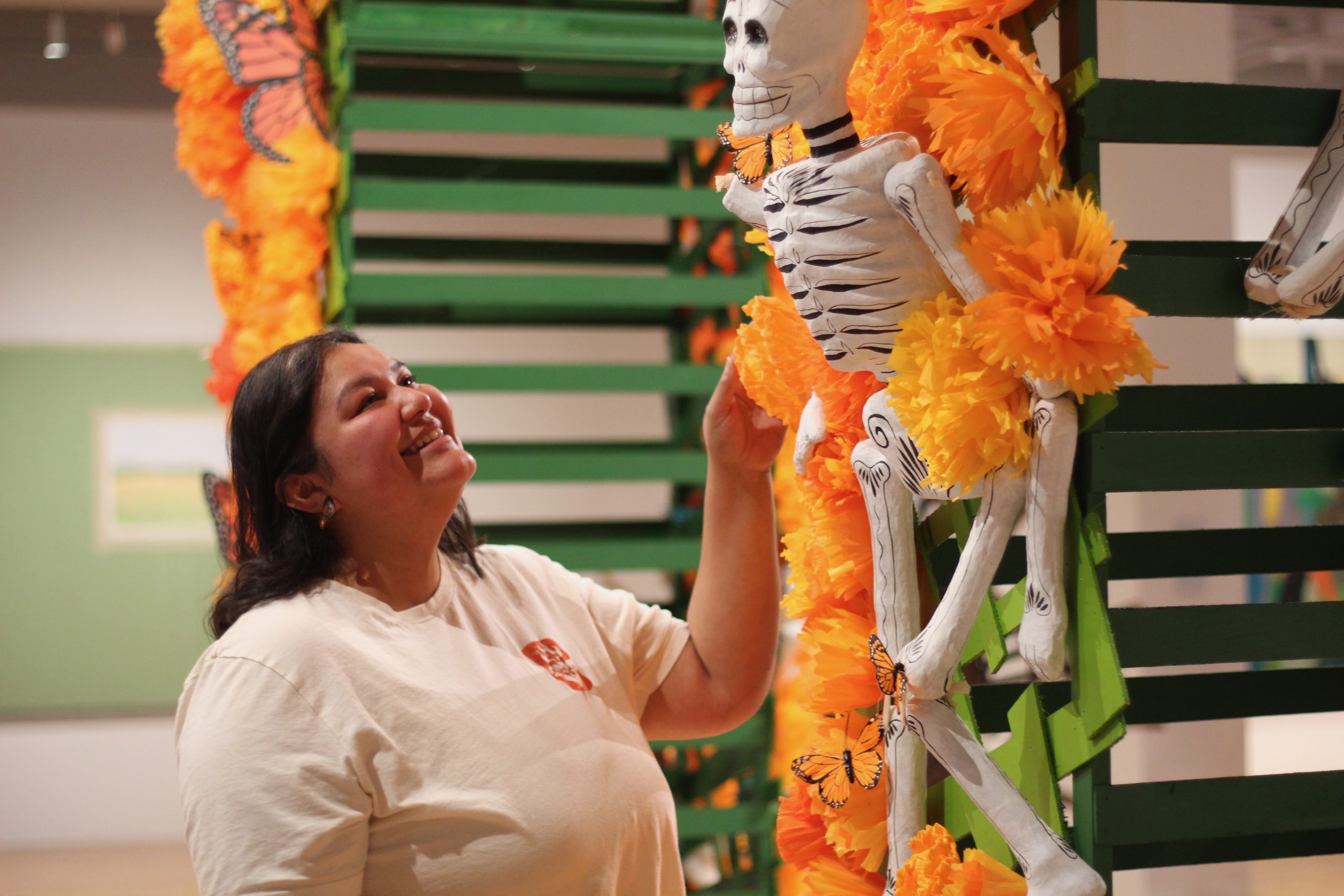
“For me, Día de Muertos is not just a chance to honor our loved ones [who have passed], it’s also a chance to celebrate the joys in life,” Martinez said last Thursday afternoon, framed by soft electric flames and skeletons that seemed to scale the sides of an 11-foot arch covered in giant, delicate paper marigolds.
This year, the hours–long celebration includes live mariachi from the group Mariachi Tercera Generacion, as well as free Mexican hot chocolate from Evelyn Ruiz’ Hartford-based coffee truck Hasta Luego Friend, and sweet, fragrant pan de muerto from Guadalupana Bakery in Brooklyn, for the first 100 attendees. For years now, Martinez has also worked with the Brooklyn-based shop Mexico In My Pocket, which is owned by her friend Luisa Navarro, for some of the celebration’s furnishings, like hand-painted skeletons and clay skulls from Mexico.
Día de Muertos itself, celebrated in Mexican households across the globe each year, dips back into thousands of years of history. Long before the Catholicism that accompanied Spanish colonization in the sixteenth century, the Aztecs dedicated two rituals, Miccailhuitontli and Hueymiccailhuitl, to the memory of children and adults who had died. The words, like the festivals themselves, come from the name of the deity Mictēcacihuātl, thought to rule the underworld.
It was during these rituals that the custom of using cempasúchil, or marigolds that glow a fiery, almost otherworldly orange, became common (other common flowers include chrysanthemums, baby’s breath, and cockscomb among others, Martinez said). At the time, just as in the present, families believed that the flower helped guide the spirits of the dead temporarily back into the world of the living. Their vibrancy, along with the scent of copal, has remained an enduring part of the day even as it became a fusion of Indigenous and Catholic traditions.
As Día de Muertos evolved, shifting with both the influence and force of colonialism, it took on many of the contours that are still familiar to it today, including a shift to celebrating it later in the year, closer to All Saints’ Day. In addition to putting up an ofrenda that includes photographs of those who have died, including especially the very young and the very old, families often set out sweet, eggy pan de muerto, libations like beer, water, whiskey, tequila and soda that the departed loved in life, bowls of fruit or food, and flowers, sometimes laid so thickly they resemble a carpet.
For Martinez, a speech language pathologist, serial crafter and artist raised between New Jersey and Connecticut, it’s a chance to both deeply grieve those she has lost, and celebrate life with a creative community she has come to love, and to which she is fiercely committed. Four years ago, she launched the celebration as a grassroots gathering on Hartford’s Pratt Street, as she and fellow artists were still coming out of a pandemic that had turned the arts, and the ability to gather, on its head.
That year, dozens of people came out, including Alexisjacqueline “AJ” Martinez, a childhood friend who had recently taken a position as community engagement and access coordinator at the Wadsworth Athenaeum Museum of Art. When the two reconnected, they began talking about opportunities for collaboration, which led to a location change to the Wadsworth in 2025 (in 2024, it drew hundreds of people to Pratt Street).
“It really made perfect sense,” said AJ Martinez, who had launched a similar celebration at the Wadsworth with artist Carlos Hernández Chávez in the years prior. In 2024 and again last year, she remembered, Helena Martinez had made a short speech, assuring attendees that their presence was a sign of strength and resilience in a moment of political uncertainty. “She was like, ‘We’re here and we’re going to celebrate.’ It was beautiful and powerful.”
But the story of Helena Martinez’s own path to observing Día de Muertos takes root many years before that, during her childhood in Vernon and Manchester, Connecticut. The third of six siblings, Martinez grew up with an interest in crafting, cultivated during dozens of free workshops at craft stores that her mother took her to on the weekends. She didn’t think of herself as an artist until much later, but knew that something about creating made her feel at home.
When Martinez was a junior in high school, her older sister Charlie died suddenly, just weeks before her 18th birthday, after a freak accident sent her into cardiac arrest. It left the family reeling: Charlie was “our goth princess,” the sister who was opinionated and bookish, with a dark sense of humor and biting kind of snark that still managed to be funny and charismatic. When she died, “it was just very raw and heavy,” Martinez remembered.
“We grieved her death, but we were all comfortable on what to do,” she continued. Shortly before Charlie had died, she and several siblings had gathered to watch Peter Jackson’s film “The Lovely Bones,” based on Alice Seabold’s novel of the same name. In the book, the young narrator is murdered by a neighbor, and watches life on earth continue to unfold without her. Charlie, who had loved the book, wasn’t having it.
“She was like, ‘Don’t bury me in the ground for all the worms and bugs to eat me,’” Martinez remembered. “I want to be cremated.”
Just weeks later, those words seemed strangely prescient. Martinez’s mother, Mary Martinez, built a shelf in her home to hold an urn with Charlie’s remains.
The year after Charlie’s death, Martinez and her siblings built an ofrenda for the first time, honoring the heritage that their mother held onto when her family migrated from Reina and Matamoros, Mexico several decades ago. Up until that time, she remembered, she had always leaned more towards her father’s Salvadorian side of the family, but something in the ritual called to her. She has made one ever since, in addition to the altar that remains up year-round in her home.
Four years ago, “I felt like my sister was calling me” to do something bigger, Martinez remembered. By then, she had piloted a stationary company and lifestyle brand called Hecho by Helena, which featured language and imagery meant to honor the depth and breadth of Latinidad. She was working as a speech language pathologist in Springfield, and had started hosting community crafting craft sessions (she now fondly refers to them as “Craft or Crash Out,” to recognize crafting as a form of emotional regulation). The celebration on Pratt Street grew organically from there.
This year, her second at the Wadsworth, the installation includes four different, intertwined stations, all designed with the idea of community participation and physical accessibility in mind. The first, visible from the museum’s lobby, is an archway covered in large crepe paper marigolds, the color so vivid it seems as though they have absorbed the sun itself. As she wove through the space last week, Martinez dipped in and out of the archway, inviting a trickle of visitors to do the same. The space is inherently a liminal one: families use archways during Día de Muertos to create a portal between the world of the living and that of the dead.
Nearby, Martinez’s bright ofrenda sits beside an old-school rotary phone, painted off white with glittering gold numbers, on which people can leave messages for their loved ones. On the altar next to it, electric candles glow softly over fabric covers, beeswax, wooden and ceramic skulls, bowls of fake fruit (because of the museum’s policies, live flowers, burning candles and fresh fruit are a no-go) and small items once beloved by her relatives and friends. Around Charlie’s portrait, which sits prominently on the bottom rung, unlit red candles rise from inside empty bottles of Topo Chico, a fruity carbonated drink that her sister once loved.
Above the altar, Martinez has invited community members, including staff at the Wadsworth, to include portraits of their loved ones, with a slideshow that rotates through each of their names and photos on loop. To its right, there is a place for attendees to write their loved one’s name on a small wooden heart, and add it to a collection of hearts that becomes a miniature community ofrenda of its own.
On a walkthrough of the installation with Hartford Mayor Arunan Arulampalam last Thursday, Martinez said that she often feels Charlie’s spirit with her, and still calls on her in moments of exhaustion. Earlier this month, for instance, she was midway through installation, and so tired that she didn’t think she would be able to complete her work. She asked Charlie to give her the strength to push through.
An hour later, Martinez felt a burst of energy. “I was like, ‘Oh, Charlie’s here,’” she said.
Arulampalam, who has included the event in his “Mayor’s Day Out” programming, which provides free activities to Hartford residents through city sponsorship, pointed to the Wadsworth’s celebration as a chance for Hartford residents to both experience the museum, some of them likely for the first time, and observe the tradition in community. This year, that feels especially important: many members of Connecticut’s Latino population, including and especially Mexican and Mexican-American residents, are living in fear after increased activity from Immigration and Customs Enforcement earlier this year.
As a father of five who has cherished many of his own family’s stories, Arulampalam said the day has become personal to him, too. Growing up in Los Angeles, he was continually surrounded by friends who observed the day. But it wasn’t until recently, when a caregiver in their home taught his kids about the tradition, that he thought deeply about its weight, and the chance to stop and remember the dead for the vibrant lives they lived.
Now, he said, Dia de Muertos gives him a chance to think about his maternal grandmother, Kirupa Karunananthan, who lived with his family while he was growing up, and both of his grandfathers, whom he fondly remembers as Appu and Appuchi respectively. Each winter, he still dons the coat that his paternal grandfather wore after his family fled Sri Lanka, and migrated to England. After Arulampalam was elected mayor of Hartford for the first time in 2023, that coat and its story accompanied him to the White House, where he was able to share it with then-President Joe Biden.
“I think there’s something so beautiful about living with the idea of death,” he told Martinez as the two walked through the exhibition.
He remembered supporting his wife, the Rev. Liza Arulampalam, as she went through the grief of losing her mother several years ago. “People don’t know how to interact with you when you’ve lost someone,” he said, and Martinez nodded, one hand still extended toward something on the ofrenda. “We’re all so uncomfortable with our own sense of mortality.”
“It’s like, people shouldn’t ask, ‘What can I do?’” Martinez said. “Just bring food. Be present … I think the idea of death, because we’re not able to look it in the face, becomes a source of anxiety.”
The Wadsworth’s Día de Muertos celebration takes place Sunday Nov. 1 from 10 a.m. to 2 p.m. at 600 Main St., at the museum’s website.