Anger grows over Torrent project in Maharashtra
This is not the first time Torrent has courted controversy in Maharashtra.
In May 2019, the BJP-Shiv Sena government led by Fadnavis exempted Torrent Power from paying Rs 285 crore in property tax, including interest and penalties, to the Bhiwandi-Nizampur Municipal Corporation. A government resolution of May 27, 2019 directed the corporation to withdraw recovery proceedings, saying that recovering the tax was not ultimately in the interest of Bhiwandi’s citizens. Local citizens who had complained of inflated electricity bills, intimidation of complainants and false theft accusations criticised the decision. Their campaign did not lead to significant action against the company.
Newslaundry has that, according to electoral bond records, the Torrent Group donated to the BJP, and that its chairman, Sudhir Mehta, has long been seen as close to Modi. No link has been alleged between these and the Karjat project.
What the protesters say
A pumped storage project is a configuration of two water reservoirs at different elevations that can generate power as water moves down from one to the other, passing through a turbine. The system also requires power as it pumps water back into the upper reservoir.
The Saidongar-I Karjat Open Loop Pumped Storage Project is estimated to cost Rs 13,505.15 crore. The project covers 377 hectares, of which 233 hectares are forest land and 144 hectares are village land in Bhaliwadi, Ambod, Potal, Pali, Saidongar and Dhak.
The forest is classified as and is home to leopards, sloth bears, wolves, jackals, foxes, jungle cats, sambar deer, four-horned antelopes and Indian pangolins. Recorded birds include Indian peafowl, Brahminy kites, ospreys, black eagles, white-eyed buzzards and shikras. The area also hosts Russell’s vipers, Indian cobras, Indian pythons and Bengal monitors.
According to the company’s project details, the land is needed for project components, reservoir areas, muck-dumping sites, construction camps and workers’ colonies.
Activists and residents argue that planting trees cannot automatically make up for the loss of an existing forest ecosystem. They also point to the role of the Sahyadri ranges of the Western Ghats in regulating Maharashtra’s monsoon.
Kailash More, a Karjat lawyer and activist leading the protest, says the damage will be irreversible. “The entire ecosystem and environment of Karjat will be destroyed. These trees are 200-300 years old,” he said.
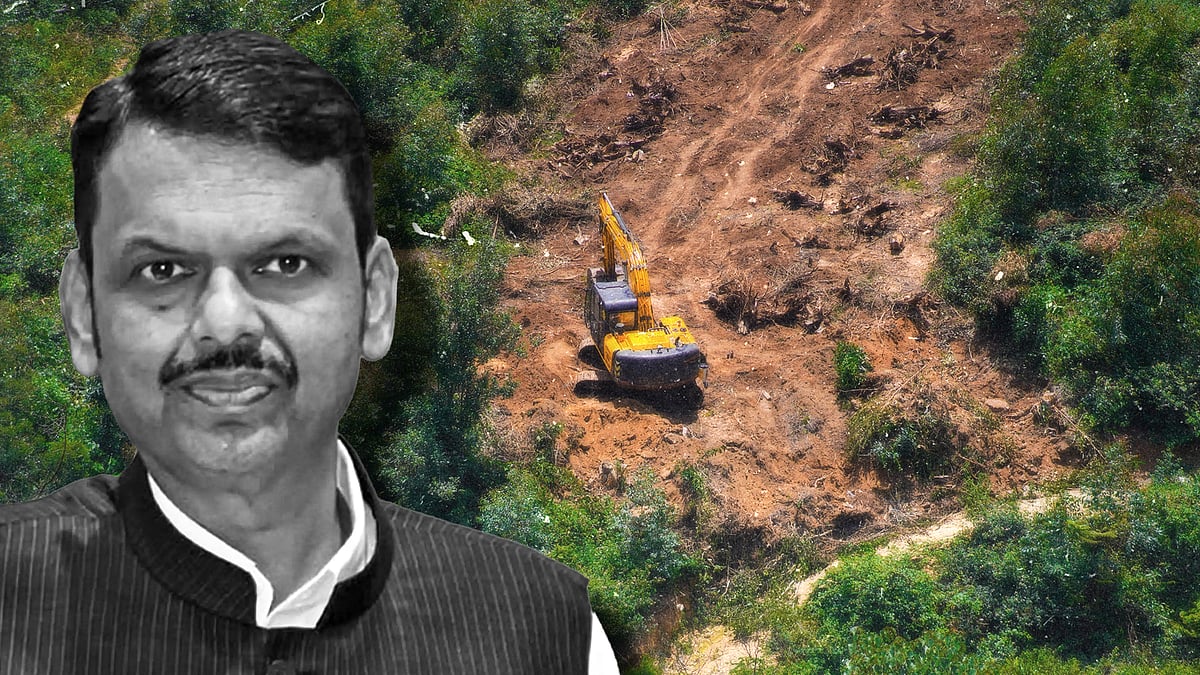
Pointing to the scale of felling, More said around 2,700 trees have already been cut. The first-phase permission covers 32,490, and if the project proceeds as planned, around three lakh could eventually be felled. Felling has stopped for the past two days since people began raising the issue, he said.
On the environmental impact, More said the dams will need 2,300 crore litres of water, which could leave Karjat’s residents and farmers facing shortages, and transmission lines and towers will extend over 14 km and affect around 1,000 acres. The government says it will plant 90,000 trees, 30,000 at the project site and 60,000 in Satara, he said. “It is like planting trees in Delhi to compensate for those cut down in Karjat,” More said, claiming that an earlier promise to plant 33 crore trees came to nothing.
More claimed work on the project has begun despite 144 hectares of privately owned, non-forest land yet to be acquired. Additionally, battery energy storage systems need no tree felling, dams or reservoirs, and the Centre itself had passed a resolution in October 2026 promoting the technology. “Even if we need more electricity generation, then it should not be by cutting thousands of trees, which is going to destroy our environment,” he said.
Doubts over the energy case
Mayuresh Warinjekar, a researcher and electrical engineer, questions whether Maharashtra needs the project. For every 100 units of electricity used to pump water to the upper reservoir, a pumped-storage project can return at most 75, he said, so a quarter of the energy is lost, “a fact that is rarely highlighted”.
Such projects make sense only when surplus power, particularly solar and wind that might otherwise go unused, is available. “But the question is whether Maharashtra actually has surplus power,” he said. Even in Pune, residents face frequent power cuts, and rural areas fare worse, he said. “Official reports may show zero load shedding, but ground-level outages and trippings tell a different story.”
He also said pumped-storage projects could add to demand, including for coal-fired power, rather than reduce it, contrary to the public perception that they simply store surplus energy.
Activist K J Joy of the Society for Promoting Participative Ecosystem Management, said, “In Maharashtra, there is a PSP concentration in the Western Ghats, which is a highly ecologically sensitive area. With so much tree cutting and tunneling, it can exacerbate land slides and land slips and also it is a highly earthquake prone region.”
However, Chief Minister Devendra Fadnavis has rejected the criticism as a “fake narrative” spread as part of an anti-Maharashtra campaign. “Maharashtra has become a pump storage hub, and this current project is one of them…3000 MW of electricity will be generated in this project. It will be clean energy. The land acquisition is needed to store the water like a reservoir,” he said.
He said 90,000 trees would be planted in and around the project area to maintain ecological balance. He also argued that without the project, Maharashtra would have to buy an equivalent 3,000 MW of thermal power, and that offsetting the pollution from that capacity would require planting 28 crore fully grown trees.
In response to a request for comment, Torrent Group executive director Jayesh Desai said, “The issue needs to be viewed in the broader context of the project’s overall environmental, energy-security and economic benefits, rather than considering tree felling in isolation. The project is designed to support the large-scale integration of solar and wind energy by storing surplus renewable electricity and making it available when required. It will thereby help reduce dependence on fossil-fuel-based generation during peak-demand periods and contribute to long-term reduction in carbon emissions. The project design has sought to minimise forest diversion and tree cutting to the extent practical. The unavoidable impact will be addressed through compensatory afforestation, greenbelt development, restoration of disturbed areas, biodiversity management and other measures stipulated under the applicable environmental and forest approvals.”
“Torrent has obtained forest clearance and all other applicable permissions before the current project activities were started. The tree-felling activity is being undertaken by the forest department in accordance with the approvals granted and the applicable statutory process. Torrent has acquired the land and obtained necessary permissions before starting any work.”
You can read his full reply
Newslaundry reached out to Maharashtra CM Devendra Fadnavis. His response will be added to this report if received.
Independent journalism means asking tough questions about powerful companies and the decisions that affect our environment. If you value reporting like this, subscribe to Newslaundry and help us keep asking the questions that matter.