Tackling workplace ageism in a super-aged society
SINGAPORE – Overcoming ageist attitudes in the workplace, rigid post-retirement job opportunities and health fatalism is key to ensuring that people can continue to celebrate extended longevity, said Professor Paulin Straughan, director of the Centre for Research on Successful Ageing (Rosa) at the Singapore Management University (SMU).
This is because seniors in Singapore need to continue to work in order to age well, as well as focusing on maintaining their healthspan, Straughan said at the 6th Rosa symposium on Oct 20.
Flexible, bite-size work opportunities that suit the seniors’ strengths will be useful. When one is past retirement age, he or she may not want to continue committing to regular work hours, particularly if the rigour does not honour their experience in terms of remuneration.
“To put it very crudely, they are now supplementary labour. When we need you, we extend (your work contract). When we don’t need you, you are the first to go,” she said.
“Of course, they say, ‘Fine, I will wean myself off paid work’… But that’s a loss to think about because we cannot afford to retire.”
Furthermore, ageism is fanned by the thinking that an older person can no longer contribute to the workplace when it extends to the actions taken many years before that happens, she said.
“From our research, people as young as in their 40s tell us the moment they hit their 40s, training opportunities escape them. (It’s because) employers feel that they have a longer runway with the investment in training if they train younger employees,” Straughan said.
Straughan, who has been advocating against workplace ageism, said the mentality will backfire because as a super-aged society, Singapore is having fewer babies, and therefore, faces a smaller workforce.
Importing foreign labour will not be enough to plug the gap, because many other nations are ageing and looking at doing the same.
In Japan, for instance, where those aged 65 and above now make up more than 29% of the population, there is a severe shortage of care workers. While they are facing challenges in hiring foreign labour, they are looking to do so, said Nagoya University Graduate School of International Development vice-dean Satoshi Shimizutani.
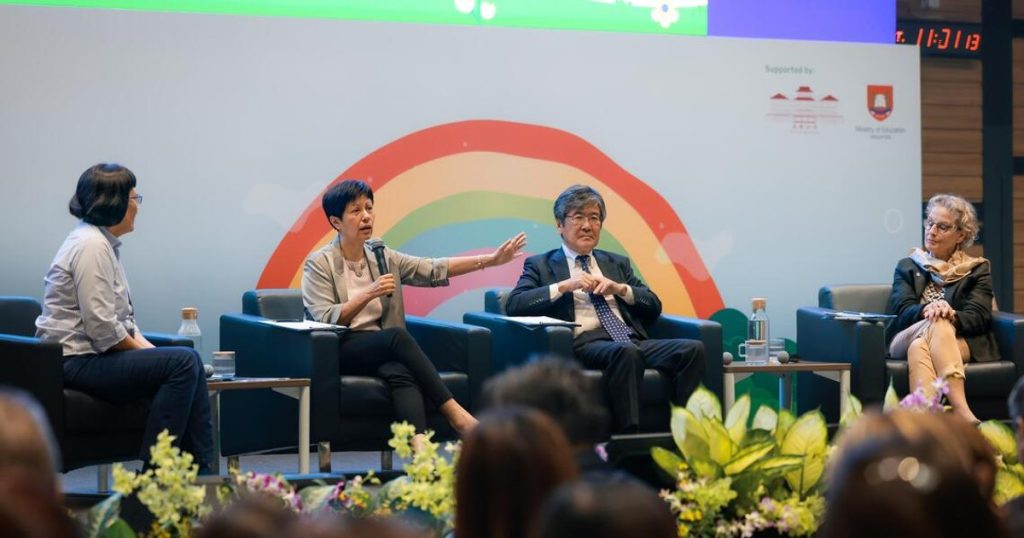
He was speaking at a panel discussion with Straughan, Indranee Rajah, Minister in the Prime Minister’s Office and Second Minister for Finance and National Development; and Technische Universität Dresden rector Ursula Staudinger.
Staudinger said that work environments play a major role in the ageing process. While monotonous routines act as “poison” for the brain, engaging in varied cognitive demands, switching tasks, and taking on ongoing challenges protect against cognitive decline.
Straughan, who shared the latest findings from Rosa based on a study of more than 7000 participants aged 50 to 79, also stressed the importance of social connections and friendships in encouraging seniors to attend health screenings.
The study found that enrolment in Healthier SG was associated with more regular cancer screening.
“In our study, we looked at fatalism, the perspective that if you’re going to get cancer, there’s nothing you can do about it… there’s no need to go for health screening because I’m going to die.”
Although the assumption is that family members are the ones who can motivate seniors to sign up for the screenings, that is not always the case.
Friendship networks were found to be directly associated with regular screening for breast, cervical and colorectal cancer in most of the groups examined, while family influence appeared to operate more through knowledge and attitudes towards screening, the study found.
“When you’re going through age-related health crises or health challenges, I think discussions and advisories from your peers, who are now more or less in that same age group, is likely to be more impactful because this is somebody who is journeying the same pathway that you are, compared to somebody who’s younger or older than you,” Straughan said.
Because people tend to befriend those who are like themselves, curating informal third spaces for seniors can help to bridge social and class divides, which can help to drive preventive health efforts like screening.
For instance, hawker centres can be turned into neighbourhood kitchens, where someone can teach seniors how to make age-friendly meals that contains sufficient nutrients, she pointed out, but this will require a scheme to kickstart the training.