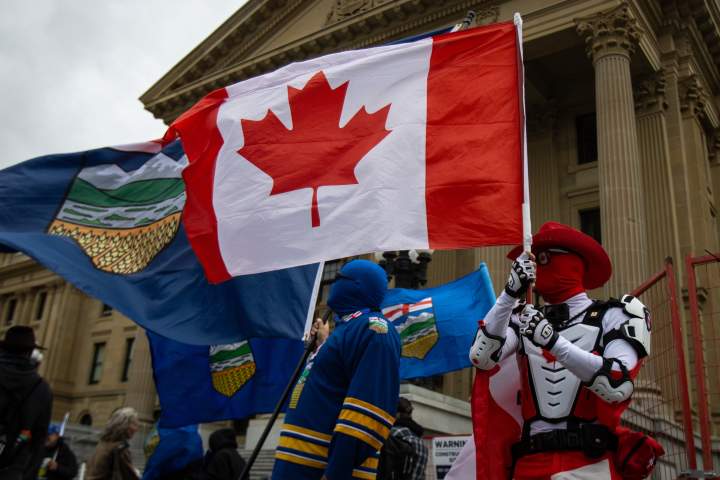
Alberta referendum voters reject separatism, choose to stay in Canada

Most of the province of Alberta has rejected a formal referendum on separatism and would rather remain part of Canada.
Elections Alberta began releasing the referendum results late Monday night, and by midnight around 76 per cent of Albertans voted to remain part of Canada without any further deliberation.
The separatism question asked voters if Alberta should remain in Canada or if the provincial government should begin the legal process of holding a future binding referendum on whether or not Alberta should separate from Canada.
As of 1 a.m. MT, the votes were as follows:
Remain: 1,005,641
Hold second referendum/Leave: 310,672
Total: 1,316,313
By law, officials must count all votes by hand within 48 hours. Question 10 — about separation — is being counted first.
Early results were supposed to start being released at 8 p.m. MT — only once the final ballot is cast and all polling stations are closed — but several locations opened late on Monday, pushing back that timeline by more than three hours.
Alberta referendum: Elections official questioned about delays in opening voting locations
The referendum asked residents 10 government-initiated questions, though public and political attention largely focused on the question asking Albertans whether they want to remain in Canada or proceed with a binding referendum on leaving Confederation.
The referendum, announced Feb. 19, initially included nine questions pertaining to immigration and the Constitution. The question on independence, added back in May by Premier Danielle Smith, is the tenth that voters were asked to mark an X on.
Get breaking National news
Get breaking Canada news delivered to your inbox as it happens so you won’t miss a trending story.
The separation question was added after Smith said she disagreed with the ruling of a Court of King’s Bench judge that quashed a separatist petition in May, saying the provincial government had a duty to consult with First Nations before Stay Free Alberta was allowed to gather signatures.
She said because the proposed referendum would not “directly trigger separation,” the court ruling would not apply.
Interest in the outcome of the referendum was high even before Monday’s official voting day.
More than 1.35 million votes were cast in both last week’s advance polls and by special mail-in ballots — a significant increase over the roughly 810,000 who voted that way in the 2023 provincial election.
The use of special ballots increased tenfold in the referendum compared to that election, with a total of 519,082 mail-in ballots received by Elections Alberta by the cut-off date.
The results reflect more than half a year of polling, which since the beginning of 2026, has consistently shown about 70 per cent of Albertans want the province to remain in Canada.
In January, an Ipsos poll found about three in 10 residents supported independence, but a deeper dive revealed that when faced with the costs and consequences, only half of those interested in separatism were truly committed to following through.
Alberta referendum: Separatist leader Jeff Rath says province will never be independent as long as ‘avowed federalist’ Danielle Smith is UCP leader
Grievances in Alberta towards the federal government are not new.
The nuanced disgruntlement harkens back decades: Alberta farmers feeling shortchanged by the monopoly the Canadian Wheat Board had over crop prices and their sales, anger at how Pierre Trudeau’s National Energy Program decimated jobs and investment in the province’s oil and gas sector in the 1980s, and more recent grievances over the Justin Trudeau government’s policies on energy investment and public health restrictions during the COVID-19 pandemic.
History lesson: How Canada’s 1968 election led to the Alberta referendum
Smith’s United Conservative Party never campaigned on holding a separation vote in the 2023 provincial election, but Smith has said some Albertans’ anger with the state of affairs under former Liberal prime minister Justin Trudeau has boiled over into hundreds of thousands signing petitions for and against Confederation.
She has said a referendum was necessary to resolve the matter once and for all.
Smith has said repeatedly that if the vote went the way polling has suggested for months, she expected everyone to accept it and move on. Leaders of the independence movement contest that.
The remaining nine questions surround immigration and constitutional issues.
The immigration questions ask Albertans whether the province should have more say over who comes to the province to work and whether it’s time to put more limitations — and potentially introduce fees — on some who arrive seeking health care and education.
The constitutional questions ask Albertans to bless talks with other provinces to wrest power from the federal government and abolish the Senate
Smith has said the first nine questions are meant to give the province leverage in negotiations with Ottawa.
The premier has also said she voted to stay in Canada, but she needs a yes on the remaining nine questions to get a mandate to bargain for a better deal with Carney.
Carney came to Alberta last week to rally pro-Canada forces and to agree to disagree with Smith. He urged Albertans to reject the nine remaining questions.
Elections Alberta hired more than 48,000 workers to count ballots, which is happening around the clock.
The results of those nine questions should be completed and announced by Wednesday. Officials will count ballots in order from question one to nine. Timelines depend on location closing times and voter turnout.
With files from The Canadian Press
© 2026 Global News, a division of Corus Entertainment Inc.