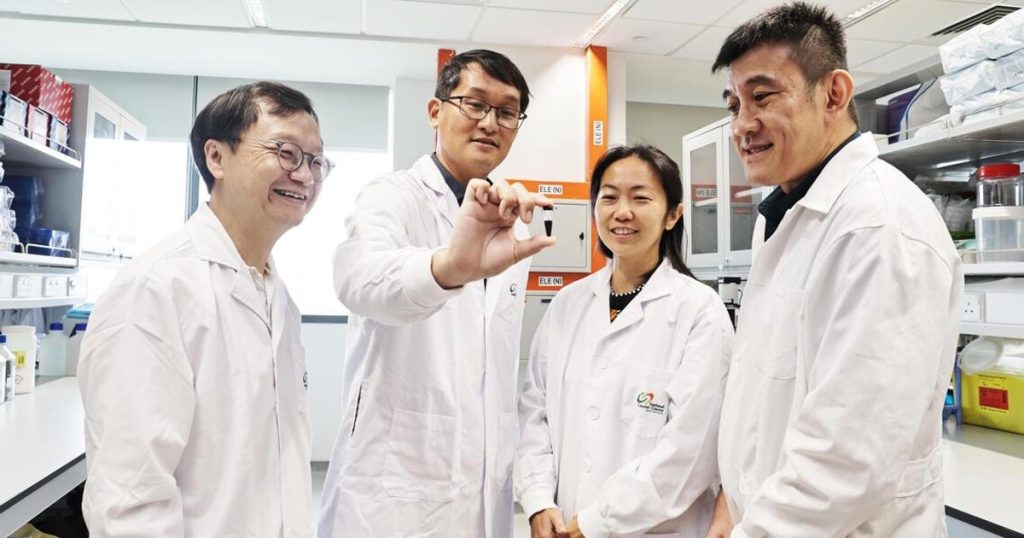
S’pore scientists target peritoneal cancer with nanobody
SINGAPORE – Scientists in Singapore have developed an experimental treatment for cancer of the abdominal lining, moving a step closer to extending the average survival rate that is currently under nine months.
Peritoneal cancer is a late-stage condition that occurs when cancer spreads to the abdominal lining from primary sites such as the stomach, colon, breast, or ovaries.
The scientists created a novel nanobody, or a lab-engineered antibody, that could stunt the growth of tumours in animal models and human tissue samples with mild side effects.
The nanobody blocks two proteins found in an abnormal buildup of abdominal fluid inside the peritoneal cavity called ascites, which the team discovered are key drivers of tumour growth in the lining.
The study’s senior author Johnny Ong said: “If you look at all the major cancers in the world, 40% of gastric cancer actually spreads to the peritoneum at some stage, 30% of colorectal cancer, and 70% of ovarian cancer.
“And if you look at the numbers worldwide, more than 1.2 million cases (of peritoneal cancer) are diagnosed each year.”
He added that while it is one of the major presentations of advanced cancer, it currently has few effective treatments.
Ong, who heads the Department of Sarcoma, Peritoneal and Rare Tumours at the Singapore General Hospital and the National Cancer Centre Singapore, said the best treatment today is HIPEC, or hyperthermic intraperitoneal chemotherapy. This specialised two-step treatment combines surgery with heated chemotherapy to target advanced abdominal cancers.
“This method is where…we surgically remove all the tumours, and then we pour hot chemotherapy drug into the cavity, like bleach, to kill all the tumour cells inside,” Ong said.
However, nine out of 10 patients are typically not suitable for this treatment.
This spurred the team to study what caused the spread of cancer to the protective abdominal membrane as far back as 2016.
The team later found that the ascites contained molecular substances that cancer cells rely on to survive, “dictating how well or how poorly the patient did”, Ong said.
Using the analogy of an apple tree growing beside a pond, he said when a rotten apple drops into the water, it could affect the whole ecosystem like how cancer could affect and spread in the abdominal cavity.
“From here, there was proof of concept that we can target the fluid instead of the tumour cells to prevent the tumour from growing or spreading. What we proposed to do was add ‘agents’ into the water to break off the growth potential of the cancer cells,” he added.
Using the latest molecule profiling technologies, the team analysed proteins and biological pathways across a 397-sample dataset spanning 21 primary cancer types. Two proteins, PAI-1 and S100A10, emerged as key drivers of tumour development in the ascites.
Selecting one protein as the therapeutic target, the scientists focused on developing a nanobody – a newer class of drugs that are small in size, do not provoke the immune system and have lower toxicity risk.
The “Eureka moment”, Ong said, came when the nanobody demonstrated therapeutic efficacy and safety across three model systems: cancer cells grown in the lab, those found in animal models and in samples of advanced abdominal cancer preserved in a jelly-like hydrogel made from hyaluronic acid.
“Across all three, the therapy effectively suppressed tumour growth with minimal toxicity,” he said.
The recent findings were published in September 2026 in Molecular Cancer, a monthly peer-reviewed academic journal in the field of molecular oncology.
Jimmy So, a professor with the Department of Surgery at NUS Medicine, said: “This discovery is particularly encouraging because of its potential to pave the way for an effective therapy for peritoneal metastasis, a common and often deadly complication of many abdominal cancers.”
“We hope this research can ultimately translate into better treatment options and renewed hope for patients facing this difficult condition.”
One such patient is retired accountant Yeow Ser Kiang, 76.
She was diagnosed with stage three ovarian cancer in 2017 and had a hysterectomy to remove her womb and ovaries.
Retired accountant Yeow Ser Kiang (left) with her doctor, NCCS SPRinT head Johnny Ong.
ST PHOTO: KELVIN CHNG
Even though she went through 10 months of chemotherapy, the cancer returned and spread to her peritoneum, forcing her to undergo several operations and rounds of chemotherapy.
Yeow has donated her ascites for the second phase of the research, in which the team is working towards clinical-grade development and a first-in-human clinical trial.
Ong said: “We are developing novel treatment strategies for patients with limited options, with the nanobody as our lead asset. We are hoping to see the first phase of clinical trial in five years.”