China’s third-quarter economic growth quickens to 4.5%, beating estimates
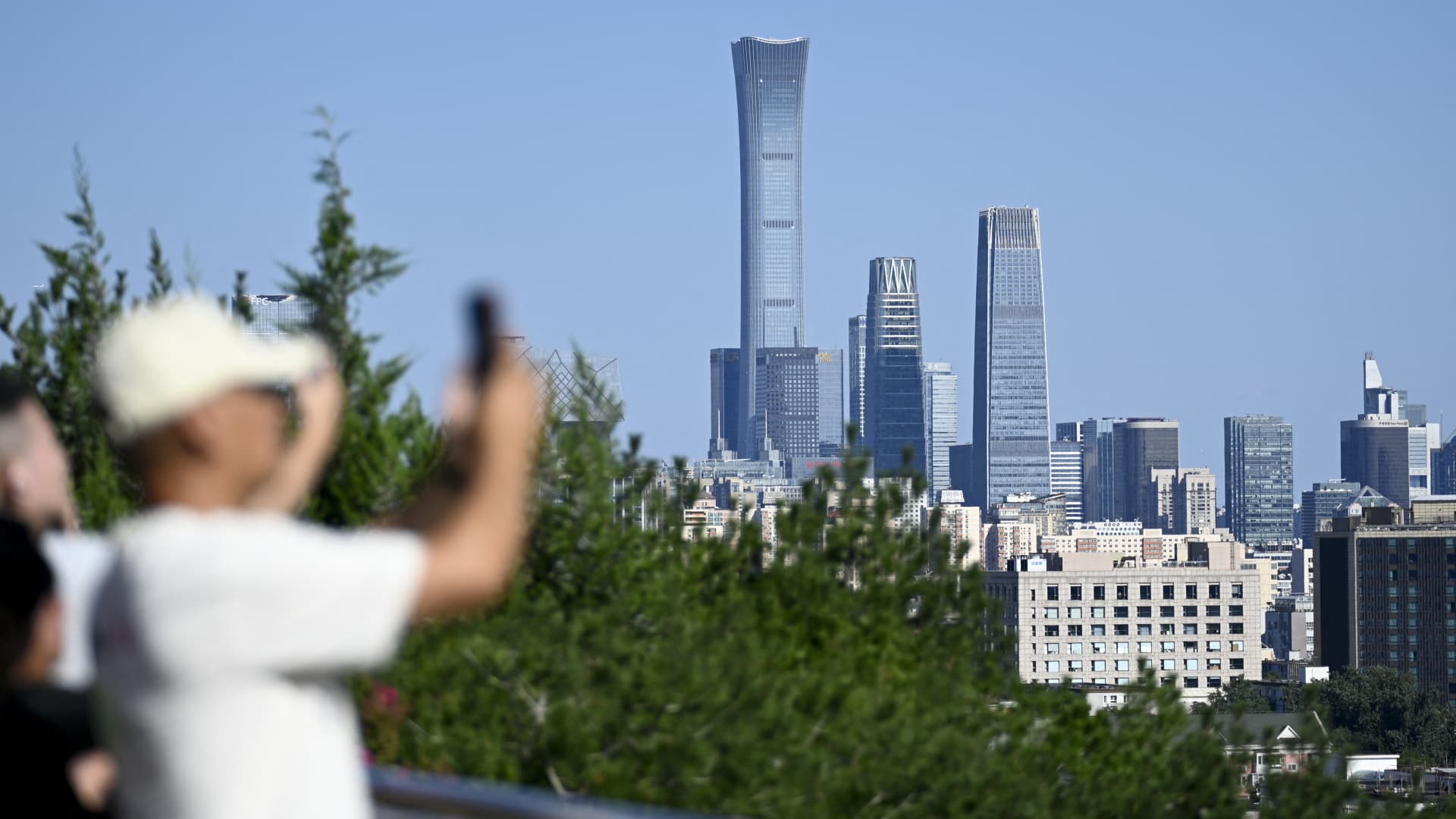
A general view shows the Central Business District (CBD) in Beijing on September 1, 2026.
Wang Zhao | Afp | Getty Images
China’s economic growth accelerated to 4.5% in the third quarter from a year earlier, as robust foreign demand for the country’s technological goods largely offset drags from a deepening property slump and sluggish consumer demand.
Third-quarter growth beat Reuters-polled economists’ expectation of a 4.4% expansion, and was also higher than the three-year low of 4.3% in the second quarter.
“The rebound in September salvaged the lukewarm performance in July and August,” said Tianchen Xu, senior economist at Economist Intelligence Unit, attributing the recovery to improved government investment that helped arrest the consistent worsening in fixed asset investment, an “ever-strong” external sector and a weak base. China’s monthly trade surplus reached a record high of $133.5 billion.
Momentum from the three forces will likely extend into the fourth quarter, Xu said, forecasting a full-year growth rate of 4.7%.
The data shows an economy still leaning on factories and overseas buyers while households and private investors hold back, with growth through the first nine months averaging 4.6%, broadly in line with Beijing’s official target range of 4.5% to 5%.
In September, retail sales eked out a 1.1% growth, exceeding analysts’ forecast for 0.6% increase, while industrial output grew 5.5% from a year earlier, in line with the forecast of 5.5% growth. The urban unemployment rate stood at 5.2% in September.
For the first nine months this year, fixed asset investment in urban areas declined 7.2% from the same period a year earlier, compared with a 7.3% drop estimated in a Reuters poll. Investment channeled into real estate development deepened declines, falling 20.6% in the January to September period, compared with 19.9% in the first eight months.
“The prolonged housing slump will continue to limit the spillover from stronger industrial activity to the wider economy,” Sheana Yue, senior economist at Oxford Economics, as Chinese households see their wealth stored in property shrink over the years.
Yue also dismissed the idea that green shoots have emerged in the property market, as home sales, construction starts, and prices offer little indication that the sector downturn is “bottoming out.”
Lopsided growth
Beijing has leaned heavily on exports for growth this year, but that engine faces growing pressure as energy costs surge and its manufacturing and export surge has provoked growing anxiety among trading partners. Meanwhile, other pockets of the economy remain weak, weighed down by feeble consumption and a multiyear property slump.
“It is clear that domestic imbalances between supply and demand continue rising,” Eswar Prasad, an economics professor at Cornell University, said in an emailed note after the data release on Monday. “The government might become more sanguine and maintain a passive approach, rather than infusing stimulus into the economy in tandem with much-needed reforms,” he added.
Producer prices climbed at their fastest pace in over four years, rising 5% in September, while consumer inflation remains below 1%, reflecting persistent excess capacity and weak demand that are constraining businesses’ pricing power. “This potentially leaves firms to absorb more of the cost shock through lower margins rather than higher selling prices,” said Yue.
Economists largely expect the People’s Bank of China to hold benchmark lending rates unchanged through this year, leaving fiscal measures to do most of the work.
While the decent growth pace may reduce the immediate pressure for Beijing to ramp up stimulus, Yue expects the implementation of already-announced measures to accelerate, supporting investment and activity in the coming quarters.
Chinese authorities have stepped up fiscal support in recent weeks, including a package of targeted rate cuts and mortgage subsidies in late September. Earlier this month, it also allocated 550 billion yuan of unused debt quota to help ease local government financial strains and bolster infrastructure spending.
Correction: This story has been revised to reflect that quarterly GDP growth was 4.5%.