
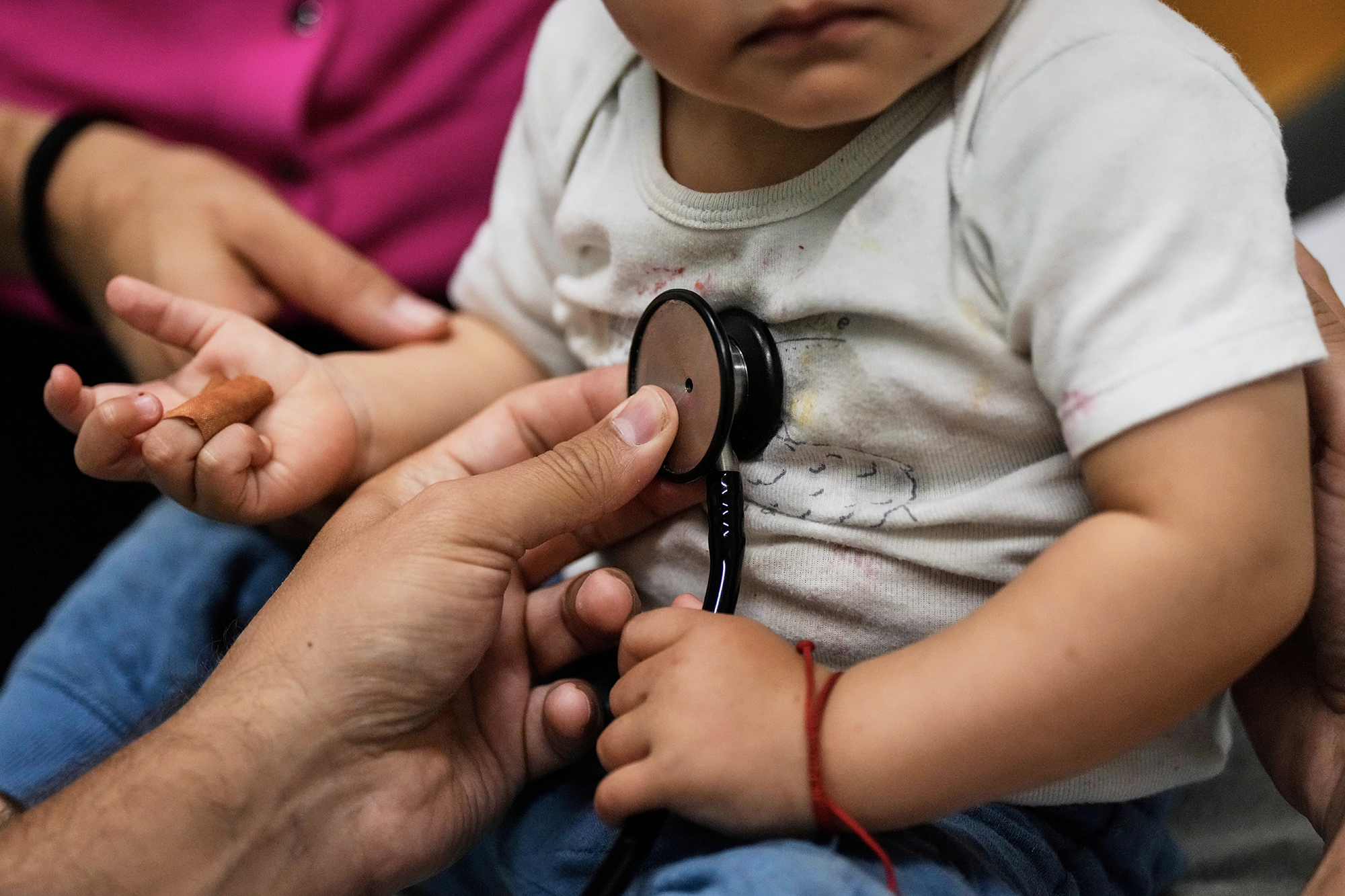
Why Prop. 44 asks you how CA medical clinics should spend money
Do clinics spend enough on patient care? The union behind Proposition 44 says no, and they want voters to decide.
As CalMatters’ Kristen Hwang explains, Prop. 44 would require community health clinics to spend 90% of their revenue on “program services” that provide charitable care to low-income and uninsured patients. Clinics that don’t comply could be fined, and that money would go toward a special fund reserved for health workforce spending.
Service Employees International Union-United Healthcare Workers West is the main proponent of Prop. 44, and it’s the same union behind Prop. 40, the proposed one-time tax on billionaires that mostly would go to healthcare.
Under current law, the nonprofit health clinics are required to reinvest 100% of their revenue back into the organization. But the union claims too many clinics spend money inappropriately on things like high executive salaries and inflated administrative costs, rather than patient care.
- Renee Saldana, union spokesperson: “We’re seeing clinics that have extravagant fundraisers or art collections or CEOs that are paid in the millions while their patients are struggling to get appointments, while the workers are dealing with broken equipment.”
Groups representing clinics, doctors and hospitals, as well as both the California Democratic and Republican parties, oppose Prop. 44.
Clinic spending is already highly regulated, said Francisco Silva, chief executive of the California Primary Care Association, which represents clinics. The association also argues that the measure would prevent clinics from spending on things like patient navigators, translators, food pantries and renovating facilities — though the union disagrees with this. And nearly half of all clinics in the state could also close, according to a study commissioned by the association.
- Silva: “In many communities, the community health center is the only source of care. You’re going to be losing the basic safety net if you lose half of the community health centers.”
CalMatters and UC Student and Policy Center are hosting a conversation Thursday with insurance commissioner candidates Sen. Ben Allen and Jane Kim to talk about their plans to address the state’s massive insurance market. Register here for the free event to attend online or in person in Sacramento at 12 p.m.
Other Stories You Should Know
Billionaires backing CA voter ID measure
An out-of-state billionaire has poured more than $17 million into the Republican-backed voter ID initiative, Prop. 39, reports CalMatters’ Nadia Lathan.
Richard Uihlein is an Illinois billionaire and chief executive of ULINE packing supplies. He and his wife have donated millions into a super PAC that often bankrolls GOP candidates in Illinois and Wisconsin, where ULINE is headquartered.
Other major Prop. 39 donors include Southern California businessman Steven Bray, tech entrepreneurs Cameron and Tyler Winklevoss, and Nicole Shanahan, the former wife of Google executive Sergey Brin and former presidential running mate of Robert F. Kennedy Jr.
Depending on how well Prop. 39 does — even if voters end up rejecting it — the GOP could still look to replicate it in battleground states such as Michigan, Wisconsin or Pennsylvania, said David McCuan, a political science professor at Sonoma State University.
- McCuan: “There is a spillover effect if you do better than expected, even if you lose.”
Who’s making sure AI is safe?
As fears grow over the potential cataclysmic harms caused by artificial intelligence, policymakers are embracing the use of evaluators who audit AI systems on behalf of the companies that create them.
AI auditors raise their own set of issues, however, which some California lawmakers must grapple with while they try to mitigate AI risks through regulation, writes CalMatters’ Khari Johnson.
Evaluating AI models requires a wide range of skills, including having expertise on privacy, mental health, cybersecurity, bias outputs and physical safety. Last month, an international joint statement calling for independent AI evaluations garnered support from nearly 30 countries.
But independent evaluators sign contracts with tech companies whose products they evaluate, which can pose a conflict of interest, said Assemblymember Rebbecca Bauer-Kahan, who successfully pushed two AI safety bills into law. The San Ramon Democrat also argued that AI companies may test models performatively to reassure the public, without a sincere effort to root out problems.
California Voices
There was no evidence of voter fraud in the L.A. mayoral primary, but the right-wing media’s rejection of its election results serves as a warning of how MAGA will likely respond if Republicans suffer significant losses in the midterms, writes John Knefel, a senior writer at Media Matters for America.
Other things worth your time:
CA leaders slam Trump for saying Iran could ‘take out’ LA or San Diego // The Washington Post (gift link)
Now’s the time to get your family ready for El Niño. Here’s how to start // LAist (free)
The kids are still vaccinated despite concern over new CDC guidelines // The Merced Focus (free)
CA’s mail ballot system excludes disabled voters, court rules // Mother Jones (free)
First priority for CA’s next state superintendent: Negotiate a job description // EdSource (free)
Restaurant workers face hidden dangers from gas stoves, including pollution and extreme heat // Los Angeles Times (paywall)
Kaiser to pay millions in back wages to more than 1,000 nurses after payroll error, union says // San Francisco Chronicle (gift link)
Golden Gate Fields on track to become waterfront park // KQED (free)
Source link