Dindga McCannon at Fridman Gallery: Six Decades of Black Art
A pioneer of textile assemblage, found-object quilting and wearable art, Dindga McCannon has always drawn on emotional intelligence and creative intuition to shape her vibrant artistic language. Her work is held in major museum collections, including the National Gallery of Art, the Whitney Museum of American Art, the Hirshhorn Museum, the Brooklyn Museum, the Studio Museum in Harlem, the Phillips Collection and the Schomburg Center for Research in Black Culture. As she weaves together different histories and the traces embodied in objects and materials, McCannon follows something of the spontaneous improvisation of a jazz riff, listening and responding with attentive, empathic understanding. The result is a layered form of storytelling built from repurposed fragments of fabric and found objects, assembled through stitching, beads, buttons, embroidery and paint.
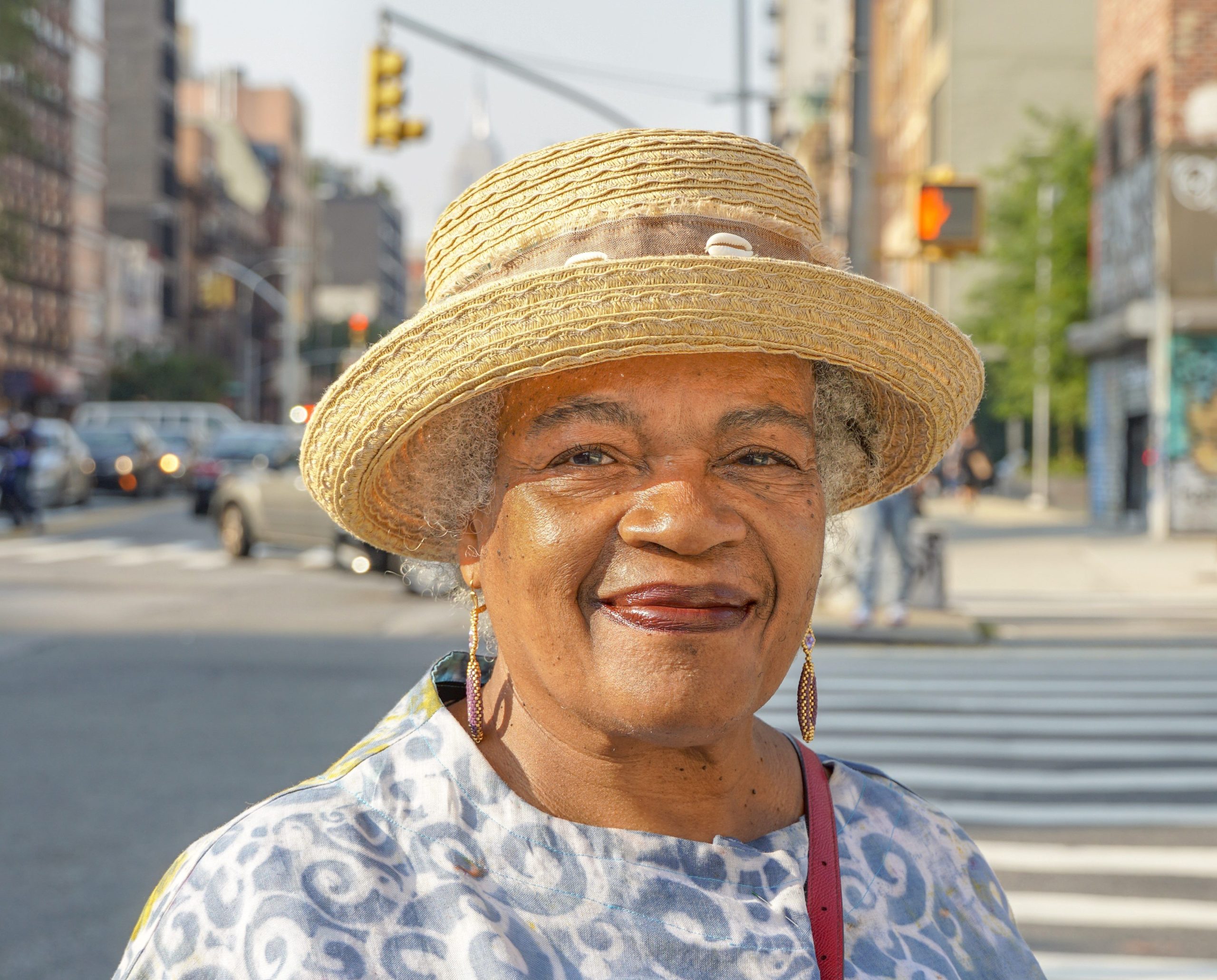
Born and raised in Harlem and the Bronx, McCannon came of age as an artist and young mother during the rise of the civil rights movement. She began her career studying with Jacob Lawrence, Charles Alston, Richard Mayhew and Al Loving at the Art Students League of New York. On her 18th birthday, she went to a concert in Tompkins Square Park, where she encountered the Sun Ra Arkestra, an alternative jazz ensemble whose Afrofuturist performance struck her as a kind of epiphany. When we met at her current show at Fridman Gallery, McCannon looked as though she had just stepped out of one of their performances—the Arkestra had played nearby only a few months earlier for the New Museum Summer Bash. Her vibrant outfit extended the work itself, revealing an all-encompassing creative universe shaped by the energy of her relentless, expansive imagination. On view through October 18, “Yesterday and Today” brings together, for the first time, her groundbreaking mixed-media quilts, paintings and prints from the 1970s to the present.
“Usually, I have some idea of what I want to do, what kind of story I want to tell, and then I start collecting things from my studio,” McCannon tells Observer, describing her studio as an immense archive of things accumulated over time. “I’ve been practicing for close to 60 years, and I pick things up as I go around the world. Sometimes I don’t know what I’m going to do with them, but if I see something interesting, I can’t leave it. So I collect it.” Her process is intuitive yet narrative-driven: materials are chosen for the story she wants to tell and the associations they carry.
She points to a sculpture, Carnival 2 (2022), which took shape after she encountered the Carnival tradition on a trip to Venice. McCannon linked that experience to attending carnival in Haiti in 1971 and to her longstanding fascination with costume, shine and collective celebration. The sculpture combines fragments from her own archive with pieces sourced from New York stores that have long served costume makers, creating a Harlequinesque compendium of the tradition across geographies. “I love costumes. I love the shine,” she says. “Carnival is a collective celebration. It’s celebrated in something like 50 countries—it’s not just one country, it’s worldwide.”
Through her freestyle approach, McCannon collapses hierarchies between materials and between art and craft, making quilting, sewing and needlework central intellectual and political languages. Although no one in her immediate family quilted, she grew up in a community with a strong quilting tradition. She distinguishes her approach, however, from traditional quilting, which she finds too dependent on predetermined patterns. “I combine the medium of art with quiltmaking,” she says, turning the tradition into a contemporary vehicle for storytelling.
African American Suffragettes 1890-1940s (2026), conceived as a personal homage to those women, is the closest she has come to traditional quilting, she notes. Here she applies “crazy quilting,” an improvisational logic that allows disparate fabrics, buttons, beads and other elements to coexist, with balance emerging intuitively rather than from a fixed scheme. “Crazy quilting is more of a free-for-all. You can use buttons, beads, all kinds of things,” she explains. “You intuitively figure out the balance.”
By taking up forms historically coded as women’s domestic labor, McCannon reclaims their place within fine art while creating a monumentality grounded in a regenerative, feminine act of care and assembly. Her approach to materials implies an aesthetics of resourcefulness: scraps, cloth and everyday matter long regarded as ordinary, domestic or peripheral are transformed into richly worked objects, making material transformation both a formal strategy and a form of cultural politics. Through a maximalist, materially layered and radically syncretic lexicon, McCannon turns making itself into a politics of visibility, embracing contamination, hybridity and permeability as possibilities rather than limitations.
Even when the work becomes highly patterned or materially complex, McCannon remains committed to storytelling, as though identity and history were being constructed through layers of material memory. Her stratified images carry biography, community histories and broader social narratives.
Rhythmically organizing materials through repeated motifs, patchwork and color, McCannon binds together disparate histories and symbolic references, embracing hybridity as a source of free expression and a way of reclaiming narratives excluded from dominant accounts. Bringing together Black cultural memory, feminist politics and domestic traditions of making, her work channels the visual energy and legacy of the Black Arts Movement while asserting its place within the rich, eclectic tapestry of American culture. Her works become monuments to Black everyday life, community, music, family, African-derived symbols and cultural self-definition.
“One of the reasons I chose to be an artist is because of the great freedom you have,” McCannon says at one point. “There are a lot of other parts of your life where you have restrictions—you can’t do this, you can’t do that. But in my opinion, the artist in his or her studio has a freedom you don’t have in other areas. You can do whatever you want.”
McCannon began as a painter and printmaker, studying under Robert Blackburn at his eponymous Printmaking Workshop and developing an approach that brought the ancestral roots of African culture into dialogue with the rigor of Renaissance prints. Textile entered the work more spontaneously. While visiting an artist friend in Washington, D.C., she became fascinated by scraps left on the floor from clothing production and began taking them back to her studio. “I would look at the floor and think, those scraps are kind of interesting,” McCannon recalls. Their patterns and textures offered a way to complicate the painted surface and pushed her practice toward the hybrid language of painting, textile and assemblage for which she became known.
Hanging at the entrance is one of her early works, Pat is Pregnant (1977), which showcases McCannon’s painterly skill while introducing fabric and other elements that complicate the pictorial space and layer the narrative. The canvas portrays Pat Davis, McCannon’s longtime friend and a fellow member of the Black artistic community around her at the time.
McCannon’s early formation was deeply tied to Weusi, the Harlem collective that grew out of an earlier group, the Twentieth Century Art Creators, which had organized sidewalk exhibitions to bring art directly into the Black community. Weusi was built on the idea that Black artists should define their own audiences, institutions, subjects and aesthetic priorities rather than wait for recognition from a white-dominated art world. In the late 1960s, its members established Nyumba Ya Sanaa, or “House of Art,” at 158 West 132nd Street in Harlem, a cooperative gallery and later an academy offering workshops, lectures and community programming—an alternative cultural ecosystem built from within.
“Starting in the ’60s, African American culture wasn’t celebrated by the general public. It wasn’t acknowledged. The things we did back then were mainly to prove that we do have a culture, we do have art, and you can have art in your homes that looks like us. That was the beginning of the momentum,” McCannon recounts. “Our culture really wasn’t at the forefront. It was way, way in the back, down around the corner—and we brought it out.”
If Weusi gave McCannon a Black-centered artistic community, it did not address the particular experience of being a Black woman artist. Seeking that more specific space of expression, in 1971 she helped found “Where We At” Black Women Artists with Faith Ringgold and Kay Brown, creating a forum where race and gender could be addressed together. Where We At sharpened those politics through the lived experience of Black women, a concern as central to Ringgold’s storytelling as to McCannon’s.
Pat is Pregnant is one example, Mother and Child (2022) another. “I don’t know those people—I invented them. Usually, when you see a picture of a mother and child, the mother is holding a baby. But mothers are mothers forever. My kid is 59, then the role changes. The kids start taking care of the mom, and then they start telling you what to do,” McCannon says of the work. “The mother in the picture is conservatively dressed while the child is not, and the child has this flowing gold hair, which, when I was growing up, we didn’t have. Nowadays, women do. It shows a difference between generations, but there’s still closeness.” Her reflection reveals how her practice serves as a tool for navigating and narrating womanhood and motherhood from the perspective of a Black woman, bringing human complexity and visibility to experiences long excluded from the “official” narratives of Western, male-centered art history. The works also register how those roles shifted as American society evolved through the postwar period.
McCannon shares affinities with Ringgold and with figures such as Betye Saar, particularly in the way Black feminist histories enter vibrant narrative textiles and assemblages of found materials invested with new symbolic charge. Asked about her relationship with Ringgold, however, McCannon stressed that the two developed independently, despite their friendship and their shared involvement in Where We At. Even alongside Ringgold, McCannon’s practice stands apart in the degree to which fashion, sewing and wearable construction share a single visual continuum with painting. Her canvases unfold as layered universes in continuous dialogue with art history, placing her subjects in conversation with the society around them while turning the works into vibrant documents of its complex cultural tapestry.
The same impulse shapes the way she introduces and celebrates other cultural figures. Music, in particular, sits at the center of many pieces. “I love music and listen to all kinds of genres,” she says. “What gets me about music is the musicians and the way they look on stage. They have such a presence, and the things they wear often fascinate me.”
Working late in the studio, she found that jazz clubs were among the few places still open, so she began spending time there, drawing musicians who eventually became subjects of her paintings, and often friends. “One thing led to another: I started drawing the musicians, then making canvases about musicians, and a lot of my friends were musicians,” she says.
Her Compositions 86 Centennial Mask (2017), honoring Thelonious Monk, takes a more abstract, metaphorical approach to “historical portraiture,” focusing on biography and on the psychological and intellectual essence of the person rather than physical likeness. McCannon wanted to avoid yet another image of the pianist at the keyboard. “Every year I would create a piece about Monk. But the last year we did it, I wanted to do something different from showing him playing the piano, because everybody was doing that. That’s how people always think about Monk,” she explains. “I got his biography and read it, and I found out that he had composed 86 compositions. I said, ‘That’s what I’m going to do.’ I like to reveal things about these bigger-than-life personalities—and ordinary people—that nobody really thinks about.”
Her relationship to music also extends into performance. During the 1980s, while spending time with Rastafarian musicians, she created a backdrop for a boyfriend’s band after noticing how visually empty the stage behind them looked. Rasta Band NYC (c. 1990) brings back the memories and energy of those moments. It was a rare instance of her visual practice directly entering the staging of live music, extending a storytelling impulse she has carried into recent works such as The Blues Queen Revisited (2024).
Looking at works from different decades that narrate and commemorate the evolution of Black culture in the U.S., McCannon notes that the political context may look different but remains, in many respects, “the same old mess.” Progress has been made, she acknowledges, but many structural problems in American society persist. “A lot of stuff has not really changed in America. The contribution of Black culture is finally being acknowledged because we refuse to be ignored, but many of the things going on today have been going on forever,” she says. The main difference, in her view, is a more open expression of prejudice in an increasingly polarized society. “We know these things are happening now, and people who formerly hid their madness are just coming out and telling you.”
At nearly 80, McCannon continues to create relentlessly. She now prefers working at home, where there is little separation between life and studio practice; she may wake in the middle of the night and keep working until morning. Over six decades, she says, her materials have changed far more than her fundamental artistic concerns. New fabrics, papers and other products have expanded the possibilities available to her, and experimentation remains central to her routine.
The show was conceived to underline that continuity: works from different decades are grouped by visual and stylistic affinity rather than chronology, allowing a piece from 1977 to hang alongside one made only a few years ago. The exhibition demonstrates how McCannon’s mixed-media language, combining painting, textile, found objects and quilting, was innovative in the 1970s and remains strikingly contemporary. She has never stopped inventing and reinventing her methods of storytelling, using them to celebrate Black culture while reclaiming its place within the broader American narrative.