
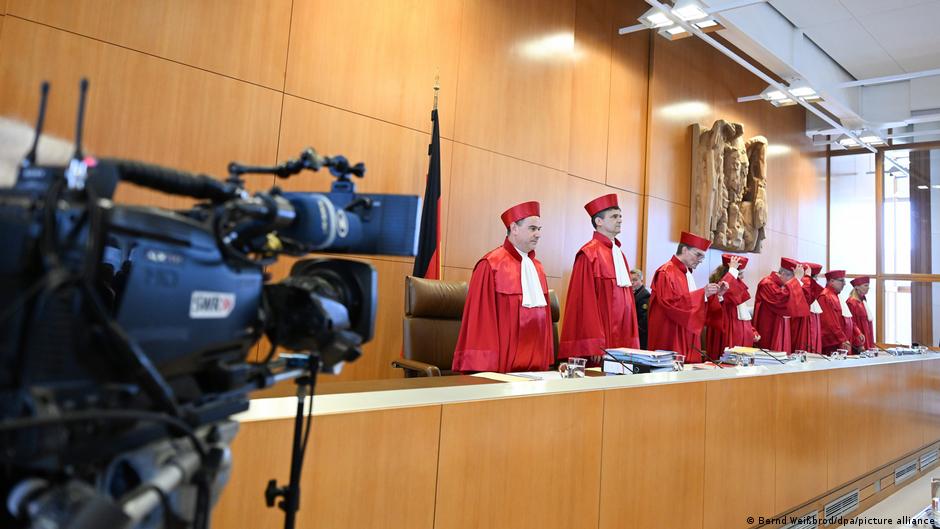
Trust in the Constitutional Court is eroding
The Federal Constitutional Court — Germany’s equivalent of the US Supreme Court — still enjoys the most trust among the population of any branch of government, but that trust is slipping, according to recent surveys.
A new survey by the pollsters YouGov, commissioned to mark the 75th anniversary of the founding of the court, found that about two-thirds (66%) of Germans trust the Federal Constitutional Court. This was significantly more than the other major branches of the country’s government system: The Bundesrat, the upper house of the German parliament, scored 47%, the lower house of parliament, the Bundestag 38%, and the Federal Government itself 29%.
But other surveys show those figures were significantly higher just a few years ago: One study from 2025 by the Allensbach Institute found that trust in the court was as high as 81% in 2021.
Exactly why this has happened remains a matter of conjecture: As a possible explanation, some analysts have pointed to the decisions the court made to allow the government to curtail certain freedoms during the COVID-19 pandemic — which precipitated many protests.
That period also saw an overall drop in trust in all the branches of government, and this decision, some argued, showed that the court was not an independent arbiter after all.
Can the Constitutional Court be ‘too political?’
Christine Landfried, former professor of political science at Hamburg University, thinks the criticism that the court can be too political doesn’t really make sense. Its purpose was always ultimately to make political decisions — but ones based on a legal argument, rather than a political debate.
“A constitutional court always deals with political questions,” she told DW. “But the way that decisions are arrived at should follow legal arguments and legal methods. That’s different from politics.”
The court was founded in 1951, in the aftermath of World War II, to make sure that the laws of the newly founded West Germany adhered to the constitution, or Basic Law, which came into effect in 1949. Over the years, it has had to interpret the tenets of the Basic Law (democracy, human dignity, the rule of law) into many political questions: What happens to citizens’ data? Should the government protect the climate? How much money should unemployed people be paid?
The importance of a plural court
Former Constitutional Court judge Gertrude Lübbe-Wolff thinks that the problem is not that the court is too political, but that its composition does not reflect new political realities in Germany.
As things stand, there is an agreement in the two houses of the German parliament, the Bundestag and the Bundesrat, that the main parties each propose a certain number of candidates for the court’s two chambers, or senates. The Bundestag and the Bundesrat each pick half the judges for the two eight-seat senates.
That agreement was fractured, however, last year thanks to a campaign against an the candidate Frauke Brosius-Gersdorf, nominated by the center-left Social Democratic Party (SPD) whose position on decriminalizing abortion and other issues were deemed by some as too liberal. The campaign — driven by populist and unproven claims on social media — caused some parliamentarians from the Christian Democratic Union (CDU) to withdraw their support, before Brosius-Gersdorf herself withdrew her candidacy.
Though this affair may have damaged trust in how the court’s judges were selected, Lübbe-Wolff argues that maintaining the court’s plural composition is “extremely important for sensible and balanced decisions that are broadly accepted by the public,” she told DW.
German Constitutional Court vs the US Supreme Court
Unlike US Supreme Court judges, many of whom are familiar names whose opinions and party affiliation are widely known, the people who sit on Germany’s Constitutional Court are not famous at all. But they are nominated by different parties in parliament, and their political affiliations are usually known to those who care to follow the nominations.
But a key difference to the US Supreme Court, Landfried points out, is that while in the US, the judges only have to agree on a decision, but each can write their own reasoning, the German Constitutional Court makes an effort to produce a joint reasoning for each decision, or a majority reasoning if some judges disagree. “The Federal Constitutional Court acts much more as an institution,” she said. “It’s considered very important that this or that senate made a decision, and not that individual judges are in the foreground.”
Lübbe-Wolff’s new book, entitled “Does the Federal Constitutional Court need (more) Reform?” contains a few ideas for how the court could be improved to make it less dependent on the choices of the political parties. One suggestion: Instead of having the different parties in the parliamentary committee propose candidates, the seats on the Constitutional Court would be advertised like any other job, and people would apply, and then have the committee decide on who to accept. This would, Lübbe-Wolff argues, maintain the democratic principles behind the court selection while reducing the influence of party politics. Austria and Switzerland both already have similar systems.
Landfried likes this idea. “That would mean party politics is not such a big part of the selection,” she said. “Very good people could apply who haven’t been chosen by the party.”
Should there be AfD candidates for the court?
Lübbe-Wolff also believes that, for the sake of plurality, the Bundestag should allow candidates put forward by the far-right Alternative for Germany (AfD) to be considered for the Constitutional Court. Germany’s domestic intelligence agencies consider some sections of the AfD extremist and hostile to the constitution.
Indeed, the recent YouGov survey found that, among supporters of the major political parties, AfD supporters had by far the least faith in the court: Only 34%, compared to around 80% for both the CDU and SPD.
Nevertheless, some constitutional courts at the state level have already accepted AfD nominees into their ranks, notably Bavaria and Baden-Württemberg.
Now Lübbe-Wolff believes that the wider array of parties in the German parliament mean that the AfD and the socialist Left Party should also be allowed to propose candidates. “It used to be that the CDU and the SPD could simply decide between themselves which judges to elect,” she said. “Today they always need votes from the Left Party too, because the AfD has become so big.” She calls this imbalance a “structural problem.”
But she believes that there are enough safeguards in the selection processes to ensure that no candidate for the Constitutional Court would hold views that were directly hostile to the constitution. “I think there are people who I believe are close enough to the AfD that the party could put them forward, but at the same time stand reliably on the foundation of the constitution,” she said. “I think there are people of a younger generation in that category, but they don’t want to out themselves.”
Landfried is not sold on the idea. “For me, sections of that party is hostile to the constitution, it is partly right-wing extremist,” she says, though she doesn’t believe that all AfD voters are far-right. “But I have my reservations, and I wouldn’t agree with that proposal.”
Landfried is concerned that, because of Germany’s Nazi history, the federal constitutional court should be especially wary about allowing people who potentially have far-right sympathies a place on the body that is, more than any other, meant to safeguard German democracy.
Edited by Rina Goldenberg