Who will stop the draining of San Luis Valley’s water lifeline?
Can Colorado do more with less water?
Where Colorado will find the water it needs to thrive is a more urgent question than ever amid historic drought, undeniable climate change and unprecedented interstate conflicts over limited river supplies.
The Colorado Sun is embarking on a solutions journalism series asking who in the state is doing their share to save precious water. Our solutions-oriented reporting will assess whether specific water conservation projects can free up water at a large scale, or whether local conservation is always overwhelmed by uncontrollable natural conditions or immovable market realities.
The Colorado Sun series, “Can Colorado do more with less water?,” will create a body of work showcasing what may or may not be possible in creating water solutions across the state. From Akron to Aspen, we’re looking for signs of success or failure that will help lead us to water security.
HOOPER
From satellite view, the entire grid of the northern San Luis Valley looks like a mat from the game of Twister, alternating 50 rounded shades of beige.
On the fields planted by family-owned Anaiak Farms, where center-pivot irrigators dampen bone-dry dirt, the late August dust creates a sandstorm every time a potato truck’s wheels drop from asphalt to gravel.
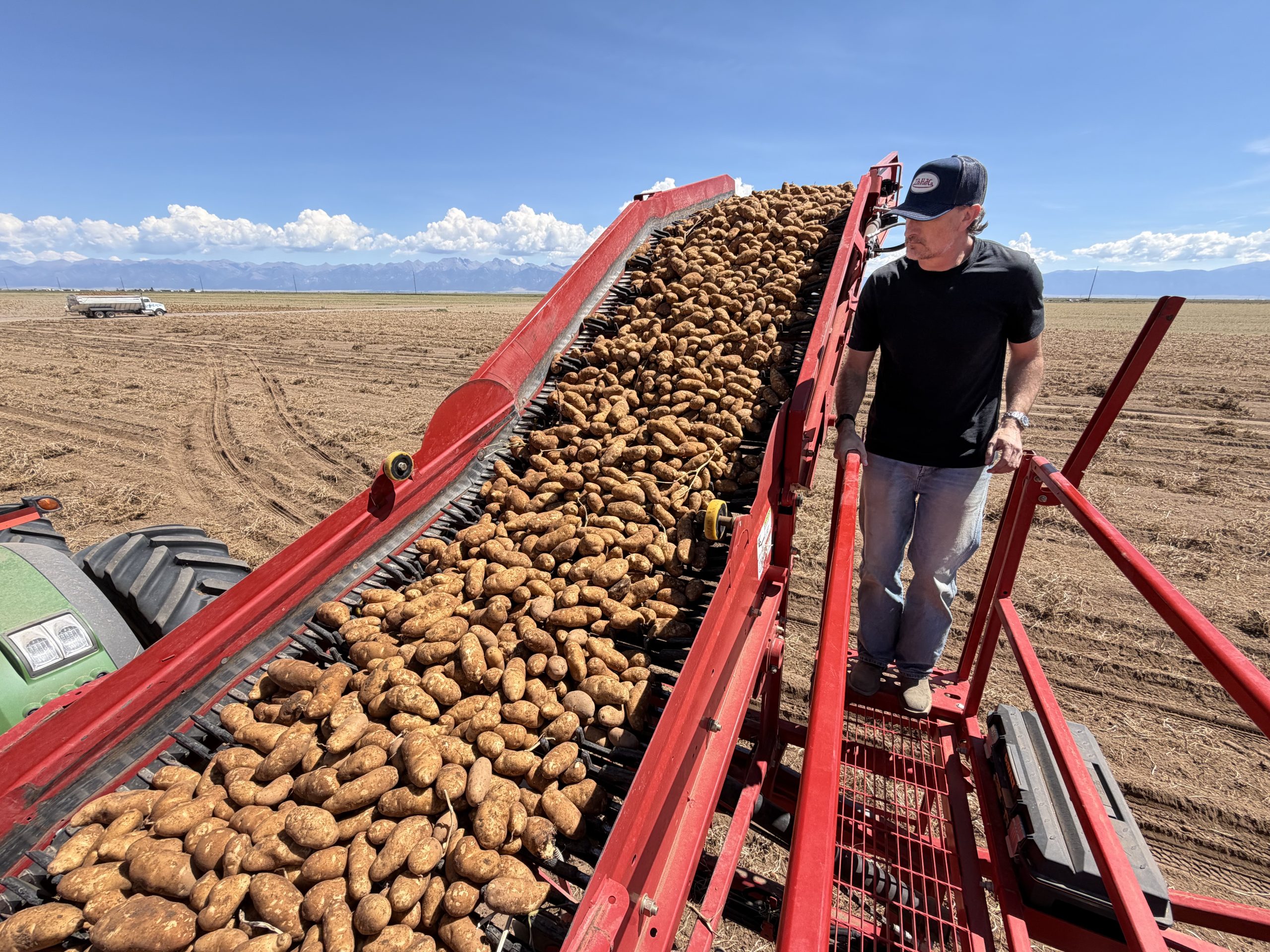
Asier Artaechevarria is ankle-deep in drifting sand and rows of freshly dug russet potatoes. He hits a phone in search of more drivers to fill an emergency order from Front Range grocery stores eager for the family farm’s first harvest of the summer.
The golden tubers tumble by the ton into the few trucks he has so far managed to assemble for the day, reminding everyone in this field why farming in view of the glorious Sangre de Cristos and Great Sand Dunes still offers days of seemingly limitless bounty.
But there is, actually, a limit.
For decades, the San Luis Valley has been shipping out its irreplaceable aquifer water one potato at a time. While the trucks are filling with moist potatoes, the aquifer is draining to levels widely expected to hit historic lows at this month’s official measurement.
Whether Artaechevarria’s family can run this harvest all over again next year, or the year after, or in decades to come, is very much in doubt. The local water conservation district is pushing a state-approved plan in water court that would charge a group of well-dependent farmers, including Artaechevarria, $500 an acre-foot for water, up from the current $150 and still more from the years-ago charge of $75. That’s a breaking point that many in the valley, even the rescue plan’s proponents, agree will change the valley’s historic farming economy and culture forever.
At the current price, the family’s well-pumping fees total $350,000 to $400,000 a year, the largest expense on the farm. The aquifer rescue plan now being mulled over by an Alamosa water court judge would more than triple that.
“I’ll be out of business, probably,” Artaechevarria said. “We just can’t make it under those terms. When that happens, you sell everything and you move on.”
Even giving up would come with a catch. At $500 an acre-foot for water to grow any crop, he added, “my land is also not worth anything. So I won’t be able to sell it.”
A once-grand river, worked to death
While high-profile special interests and advocates from Denver to Las Vegas to Los Angeles make noise about the crisis in Colorado River flows, the Rio Grande has quietly become one of the most troubled major rivers in the U.S.
Launched by snowmelt in the San Juan mountains on the San Luis Valley’s western rim, the Rio Grande used to draw strength from flowing sheets of groundwater just below the surface, known as the unconfined aquifer, as the river wound south toward New Mexico. Under long-established Colorado water law and interstate compacts, the “surface” or river water for the Rio Grande must deliver a set amount of water to the New Mexico border. The state engineer must curtail surface diversions of the river into canals if the compact minimum is threatened.
Farmers shut off from adequate surface water sank wells into the unconfined aquifer below.
But climate change and long-term drought have robbed the headwaters region of significant water. Farmers accelerated the drain by punching thousands of wells into the unconfined aquifer to water potatoes, barley, alfalfa and cattle.
When the Rio Grande started going completely dry for longer stretches in cities like Albuquerque and the Big Bend area, New Mexico and Texas came looking for water they said was theirs. Colorado legislators passed a law in 2004 meant to head off interstate water wars, and to shore up the unconfined aquifer to save a farming economy that brings hundreds of millions of dollars to the relatively low-income San Luis Valley. The legislation allowed local conservation districts to set up enforceable rules for restoration, and the Rio Grande Water Conservation District focused on Subdistrict 1, the northern valley where most of the potato farming happens.
The district set a benchmark year of 1976, before the steepest part of the drain began. Year Zero. Strategies to fix the unconfined aquifer included charging local farmers to pump water out of the ground or buying and drying farms that had surface water rights from canals fed by the Rio Grande.
The first few sets of plans didn’t help. Artaechevarria, the potato farmer who is also president of the breakaway Southern Colorado Water Conservancy District, says abundant water that used to sit just a few feet underground can now only be reached by wells drilled past 40 feet. The overarching Rio Grande Water Conservation District’s third amended plan, approved by water courts and the state engineer, says that by 2031, the unconfined aquifer needs to be restored to within 200,000 to 400,000 acre-feet of the 1976 benchmark.
The latest aquifer measurements show it is 1.3 million acre-feet below the benchmark. That’s a gap of more than 800,000 acre-feet, even after hotly controversial pumping fees and surface water buy-ups cut the district’s groundwater use by a third, to 200,000 acre-feet a year.
This story first appeared in Colorado Sunday, a premium magazine newsletter for members.
If the restoration targets aren’t reached within the next five years, state law empowers the water engineer to forcibly shut down wells, a prospect that prompts dystopian nightmares among farm families and their communities.
In the San Luis Valley, in the Republican River basin in northeastern Colorado that is also subject to water cuts from interstate compacts, and elsewhere in the state, “we’re dealing with conditions we’ve never seen before,” said State Engineer Jason Ullmann, who is responsible for assessing and enforcing water rights in Colorado.
A quarter-century of drought has left a “sense of urgency that has grown exponentially,” said Cleave Simpson, a state senator from Alamosa, a rancher and chief of the Rio Grande Water Conservation District that oversees the valley. The most draconian savings proposals are aimed at Subdistrict 1, the heart of potato farming in Colorado.
“We can be smart and engaged, and agriculture here will change incrementally,” Simpson said. “Or you can bury your head in the sand, keep doing what we’ve been doing for 100 years, and it will fundamentally change. … I lose sleep at night thinking about what will happen to my community in this space.”
The water district’s latest proposal, the fourth major amendment to the initial 2009 plan, filed with the water court, is a drastic and expensive shot at halting groundwater depletions. Farmers in Subdistrict 1 of the valley would have to replace each acre-foot of water pumped with surface water rights from the Rio Grande and its canals. If they have no surface water right for augmentation, their pumping fee will go to $500 an acre-foot from $150.
Simpson knows things get marginal at best for potato farmers without ditch and river rights at $500 an acre-foot. The Subdistrict 1 farmers supporting the district’s plan in water court are convinced the aquifer is at a crisis point, he said.
“Farmers get creative when they have to,” Simpson said.
Those who have water versus those who don’t
Artaechevarria’s splinter of farmers who rely more heavily on well water hired their own lawyer and argued the district leadership’s rescue plan was biased against them. The heated arguments played out for weeks this past July in a water court case the local news publication Alamosa Citizen called “the water trial of this century.”
In the fields around Hooper that his family controls, the looming water shortage has already arrived. Artaechevarria brushes sandy dirt from piles of ready-to-market russet potatoes and points to a fallowed area untouched by the August harvest.
“You can see here in this field, the other half is not potatoes. That’s set aside for soil health and rotation, because this field can no longer support that irrigation system for the full 120 acres, so it’s split into 60 acres,” Artaechevarria says.
Farming reality in the valley starts with “high and dry.” The San Luis Valley can count on only 6 or 7 inches of precipitation a year, compared with 12 to 15 inches in farming areas of the Eastern Plains. Only 2 to 3 inches comes to the valley during the growing season. Potatoes need about 20 inches of water by harvest time.
“It doesn’t matter to the plant whether it comes from the sky or the aquifer,” Artaechevarria said. “But 3 inches of rain in October does nothing for a crop that came out of the ground in August. In a year when that in-season rain shows up, we pump 17 or 18 inches. In a year like this one, when it doesn’t, we pump all 20.”
The valley floor didn’t get any snow this past winter, he explains. Then the spring rains, which can presoak the soil and save up to 10% of water needs later in the season, never showed.
On this particular piece of land, he said, “there’s just no other source of irrigation.”
Where Artaechevarria’s harvester and trucks are rumbling, the top of the confined unconfined aquifer water table now sits about 40 feet underground, with his wells piercing about 110 feet for reliability.
“In the mid-’80s, the water table was 2 feet,” he said.
The family’s 85-year-old patriarch enjoyed those higher water tables starting in 1975. Jose Artaechevarria came to Colorado from the Basque region of Spain as one of many shepherds from overseas who found work in the high meadows looking down on the San Luis Valley. He raised enough money and found a partner to start a feedlot in Longmont, then decided to come back to the valley and establish a potato farm.
Asier Artaechevarria drops potatoes onto a conveyor belt and points at a hangar-size shed to the west. The shed can hold 100,000, 100-pound sacks of potatoes, part of the family’s Anaiak Farms overall storage capacity of 500,000 sacks. It’s not just the harvesters and truck drivers who go unemployed when fields are fallowed for lack of water, Artaechevarria notes. The coalition of farmers objecting to the official water savings proposal have counted up about 500 employees in Saguache County doing potato work ranging from day labor harvesting to packing and shipping warehouses. In a county holding fewer than 7,000 people.
Artaechevarria left the valley for years, to get a finance degree at the University of Colorado in Boulder and then to work more than a decade as a commodities trader and analyst in New York. He’s comfortable arguing the numbers about who’s responsible for draining the local aquifer, and who should pay what to start fixing it.
“The drop in the aquifer was created by users that didn’t change their practices during the drought, people who could no longer import surface water and made up that difference by pumping from the aquifer,” he said. “The people who’d always used the aquifer didn’t increase their use. So the people with the surface water caused 80% of the problem.”
The farmers in the splinter group only caused about 20% of the problem, their attorneys argued in water court. And yet the district’s proposal, Artaechevarria said, “requires that we cut back 80%, and everybody else cuts back 20%. That’s it in a nutshell. That’s just not fair.”
New Mexico farmers will be making the same arguments in coming years, as climate change and the worst southwestern drought in 1,000 years robs more and more water from the Rio Grande Basin. New Mexico snowpack contributions to the river have dropped 17% since 2000, Source New Mexico reports, and federal water officials expect average temperatures to heat up another 4 to 10 degrees by 2100.
To resolve the conflicts with downriver Texas, New Mexico farmers are required to cut back on well pumping to leave more water in the aquifer and river. Scenes last week of flooding from late-season monsoons along the Rio Grande may offer hope of temporary relief, but the long-term trends are dire.
Farmers everywhere know they must contribute to water savings, Asier Artaechevarria said.
“Everybody knows there needs to be cutbacks. It’s who is bearing the burden of those cutbacks.”
Seeking the sweet spot in a volatile climate
Perfect potatoes thrive in a narrow band of weather and geography that the valley has supplied for hundreds of years. Between 40-degree chills at night on the high valley floor, and 80-degree sun in the daytime, the proper sugars move up and down the potato plant like mercury in a thermometer. At 90 degrees, which the valley like the rest of Colorado is seeing more of, growth turns sluggish.
Raising the aquifer demands a similar search for the perfect numbers. The district needs to limit groundwater pumping to only the amount equal to what is pulled off the Rio Grande each year into irrigation canals, Simpson says. If that number balances, then the aquifer will recharge from natural flows that come down off the surrounding mountains’ snowmelt and leak underground at the edges of the valley.
The price per acre-foot of pumped water forces the next round of calculations. Farmers of small grains like sorghum or rye can only afford $200 to $250 an acre-foot for water, Simpson said. “Sometimes, you can raise potatoes here and pay 300, 400, maybe even 500 bucks and still be economically viable,” he said.
It’s a bigger number, all the sprinkler-irrigated farmland in the valley, that disturbs Simpson’s sleep. If the water court doesn’t approve the fourth amended proposal, there’s no clear path to progress, he says, and the state engineer then won’t approve the district’s annual water use plan.
“Which then shuts down irrigation on 160,000 acres of groundwater-irrigated farmland,” Simpson said. “He has that obligation and that duty.”
As isolated as the valley can feel, a four-hour drive from Denver, politicians have been trying to help. In 2022, the state legislature sent $60 million to divide among the San Luis Valley and the Republican River basin to buy up water rights to meet conservation mandates. Simpson and allies had asked for $100 million.
“That bill passed every committee, every vote, every chamber, everywhere, without a single ‘no’ anywhere,” Simpson said. “There certainly is a recognition of the challenges here.”
Retiring irrigated land in the valley has also been sped along by the federal Conservation Reserve Enhancement Program, which pays farmers to set aside eroded or otherwise compromised acres.
While the proposed fix appears punishing to the farmers relying on groundwater, it also resets the clock in a way that could prove an enormous gift for the entire valley. The currently approved operating plans that are proving inadequate to the task mandate 2031 for raising the aquifer to a set benchmark — a level it hasn’t reached since 2010.
The proposal in water court sets a much murkier adequate-progress standard each year, and gives another 20 years for the valley farmers to get there by their own design.
The new plan would allow valley farmers to “determine their own future,” state engineer Ullmann said.
That’s a worthy goal, Artaechevarria responds. It’s just that the narrative of the valley’s water problems has been dominated by accusations aimed at farms with wells and pumps.
“That we’re somehow not wanting to cut back, or not wanting to protect the aquifer, and none of that is true,” he said.
In the July water court “trial of the century,” Artaechevarria and other members of their splinter group were called to testify. Strains in valley relationships became part of the official record.
“I had a few farmers telling me, ‘I’m third, fourth generation,’” retired local farmer Ernie Myers testified, quoted in the Alamosa Citizen. “‘You’re a newcomer. You came in ’73 with your father. You have no right to do what you’re doing.’”
The future of the aquifer draining away, versus the establishment’s plan to save it, are each “just as bad,” Artaechevarria says now. “Either one puts me out of business.”