
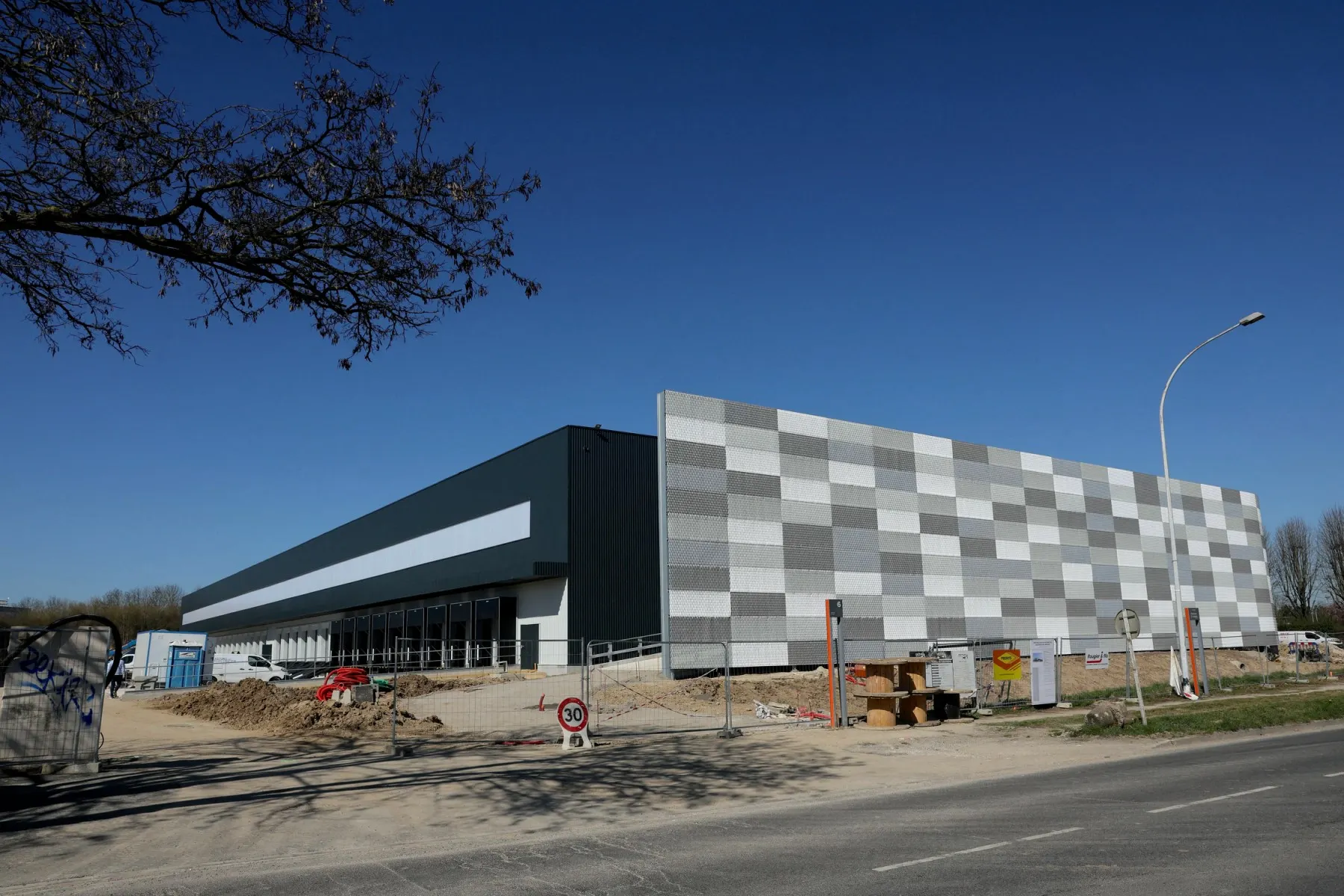
Opposition grows as France plans wave of giant data centres

Around 80 data centre projects – including one billed as Europe’s largest – are hoping to connect to France’s power grid – but local opposition is growing.
The ‘Campus IA’ project at Fouju in the greater Paris region – billed as the largest data centre project currently underway in Europe – has become a battleground for the issue of data centre construction.
The €50 billion project, backed by MGX (an Emirati investment fund), Bpifrance (France’s public investment bank), Mistral AI and Nvidia, is planned for the small village of Fouju – population 600 – located in the middle of an agricultural area in the Seine-et-Marne département.
Plans include an 11-building complex on 90 hectares, with a power demand of 1.4 gigwatts at full capacity, according to RTE figures reported by Radio France – that’s roughly the output of a large nuclear reactor.
Opponents are set to file two legal challenges, according to business newspaper Les Échos, targeting the change to local planning rules made for the project and its environmental study.
The Fouju project also faces a petition, signed by nearly 70,000 people by late September, objecting to its “colossal electricity consumption, sacrificed farmland, a devastated rural landscape, depleted resources, and pollution that will affect the water, air, soil, and health of local residents.”
But although it’s the largest, the Fouju site is just one of many AI data centre projects currently being considered in France.
By May 2026, the country’s grid operator RTE (Réseau de Transport d’Électricité) said it had reserved close to 18 gigawatts of grid capacity for around 80 data centre projects – up from around 40 projects totalling 5 gigawatts at the end of 2024.
Not all are dedicated to AI – around three-quarters are “colocation” centres, which rent space and power to several companies. It’s also worth noting that ‘reserving’ means booking space on the electricity grid in advance – but it’s only a ‘reservation’; it doesn’t mean every project that reserves capacity will be built.
Nevertheless, the proposed projects could constitute a huge addition to the nation’s data centre network – and would demand a significant amount of energy from the grid.
There are currently around 300 existing data centres in France, collectively using about 10 terawatt-hours of electricity a year – around 2 percent of national consumption.
According to RTE’s forecasts, this will rise to between 23 and 28 terawatt-hours by 2035 – about 4 percent of the country’s consumption.
RTE assumes not every project will go ahead, and those that do will increase their power use gradually.
Where could France’s new data centres be built?
Around three-quarters of the power reserved so far is for projects in the Paris region and Hauts-de-France, France’s former industrial heartland in the north east.
In May, Japanese tech investment group SoftBank announced it would invest up to €75 billion in 5 gigawatts of AI data centre capacity in France.
The first phase, worth €45 billion, covers three sites in Hauts-de-France – Loon-Plage near Dunkirk, Bosquel and Bouchain – and is due to be completed by 2031.
The largest project by land area announced so far is Google’s planned campus at Étrechet – a village of around 1,000 people near Châteauroux in the Indre – which would cover around 195 hectares with eight to ten buildings.
RTE does not publish the locations of individual projects, but other projects reported so far include:
In the Paris region: Dugny (Seine-Saint-Denis), where Digital Realty is building three data centres; Le Bourget (Seine-Saint-Denis), where a petition against a new data centre gathered more signatures than the town has residents; Montereau (Seine-et-Marne), where OpCore plans a 400-megawatt AI site; and Villebon-sur-Yvette and Les Ulis (Essonne).
In Hauts-de-France: Cambrai (Nord), where Data4 plans a 1-gigawatt site on a former airbase, and Escaudain (Nord), where it plans a 700-megawatt campus on a former industrial site.
Elsewhere in France: Petit-Landau near Mulhouse (Haut-Rhin), where residents protested in June against a planned Microsoft data centre; Rovaltain near Valence (Drôme), where opponents have gone to court; Bordeaux, where the city has scrapped the planned site for a 250-megawatt AI campus but is looking for another; and Dardilly near Lyon, where local reports say work on an 18-megawatt AI data centre was due to start in September.
Growing opposition
Opposition to many of these sites is growing, with local collectives forming on social media and petitions being launched.
One of the most dramatic protests so far has been in Étrechet, where three deputy mayors and a councillor resigned on September 10th, followed by the mayor on September 15th, saying they had no real say over Google’s proposed project.
“We can no longer remain in office nor take responsibility for a project that contradicts our deepest convictions,” deputy mayor Marie-Pierre Chabenat-Canals told Le Monde, citing the visual impact, water resources and strain on the grid.
Meanwhile, a petition by the collective “Ozans dire non,” opposing the same project, had gathered almost 20,000 signatures by late September 2026.
Opposition to Google’s proposed AI centre in Châteauroux has led to the launch of a petition.
Government backing
The government, however, continues to back the projects.
“Building data centres on our soil is a priority, serving our digital sovereignty,” said Anne Le Hénanff, France’s junior minister for AI and digital affairs, in a statement.
In April, Macron was reported by French radio station, Alouette, to have added Étrechet to a list of 150 ‘strategic industrial projects’ – before Google had even confirmed it would build there.
In a LinkedIn post, Gil Avérous, mayor of Châteauroux and president of Châteauroux Métropole, called the project “a historic opportunity” for the area, and told radio station Ici it will create nearly 1,000 direct and indirect jobs.
Developer Data4 has also presented its proposed €5 billion campus at Escaudain in the Nord, as a way to help regenerate a historic industrial region.
What next?
There is no single body deciding which of the 80 projects go ahead.
Each one needs a grid connection from RTE, planning permission and, for most, an environmental authorisation from the local préfecture – and these decisions can be challenged in court.
That said, projects classed as being of “major national interest”, like the one in Fouju, benefit from a fast-track procedure that allows the state to override some local planning rules.
The courts will then examine the challenges against the Fouju project, a process that can take a year or more.
Meanwhile, a public consultation on Google’s project near Châteauroux is due to open this autumn, with details on how to take part published on the website of France’s public debate commission, the CNDP.