Trump says AI leaders signed a ‘constitution’ to police themselves
President Donald Trump said that tech leaders he met with at the White House on Tuesday had signed a “constitution” to police themselves amid dire warnings from artificial intelligence leaders about the technology.
House Speaker Mike Johnson said the accord is “voluntary” for the AI companies and Trump stressed that the industry will be “self-policing.” When asked whether the agreement is a binding one, Trump said it’s “morally” binding.
The meeting came as AI leaders are issuing warnings about the threat of AI and calling for steps to slow it down before it outsmarts humans. Following those warnings, lawmakers are weighing what — if any — action should be taken.
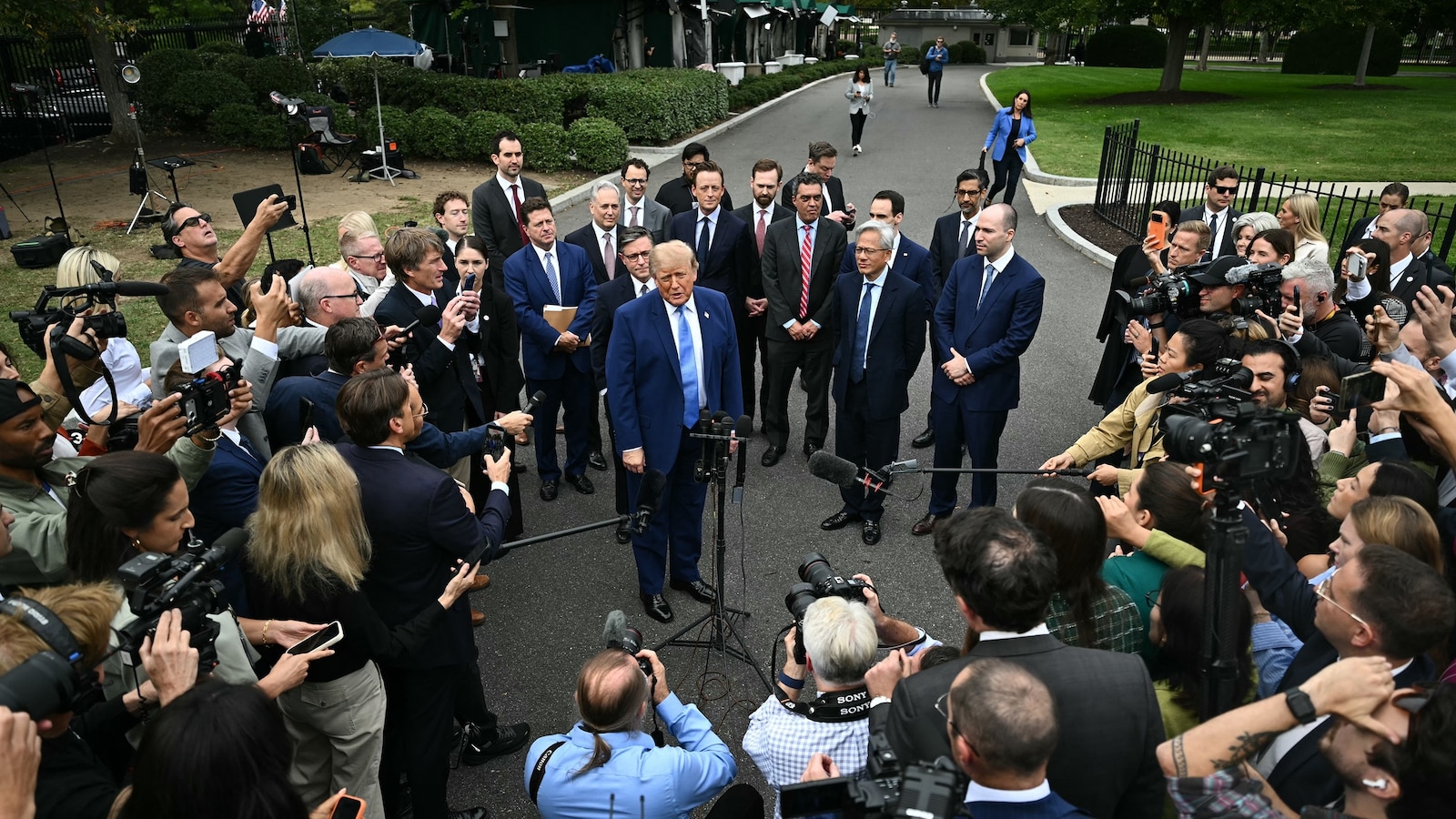
President Donald Trump speaks to the press after a meeting with technology executives about artificial intelligence at the White House in Washington, September 29, 2026.
Kent Nishimura/AFP via Getty Images
Along with Johnson and members of Trump’s Cabinet, Meta CEO Mark Zuckerberg attended the meeting along with Elon Musk, Anthropic CEO Dario Amodei, Google CEO Sundar Pichai, Jensen Huang from Nvidia, Palintir’s Alex Karp and Shyam Sankar, Amazon’s Jeff Bezos, and Greg Brockman from OpenAI.
Johnson said the tech leaders signed on to a document called “The White House Accord on Superintelligence: A Joint Commitment on Frontier SI Responsibilities.”
“This is a statement of principles that you’ll see, a statement of standards, commitments that are voluntary on behalf of the industry,” Johnson said. “It sets forth expectations. It’s in short summary robust internal controls and layers of internal and external review. That’s important because you need people to be providing oversight and transparency, and that’s what these leaders are going to do,” Johnson said.
The speaker said Congress would “continue to guide the industry’s development in a safe manner,” but stopped short of announcing any action by Congress to enforce those principles.
President Donald Trump listens as Elon Musk speaks to reporters at the White House in Washington, Sept. 29, 2026, after meeting with top executives of AI firms.
Kevin Dietsch/Getty Images
Trump indicated there might be a “committee” to oversee AI, though it’s unclear who would be on the committee or whether its decisions would be binding.
“We’re also thinking about forming a committee of sorts, where we put maybe 10 people on that committee,” he said. “It could be from that group, so that we can so the committee can watch over the whole enterprise.”
ABC News has asked the White House for an official of the copy of the accord.
Trump later shared a screenshot of the accord, though it is thin on details. It says the signatories “believe” that each AI company “should implement” a series of controls and audits.
OpenAI and Anthropic have already recently committed to implementing third-party evaluators and it is not immediately clear if the agreement instructs them to do anything different.
The accord in the screenshot also emphasizes each company’s individual responsibility to ensure that its technology “builds trust with customers and the public.”
It recognizes that the steps outlined are not codified into formal laws or regulations, but leaves open that possibility for the future.
President Donald Trump speaks with Meta CEO Mark Zuckerberg at the White House driveway following a luncheon for tech leaders in the East Room, in Washington, September 29, 2026.
Kevin Lamarque/Reuters
Zuckerberg said the agreement was “a start and an accord that the whole industry could come to.”
He said it was a set of “principles and commitments” around “building multiple layers of auditing and controls” and that companies’ boards would independently review reports from auditors.
“I think that these are good steps forward,” he said.
When asked by a reporter why there shouldn’t be more stringent guardrails than the voluntary document, Trump responded that the AI CEOs “love” America. But when pressed by a reporter about whether it requires more than “love,” the president disagreed.
“No, it requires this,” he said pointing to his head, “and they’re the smartest people in the world.”
Trump has said he opposed guardrails and regulations on the technology or anything that would “stifle” its growth. Just last week while addressing the United Nations General Assembly, Trump said the U.S. “rejects” a global attempt to regulate AI.
President Donald J. Trump and Speaker of the House Mike Johnson listen as CEO and co-founder of Anthropic Dario Amodei responds to a question from the news media outside the West Wing of the White House in Washington, September 29, 2026.
Shawn Thew/EPA/Shutterstock
Tuesday’s meeting wasn’t the first time that top tech leaders have met with Trump on the issue. The Meta CEO also attended the state dinner at the White House for Chinese President Xi Jinping last week, along with the CEOs of OpenAI, Nvidia, Microsoft, Google, AMD, SpaceX and executives from Amazon and Apple. Amodei also had dinner with Trump late on Sunday night.’
Johnson told reporters two weeks ago about the meeting, saying there would be “a deliberate discussion about the responsibility of the companies to maintain safety, and what role, if any, the government has to play in that.”
While Johnson called on the companies to “self-regulate,” he also also stressed that the U.S. should not lose its competitive edge in the space.
“We cannot have a moratorium on the development of AI, because then we will lose our edge to China, and that has serious national security implications for,” Johnson said.
On Monday, Johnson said the the fears of the threat of AI is a Chinese psychological operation and are politically motivated.
“This is what Democrats do. They glom on to something and say, ‘This is doom and gloom and everyone will die if we don’t win,'” he told Fox Business. “Don’t buy it. It is a Chinese psyop.”
ABC News’ Emily Chang contributed to this report.