
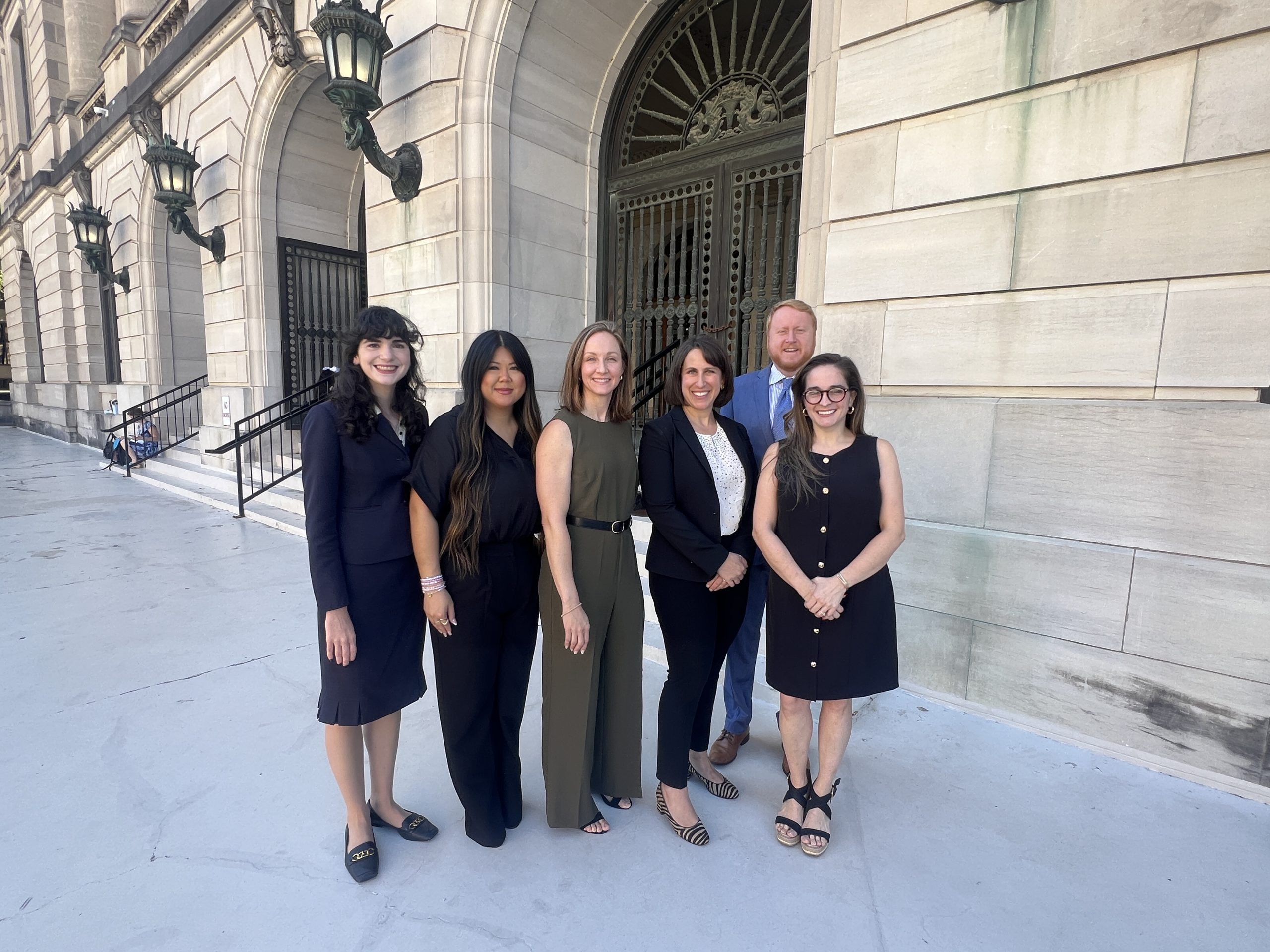
First hearing held in challenge to Arkansas’ abortion ban
How is a doctor supposed to know when it’s okay to perform an abortion under Arkansas’ near-total abortion ban?
That question was at the center of Monday’s hearing in Pulaski County Circuit Court, where Judge Cara Connors heard arguments over whether to dismiss a lawsuit, Waldorf vs. Arkansas, challenging the state’s ban.
In what was the longest volley in the two-plus-hour hearing, Connors repeatedly pressed the state’s attorney on what concrete guidance the law gives doctors in deciding whether an abortion is necessary to save a pregnant patient’s life. Connors also questioned whether a doctor could later be second-guessed by a jury for making that decision.
The Waldorf case is brought by seven plaintiffs, including six patients and one OB-GYN. The case hinges on whether the state’s near-total abortion ban — which took effect in 2022 after the U.S. Supreme Court overturned Roe v. Wade — violates pregnant individuals’ rights to life, liberty and the pursuit of happiness under Arkansas’s state constitution. The case also contends that the law’s “life of the mother” language is unconstitutionally vague, among other arguments.
The state was represented by Autumn Hamit Patterson, who was appointed Solicitor General in February 2025. Throughout her nearly hour-long argument, Patterson made multiple mentions of one plaintiff’s decision to get an abortion to pursue her “creative vision,” pointing repeatedly to the circumstances of plaintiff Kishaya Holloway. Holloway, a working artist who was added to the lawsuit in April, sought an abortion because, as she’s publicly stated, she did not want to have kids. Other plaintiffs sought abortions after sexual assault or for ectopic pregnancies, among other circumstances.
The state started its arguments by addressing the issue of sovereign immunity, which Patterson argued protects the state and its officials from lawsuits. The state contends that Gov. Sarah Huckabee Sanders, Attorney General Tim Griffin and members of the Arkansas State Medical Board — all defendants in the case — cannot be sued because they do not directly enforce the abortion ban.
Connors pushed the state on these arguments. “You would agree the attorney general has enforcement powers,” Connors said, also questioned Patterson about whether the Medical Board could revoke a doctor’s license after a conviction.
Molly Duane, lead counsel for the plaintiffs, argued that the Arkansas Supreme Court has long allowed exceptions to sovereign immunity in certain cases and that this case fits the pattern of that exception.
From there, the state moved on to the plaintiffs’ three constitutional claims, which concern the inalienable rights protected in Arkansas’s state constitution, equal treatment under the U.S. Constitution and the abortion ban’s vague language regarding medical exceptions.
On Arkansas’s constitutional protections for life, liberty and happiness, Patterson argued the judge should interpret those words based on what they meant at the time the constitution was adopted, noting that Arkansas restricted abortion during early statehood.
“They are arguing for an expansive definition of the life and liberty provision to include the right to abortion on demand and the right to pursue their happiness as they see fit,” Patterson said of the plaintiffs’ case.
Arkansas’ first abortion law, enacted in 1837, prohibited abortion after “quickening” — an antiquated term that refers to when fetal movement could be detected. In 1875, the state’s abortion laws were expanded to prohibit abortion before quickening as well.
Connors asked the state’s attorney whether this did not mean, in fact, that Arkansans had possessed some right to abortion during this time period.
“You would agree historically at that point, at least in the 1830s, that there was a right to an abortion?” Connors asked.
Patterson said there was no “positive” right to the procedure.
Duane meanwhile urged Connors to apply the “plain meaning” of constitutional rights. She noted that Arkansans have even more expansive inalienable rights than those laid out in the U.S. Constitution and that Connors should look to other states, like Kansas, that have ruled abortion restrictions violate the rights of pregnant individuals.
Unconstitutionally vague?
The issue that drew Connors’ sharpest questions was over whether the abortion ban’s medical exception for the life of the mother is too vague for doctors to follow and therefore unconstitutional.
The abortion law allows a narrow exception for an abortion to be performed “to save the life of a pregnant woman in a medical emergency.” A 2025 amendment to the law sought to clarify the language, defining a medical emergency as one determined by “reasonable medical judgment” as made by a qualified physician familiar with the patient’s case.
Connors repeatedly asked Patterson what concrete guidance or parameters doctors can consult when deciding what counts as reasonable judgment.
“What in the law says that this is reasonable? What definition in the statute sets out what those parameters are?” Connors said.
Duane argued that the law’s uncertainty was already threatening lives, pointing to Waldorf’s complaint. Waldorf, a Fayetteville woman, was left in medical limbo in a local hospital after her water broke 17 weeks into pregnancy and doctors and lawyers debated over whether she was sick enough to have an abortion. Waldorf paid out-of-pocket to take an ambulance across state lines to Kansas, where the procedure was performed.
“Looking to Miss Waldorf’s allegations,” Duane said, “neither her doctors nor the hospital general counsel knew when, in the progression of her condition to a cervical insufficiency, the risk of infection was high enough when abortion was necessary to preserve her life.”
Duane said roughly one in five Arkansans is of reproductive age (about 600,000 women, according to the complaint), yet no abortions were reported to the state in 2025. She argued that these statistics show that the threat of prosecution is “chilling otherwise necessary medical care.”
Toward the end of the hearing, Connors noted that ruling on abortion cases from the perspective of an inalienable right to life possessed by the pregnant person marks a shift in how abortion cases are handled. Roe v. Wade centered on a woman’s right to privacy, not an inalienable right to life.
“Essentially the fundamental right here is not the right to an abortion,” Connors said, “but in fact a right to life that is being jeopardized by this statute by criminalizing a doctor that that would typically have the autonomy to perform an abortion where they deem it necessary under a medical emergency circumstance, or without the fear of arrest.”
Following more than two hours of arguments, Connors said she would take the state’s motion to dismiss under advisement and issue a written opinion.
Duane said she was hopeful that Connors would allow the case to proceed. “I am very hopeful that she will allow the case to proceed and that we can finally move forward to an evidentiary hearing,” she said.
Source link