They served their time in prison. Then the bills arrived.
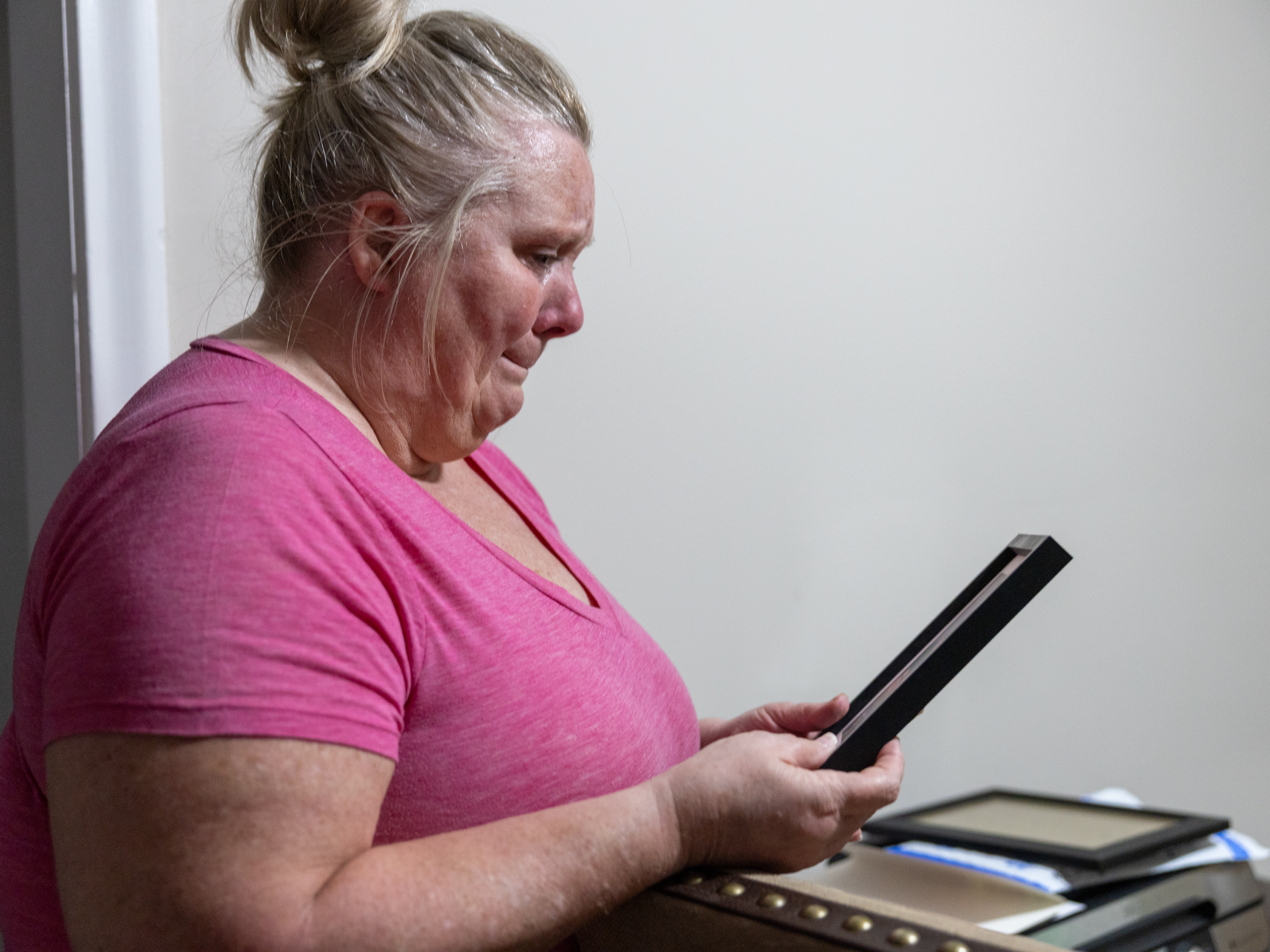
When Tracy DeSenti’s husband died in 2023, she was so distraught, she barely got off the couch for weeks. She showered only after her adult sons threatened to spray her with a garden hose.
In the midst of her grief, as she learned to pay bills on her own and returned to work as an addiction counselor, a letter arrived from the state. Connecticut was demanding part of the inheritance she expected to receive from her husband’s estate.
DeSenti, 57, and her husband Billy DeSenti met in 2008, soon after they were released from prison, at a post-incarceration program in New Haven. The two had spent years in prison on a variety of drug and — in Billy’s case — assault and larceny charges that stretched back to the early 1990s, but in the 15 years that followed, they turned their lives around. They found work. They volunteered in their community.
And they bought a house for $266,500 — a 1959 split-level in North Branford where they installed a saltwater pool soon after moving in, a back porch Bill DeSenti rebuilt with teak wood, a charming fireplace in the family room where they put in a “ridiculous leather couch” as a celebration for their accomplishments. DeSenti describes it as the first “fancy” thing she ever bought.
They loved that house, and to them, being home felt like being on vacation, said DeSenti, who was first on her own at 13 and was arrested for the first time as an adult in her 20s.
But now Billy was dead, and the state of Connecticut said he owed $232,733 for room and board during his earlier prison stay. Selling the house where DeSenti now lived alone would help satisfy that debt.
“It felt like we were being punished all over again, despite everything we had just accomplished,” DeSenti told the court in 2024, as she begged to keep the house.
In the end, the state Department of Administrative Services — which serves as the state’s collection agency — successfully argued that DeSenti needed to sell the home she’d lived in for nearly 10 years to satisfy what ultimately amounted to roughly $21,000 of her husband’s debt. Probate court took the property, and DeSenti was then locked out of the house, unable to even finish moving out.
She now lives in a house where the rent is more than double the monthly cost of her old mortgage.
DeSenti’s experience is not unique. She is one of hundreds of Connecticut residents who have had money seized in the last five years through a state law that dates back more than three decades. That law enables the Connecticut Department of Correction to charge a fee for every day a person spends in prison and then collect on that debt in certain situations.
If a formerly incarcerated person wins the lottery, for example, collects an inheritance or receives certain lawsuit settlements, the state can take up to half the money to satisfy the debt.
The same is true in cases where a former prisoner dies and leaves money or other assets to their children, spouses and heirs.
Other states and the federal government have similar laws on the books, commonly referred to as “pay to stay” statutes, but Connecticut’s is one of the harshest, a Connecticut Mirror investigation has found. That’s because the daily cost that Connecticut bills to prisoners is one of the highest in the country.
The state has charged as much as $347 per day, meaning anyone who was imprisoned for a year in Connecticut racked up a tab of nearly $127,000. The state can collect on that debt for up to two decades after people are released from prison.
CT Mirror reviewed hundreds of cases filed from 2020 to 2026 in which the state sought to collect on prison debts in recent years and interviewed more than a dozen people who were forced to pay for previous prison stays either for themselves or their family members. In total, the state collected about $21 million from 2020 to mid-2026.
That reporting revealed that the state frequently seizes money from legal settlements stemming from medical malpractice, police brutality, workplace injury and other wrongful death lawsuits.
In one such case, Connecticut officials collected a prison debt from a man whose 1-year-old son died while in state foster care. With one hand, the state paid $2 million to compensate the family for the child’s death, and with the other, it demanded the father pay back more than $84,000 for his time in prison.
The CT Mirror also documented numerous cases, like DeSenti’s, in which people were forced to sell their homes to satisfy the so-called incarceration liens.
In recent years, there has been a growing movement to repeal such laws because of the harm they can cause to former prisoners, who often make up some of the poorest rungs of American society.
Connecticut’s pay-to-stay statute has been revised several times over the past decade and has been challenged in federal court. But the system has continued.
Dan Barrett, the legal director for the ACLU of Connecticut, said the daily cost that Connecticut assigns to prisoners is “unspeakably high.” It’s more than double what the federal government can charge.
“It builds so quickly that you can reach astronomical numbers within a comparatively short amount of time,” Barrett said.
Officials with DAS said they rely on the DOC to tell them how much each person owes. Meanwhile, officials with the DOC said the collection process is the responsibility of DAS.
The result is a complex system that can be difficult to understand and that many people don’t even know exists.
The DOC did not respond to repeated requests for an interview over the course of more than three months.
Additional punishment
Since 2020, Connecticut has sought to collect prison debts from roughly 500 people each year, according to state data, and on average, the state recovered roughly $3.3 million annually through those collection efforts.
Proponents of the law said that money helps balance the state budget in the face of an expensive prison system and encourages more accountability for people who commit crimes.
Critics point out that the amount of money the state collects is negligible compared to the state’s overall finances. It’s roughly 0.006% of the state’s yearly operating budget, and less than 0.5% of what the DOC spends to run and maintain the state’s corrections system each year.
Prison liens made up a tiny share of General Fund spending
The entire grid represents state General Fund spending. Each
square represents 0.01%.
0.016%
Prison lien collections equaled just
0.016% of General Fund spending
from 2020 to 2025.
2020 to 2025, and that money goes into the state’s General Fund. General Fund spending totaled $125.3
billion during the same period.
Sources: Connecticut Office of the State Comptroller and state
prison lien collection records.
By: Ginny Monk / CT Mirror
But for the people who are forced to turn over money and assets to the state, the claims can represent a painful financial loss.
Criminal justice advocates have argued for years that the state’s prison debt system makes it harder for formerly incarcerated people to reintegrate into society. And they’ve said it perpetuates intergenerational poverty among the families of people who have been to prison — making it next to impossible for them to inherit money or pass on wealth to their children.
Lisa Foster, a co-founder of the Fines and Fees Justice Center, said laws like Connecticut’s seem to exist solely to stack another punishment onto people. It doesn’t matter if they’ve served their sentence and paid their debt to society, she said.
“It’s not the way we should be running the criminal justice system. It’s a regressive tax,” said Foster, a former California Superior Court judge.
Several lawyers and law professors pointed out that people who are sentenced to prison in Connecticut are not notified ahead of time about the massive debts they will accrue while they are behind bars, not even when they are pleading guilty to a crime.
Almost all of the people the CT Mirror interviewed said they were completely unaware they owed money to the state until a lien was filed against them in probate court.
When DeSenti learned of the debt hanging over her head, she said it felt like she was being sentenced all over again.
“They are still judging me for something that happened 20 years ago. I’m a different person,” DeSenti said.
The John Gottis of the world
Connecticut’s history of charging people for their incarceration began in 1995 — an era during which the state’s prison population was exploding and lawmakers from both political parties were eager to show that they were tough on crime.
State legislators passed a law that year instructing the DOC to assess a daily cost to every person behind bars. In subsequent years, they clarified how the state would collect those debts.
The elected officials who championed the original legislation said the goal was two-fold. The state, they argued, could offset the price of incarcerating tens of thousands of Connecticut residents. And anyone who was serving a prison sentence would be forced to come to grips with the full cost of their crimes.
“It’s more than just fundamental fairness that we’re talking about in trying to get people who are incarcerated in our corrections facilities to help pay some of the way for their own freight,” Sen. John Kissel, R-Enfield, told his colleagues on the Senate floor in June 1995. Kissel did not respond to requests for comment.
“It also helps to make them more responsible citizens and learning that they have to pay for … their keep and pay for the crimes that they commit,” added former Sen. Brian McDermott, D-Wallingford, at the time.
Michael Lawlor, who served as the Democratic chair of the House’s Judiciary Committee from 1995 to 2011, said the passage of the law coincided with Republican Gov. John G. Rowland’s first term as governor.
Crime was one of the biggest issues during the 1994 gubernatorial election, Lawlor said, and Rowland made crime a centerpiece of his campaign that year.
“The early ’90s was the peak of crime nationwide and here in Connecticut,” Lawlor, who is now a criminal justice professor at the University of New Haven, told the CT Mirror. “So crime in general, the response to crime, was among the hottest of hot political topics at the time.”
As the bill sailed through the Republican-led Senate and Democratic-controlled House, very few lawmakers raised questions about the legislation.
Sen. Biagio Ciotto, D-Wethersfield, asked whether it was actually feasible to collect money from formerly incarcerated individuals who already had trouble paying their court fines.
“Most of these people don’t have two nickels to rub together,” Ciotto, who ultimately voted for the bill, said at the time.
The Connecticut Civil Liberties Union, a precursor to the CT ACLU, was one of the only groups that testified against the bill, arguing that the law would add “substantial additional monetary penalties” on top of the criminal sentences handed down in court.
Most of Connecticut’s elected leaders did not share those concerns, however.
During a public hearing on the bill, U.S. Sen. Richard Blumenthal, who was then the state’s Democratic Attorney General, noted that several other states and the federal government had passed similar legislation. He also referenced former New York mob boss John Gotti, who was serving a federal sentence for murder, racketeering and tax evasion, to emphasize the effectiveness and need for such legislation.
“John Gotti is paying for the cost of his incarceration right now in the federal penitentiary. It is a very workable concept,” added Blumenthal, who declined through his spokesman to be interviewed for this story.
More than 30 years later, most of the people the state is collecting money from have very little in common with The Dapper Don and other famous mobsters.
Blood from a stone
Up until about a year ago, Mark Mullen had a stable routine: He exercised, he cared for his mother, and he worked at a nearby gas station.
He only earned about $28,000 a year, but he wanted to spend more time at home taking care of his ailing mother.
After his mom died in November 2025, Mullen got a letter from the state telling him he owed more than $50,000 for his year of incarceration. He’d been sent to prison in 2009 after multiple drunken driving offenses.
He’s been sober for nearly a decade.
Mullen and his brothers will have to sell their mother’s house to pay part of this debt. Mullen fears he will lose out on money he could have used to start his own landscaping business.
He attempted a few times to call DAS to work out a payment plan that would potentially allow him to keep the house or negotiate the amount he owes — to no avail.
“I’m just trying to survive. I wish I could say ‘I got a house, I got a 401k. I got this, and I got that.’ I don’t. I have none of it,” Mullen said.
While $50,000 hardly registers in the state’s $28 billion budget, for Mullen, it represents more than a year of income.
“I would even go as far to say it’s a life-changing amount,” Mullen said.
Many of the people whom the state has collected money from in recent years are like Mullen — lower-income individuals who stand to inherit modest amounts of money.
The vast majority of people the state pursues for prison liens, however, have even less.
Since 2020, the state received nothing from roughly 72% of the liens that DAS filed in probate court. That is because in many cases, probate judges determined there was nothing left in the estates after funeral costs and other debts were paid.
Barrett, the legal director for the ACLU, said that fact highlights how little most people have after leaving prison. “This is trying to squeeze blood from a stone,” he said.
The cases that seem to reliably yield larger amounts of money for the state are instances in which people are forced to turn over legal settlements they won in court.
It’s unclear how much the state spends each year calculating everyone’s prison debt and tracking hundreds of cases through the state’s probate courts. DAS officials said the agency has never conducted a study to determine if the state collects more money than it spends.
It should not come as a surprise, however, that the state ends up empty-handed in most cases. Lawmakers were warned as far back as 1990 that extracting money from the state’s incarcerated population would not be a lucrative endeavor.
Larry Meachum, the state’s DOC commissioner at the time, submitted a report to the legislature that found that most people who were sentenced to prison did “not possess the financial resources to make collection of incarceration costs feasible.”
The state’s nonpartisan Office of Legislative Research reiterated that point in a 1994 report issued one year before the state’s pay-to-stay law passed.
“There is no legal or constitutional problem with charging correctional inmates for room and board,” the report stated. “There are, however, several significant practical problems involved. The most important is that very few inmates have the economic resources to pay.”
Calls for repeal
For most of its history, Connecticut’s pay-to-stay law faced little opposition. But that shifted in recent years as criminal justice advocates called attention to the issue.
The state’s practice of charging prisoners was debated by the state legislature. The ACLU also filed a lawsuit in federal court in 2022 that challenged the law on the grounds that it violated the Eighth Amendment to the U.S. Constitution, which prohibits the government from issuing excessive fines.
Unlike Connecticut, most states don’t charge prisoners for the full cost of their incarceration. They only take a portion of the wages that people earn while in prison.
And among states that bill for the full cost, nearly all charge far less than Connecticut. Some states have partially or completely repealed their pay-to-stay laws.
For a time, it looked like Connecticut’s prison debt system would come to an end just like similar programs had in Illinois, New Hampshire and Missouri.
Democratic lawmakers who controlled the legislature’s Judiciary Committee voted largely along party lines in 2022 for a bill that would have abolished the law after listening to testimony from people who had lawsuit settlements and inheritances taken by the state.
Republicans, including Kissel, who helped to pass the law in 1995, said they were unwilling to give up the money that DAS collects every year.
Many of the committee’s Democratic legislators, however, voiced concern about the law’s effect on formerly incarcerated people, and they took particular issue with how the state seized money from court settlements.
But as the 2022 legislative session stretched on, the repeal effort quietly stalled. Neither the House nor the Senate took up the bill, despite Democrats holding a supermajority in both chambers.
Instead, lawmakers opted for minor changes to the law both in 2022 and in follow-up legislation in 2024.
They prohibited the state from taking many legal settlements. They added language to allow former prisoners to keep the first $50,000 they receive through probate cases. And they waived the prison debts for anyone who was pardoned or had their convictions erased or overturned.
But that hasn’t stopped the state’s collection efforts as many advocates hoped.
Collections continue
The state is still actively pursuing hundreds of people in probate court and, despite the changes to the law, it continues to sweep up lawsuit settlements in wrongful death cases, which are meant to compensate the families of people who die.
In recent years, state officials took tens of thousands of dollars from people whose loved ones were hit by cars, killed by police and died in workplace accidents.
In 2024, for instance, the state collected more than $40,000 from the family of an East Hartford man who died after two police officers slammed him to the floor.
DAS similarly seized more than $53,000 from the family of a man who died at a construction site when the scaffolding he was working on collapsed.
More recently, DAS filed a lien to collect a prison debt from Victor Torres, the father of Jacqueline “Mimi” Torres-García. Torres, who served a three-year sentence for drug and firearm convictions, argues that the state Department of Children and Families didn’t do enough to protect his 12-year-old daughter, who died of severe child abuse and starvation in her mother’s care. Her decomposing body was found in a plastic bin more than a year after death.
He filed a lawsuit against DCF seeking $75 million in damages. In response, DAS filed a prison lien against Torres for more than $300,000.
People have also still had to sell their properties in order to help satisfy prison debts. Although DAS said the agency ensures no one is left homeless as a result of the liens, probate court records show that’s not always true.
In 2024, a Bridgeport man was forced onto the streets after a house that he stood to inherit was sold to satisfy part of his debt, records show.
The man had been living with his aging mother, but when she died, the property was sold so the state could collect just over $31,000. A note in the probate file said that the man became “unhoused after the sale of the property.”
Advocates say the practice of forcing people to sell homes exacerbates long-standing income disparities in the state. Research has also shown that displacing former prisoners and leaving them with huge amounts of debt can make it more likely that they’ll wind up back in prison.
“It hurts people’s ability to reintegrate into society when they carry these debts,” said Alex Taubes, an attorney and advocate for criminal justice reform.
A punch in the heart
Efforts to contest the state’s liens in probate court have been largely unsuccessful.
Lisa Janssen, a Brookfield resident, tried to get the state to set aside two liens against her son and deceased husband, both of whom had been to prison for a variety of larceny, theft and drug-related crimes.
Janssen presented evidence to the court that she was living on roughly $2,000 per month and explained that she needed the money in her husband’s estate to support herself. She said her finances had been severely diminished by medical bills after her husband was diagnosed with a severe kidney disease.
Janssen’s attorney cited a section of the state law that allows the liens to be set aside in cases where the money is needed to support a spouse, parent or child.
But that legal argument went nowhere, and the state eventually took roughly $35,000, which included part of a lawsuit settlement that Janssen received from Danbury Hospital following her husband’s death.
Janssen, who has since applied for SNAP benefits to supplement her limited income from Social Security, said the decision was like a “punch in the heart.”
“It really takes you off your feet and takes you back,” she said.
DAS officials told the CT Mirror they have no ability to waive a prison lien based on the statute that Janssen’s attorney cited.
“We’re not involved in the policy discussion here,” DAS Deputy Commissioner Eleanor Michael said. “We’re just the ones that are implementing the law.”
Priority creditor
Probate records show that once the state files a lien, it aggressively pursues every dollar it can get. In at least one recent case, that included trying to collect on a prison debt that was more than 20 years old.
In 2024, the state filed a lien against a West Haven man who had served a drug-related prison sentence that ended decades earlier. An attorney for the man’s family pointed out that the statute of limitations on that debt had passed by the time he died, meaning it was no longer collectible, but even after being presented with evidence, the state continued to press its case.
When the probate judge ruled in the family’s favor, the state brought in a lawyer from Attorney General William Tong’s office to try to overturn the decision.
In the end, the probate judge rejected the state’s argument twice. The law was clear, he said, and the state had no authority to charge someone for a prison sentence that ended more than two decades ago.
Tong and his staff declined an interview for this story but issued a statement saying the attorney general’s office was required to assist DAS in the collection of prison debts “if the statutory criteria and facts of each case warrant it.”
Several people who were pursued by the state said the process can feel downright vindictive at times.
When DeSenti pleaded with a probate judge to allow her to keep her house, she said the DAS employee who was assigned to her case became outraged during a hearing.
The employee wrote a follow up letter to the probate court, emphasizing that the state was a “PRIORITY CREDITOR” and arguing that DAS had allowed DeSenti to live in the house “RENT FREE” while the probate case proceeded.
“DAS feels that the surviving spouse received more than a fair amount,” the state employee added.
DeSenti, who also has outstanding prison debt from her own incarceration, now lives in a house in Hamden with her three sons rather than the dream home that she and her husband had renovated together. She’s going to school, hoping to become a probation officer and help people like her.
DeSenti still cries when she talks about her husband. It’s still his grinning face that lights up her phone background, and she still spends time with his adult children. The lien process and ensuing money troubles made it harder to get through one of the most difficult times of her life.
“I still can’t wrap my head around losing the thing that I worked for,” she said.