While Traditional Fairs Scale Back, the Other Art Fair Is Growing
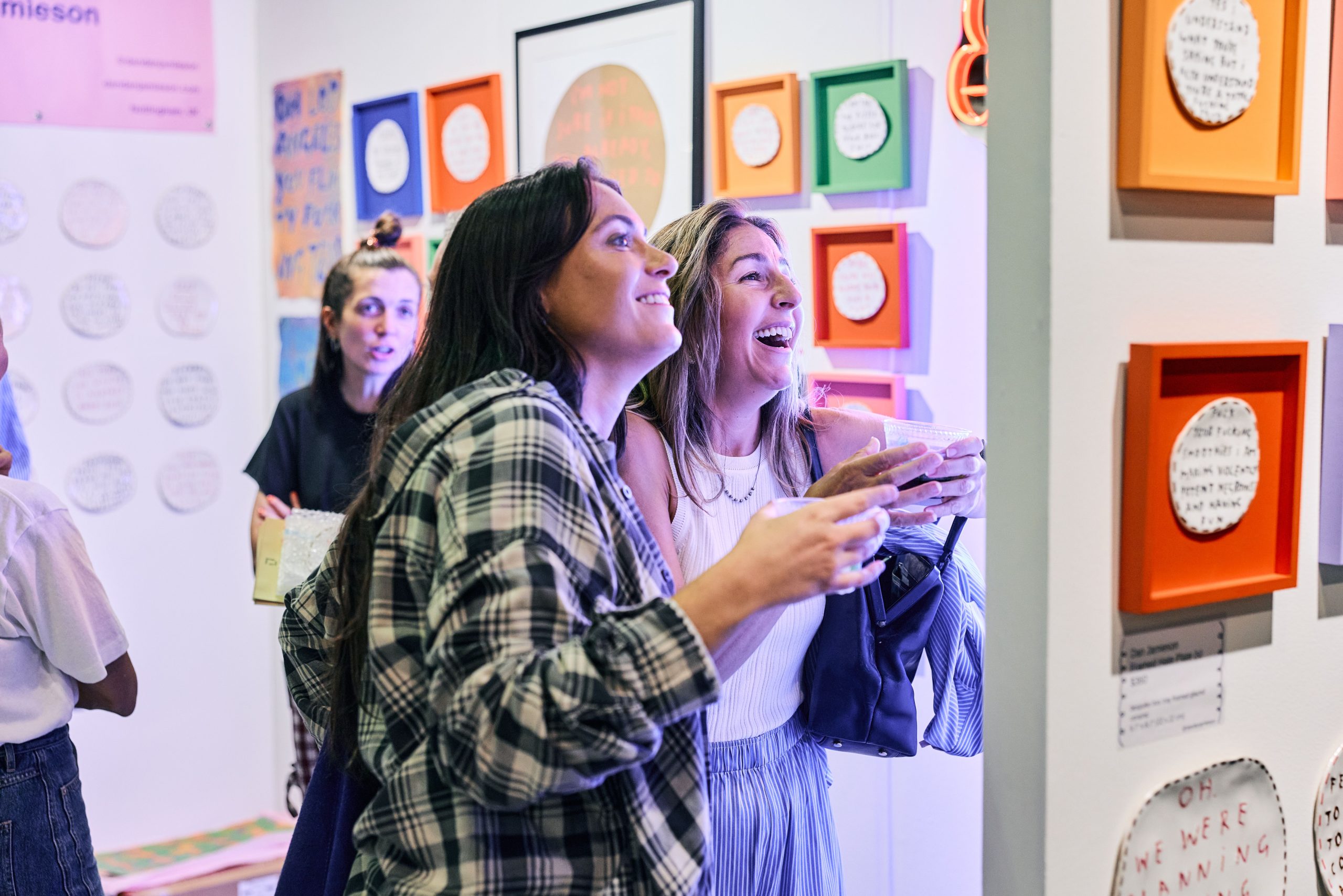
The Other Art Fair isn’t like other art fairs. While Frieze, Art Basel, TEFAF, etc., are crawling with elite collectors who buy before they even arrive, the Other Art Fair, presented by Saatchi Art, is for and by the people. There are no dealers, just artists who purchase booth space and fill it with their wares, selling directly to the public. Since its inception in 2011, it hosts 11 fairs annually across the U.S. and the U.K., including two in Los Angeles—one during L.A. Art Week, and the other currently at Barker Hangar in Santa Monica through Sept. 27.
“We’re not dealing with anywhere near the prices that these other fairs are. It’s a completely different art audience that we’re speaking to,” fair director Nicole Garton tells Observer, noting that this iteration features 160 emerging artists from around the world chosen by selection committee members Carlye Packer, Essence Harden, Siting Wang and Briana Salatino.
Buyers here might be people who’ve never been to a fair before and are making their first purchase. It’s one of the reasons why artists are advised to keep their works to a reasonable cost and size (under 36 inches), so collectors can easily walk out with the artwork under their arm. “What we’re seeing across our U.S. fairs and London is people are still really interested in collecting directly from artists, and they’re buying in greater frequency and at higher price points than they have been.”
While blue-chip fairs are undergoing major transitions, with sellers like Marian Goodman cutting back their participation on account of escalating cost and chancy rewards, the Other Art Fair saw a 40 percent increase in February’s L.A. iteration. “We’re seeing early signs of that same trend translating in Atlanta,” Garton says of the newest edition, opening Oct. 1. “Everyone’s seeing market contractions, and there was all this hubbub of the art world consolidating for the past two plus years, but we’ve seen more and more people coming out to spend more at our fairs.”
Over the years, Instagrammable spectacle has become a mainstay at such events, and the Other Art Fair is no exception. At “Leave a Fortune, Take a Fortune,” collectors can exchange written fortunes in artist Gina Su’s oversized ceramic fortune cookie. Last night’s opening featured typewritten poetry by The Haikuists, transforming a brief conversation into a complimentary three-line poem. If you’re feeling athletic, you can play a round of mini golf at “The Other Open: Artist-Designed Mini Golf,” three holes courtesy of local practitioners Suze Riley, Isabel Arenda and Heather Bellino.
Sept. 25 is Dolly Day, a statewide celebration of the late country music queen, observed at the fair with an array of original artwork for under $500 by exhibitors including Gregg Chadwick, Richard Hoffman, Pash Pashkow, Andrea Lopez and Lisa Tse, who happens to be the recipient of the fair’s Fall 2026 New Futures award, affording her mentoring and free space in which to ply her work.
“It’ll connect me to my audience, hopefully,” says Tse, a former graphic designer whose vibrant oil and mixed media palette captures images of women, some with leopards, some in gardens. “I went from being really realistic to loosening up my style and just playing more and having fun with it. And through experimenting, I kind of found this style. It’s rooted in female connection and friendship and fierceness with a side of cheekiness.”
Tse hopes to follow in the footsteps of Jackie Amézquita, who did an installation at the fair in 2019, and later showed in a booth. Working primarily with soil, corn masa (dough), limestone, salt and copper, she creates sculptures that touch on memory and transformation. The Other Art Fair was just one stop on her way to becoming part of the Hammer Museum’s vaunted citywide survey “Made in LA 2023” where she won the Mohn Public Recognition Award.
Coming from Norfolk in the U.K., Alec Cumming was here last February. It went so well, he decided to return. “It was the first time where people said we’ve been following you for a long time—they take note,” he says. “My work has been about visiting places and traveling. I’m trying to translate that onto the canvas.” His oil paintings evoke tropic and desert climes in an ochre and yellow palette—California, Palm Springs, or Cypress and the Mediterranean—with a nod toward influences like Matisse and Hockney. Since graduating from Norwich School of Art in 2007, he’s been working full time as a painter.
Lauren Lee Ly from London works as an illustrator, which translates easily to her canvases depicting locations in some of her favorite novels, among them, Kafka on the Shore by Murakami, The Vegetarian by Han Kang and Sweet Bean Paste by Durian Sagawa. A veteran of the London, New York and Chicago iterations of the Other Art Fair, she says, “It’s very worthwhile for me to come over here. Especially the Brooklyn show, that was very good for me. I’ve been doing it for two or three years now.”
Pash’s first time ever in an art show was last autumn’s iteration. A one time graduate of USC and current teacher at the university’s school of design, he liked the Other Art Fair so much, he returned in February. “I didn’t sell prints at the first show, I just had canvases and they’re a little more expensive,” he says, noting an uptick in sales in February for his limited edition digital prints featuring familiar logos with letters missing. “I started doing the prints at lower price points and they’ve been incredibly popular.”
Since its inception, the fair has provided a platform for nearly 10,000 artists with over 100,000 artworks sold. In the past 12 months, the Other Art Fair has held 9 events across the U.S. and U.K. and paid out over $7 million to artists. But their pioneering efforts to democratize the art world by connecting emerging and independent artists with buyers of all stripes doesn’t come cheap. With revenue streams coming from booth sales, ticket sales, bar sales and 18 percent of art sales, the key to financial success is partnering with sponsors and keeping venue costs to a minimum.
“I would say what’s probably affecting art fairs in particular is the rise of converting buildings and open spaces to data centers,” Garton sighs, noting that they lost their Dallas venue that way. “But at the emerging end of the market people are still really interested in collecting directly from artists, and they’re buying in greater frequency and at higher price points than they have been.”