
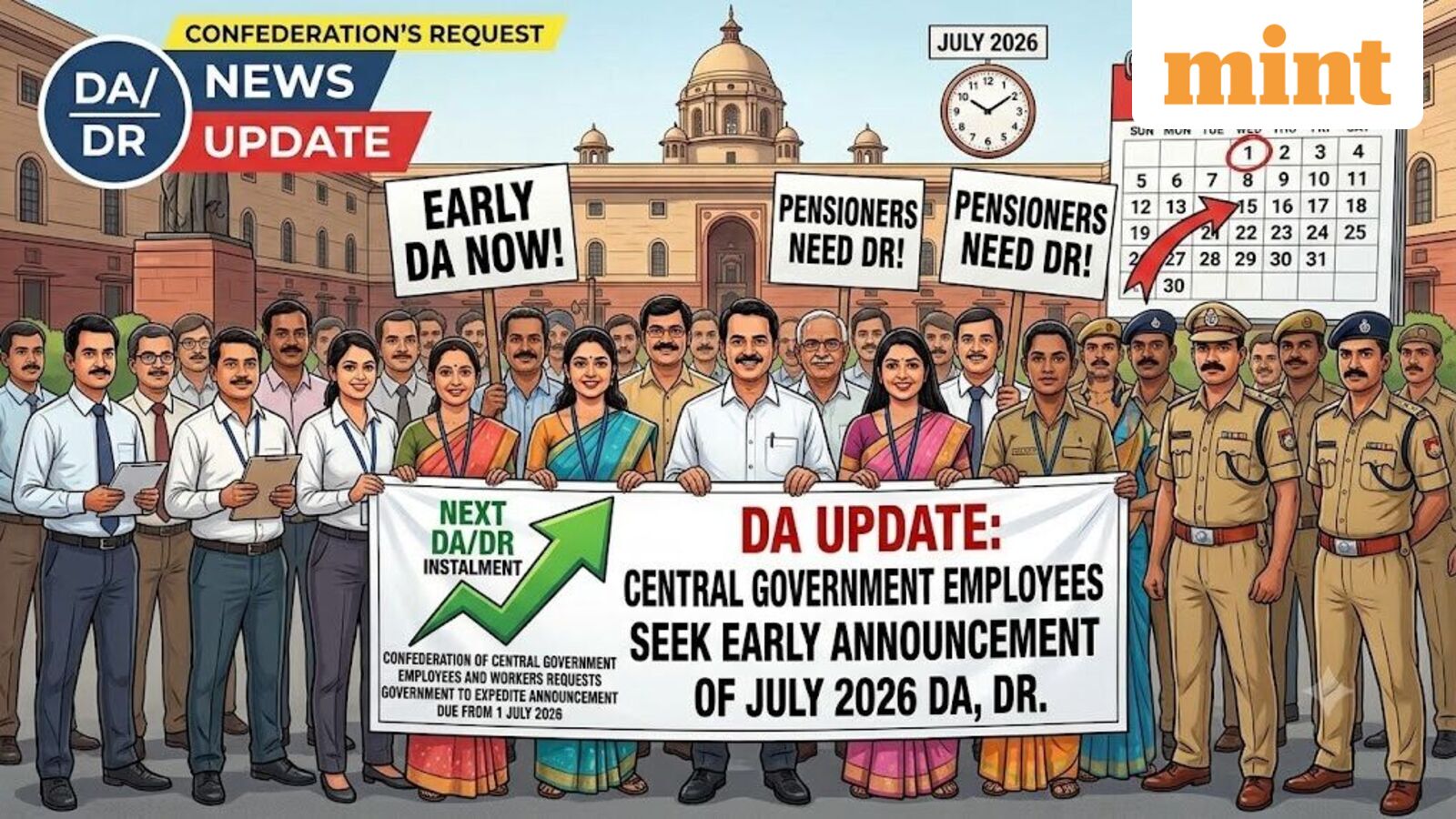
Central government DA, DR update: Employee body urges early decision on the July 2026 revision
The Confederation of Central Government Employees and Workers has requested the central government to expedite the announcement of the next instalment of Dearness Allowance (DA) for employees and Dearness Relief (DR) for eligible pensioners, due from 1 July 2026.
In a letter dated 24 September, the prominent employees’ body requested the Department of Expenditure under the Ministry of Finance to complete the basic process and steps at the earliest, once the relevant Consumer Price Index (CPI) data and the prescribed formula are available.
The letter stated: “As your honour is aware, DA is revised twice a year in accordance with the accepted formula based on the recommendations of the various pay commissions, with the primary objective of compensating for the continuing increase in the cost of living and prices. The recent movement in DA/DR rates reflects the continuing impact of price rises, i.e., July 2023 – 46%, January 2024 – 50%, July 2024 – 53%, January 2025 – 55%, July 2025— 58%, and January 2026— 60%. Thus, within the recent period, DA/ DR has moved substantially upward, from 46% to the present 60%, reflecting the cumulative effect of price movements.”
The letter further stated: “We fully appreciate that the proposal for revision must undergo the prescribed examination and approval process. Nevertheless, once the relevant CPI data and the applicable formula enable the revised rate to be determined, the proposal may kindly be processed and placed before the competent authority at the earliest possible opportunity.”
The primary concern of the request is the timely processing of the benefit from its current effective date, rather than any additional or advance payment. Furthermore, any arrears arising from the revision can be settled through the normal process.
July 2026 DA: What employees and pensioners can expect
It is important to keep in mind that DA and DR are revised twice a year, generally in January and July, to account for changes in the cost of living and rising inflation. The rate for central government employees increased from 46% in July 2023 to 60% from January 2026, as explained in the letter.
That is why, based on the latest available AICPI-IW data and projections thereof, the July 2026 DA revision is estimated at 64%. Still, this is only an estimate, and the final rate will be known only after the government formally approves and announces the revision.
For example, in the January 2026 cycle, the centre approved a 2-percentage-point increase in DA, raising it from 58% to 60%. The announcement was made in April 2026.
Now, in case the July revision is approved at 64%, employees and pensioners would see the revised rate applied from 1 July 2026. It will also result in arrears payable for the period between the effective date and the actual implementation date.
Why early announcement matters
The employee organisations and associated stakeholders have pointed to rising household expenses due to inflation, including education, travel, and other family commitments, as reasons for seeking an early decision.
The timing is also of immense value, because the festive season is approaching. The NC-JCM, i.e., the National Council-Joint Consultative Machinery, another prominent employee union, has separately requested the release of the revised productivity-linked bonus ahead of Dussehra.
The possible impact of a delayed DA announcement
A delay in the approval of the DA/DR for serving employees and pensioners, respectively, could postpone the actual disbursement of the revised DA/DR, even though the increase, once approved, would remain effective from 1 July 2026. Employees and pensioners in such a case may therefore have to wait longer for the benefit and arrears.
In summary, the government’s decision and the Union Cabinet’s approval of the July DA and DR instalment will determine when employees and pensioners can receive the revised benefit and associated arrears. Till the formal announcement is made officially, the 64% figure or any other similar metric should be treated only as an estimate, not a confirmed DA rate.