
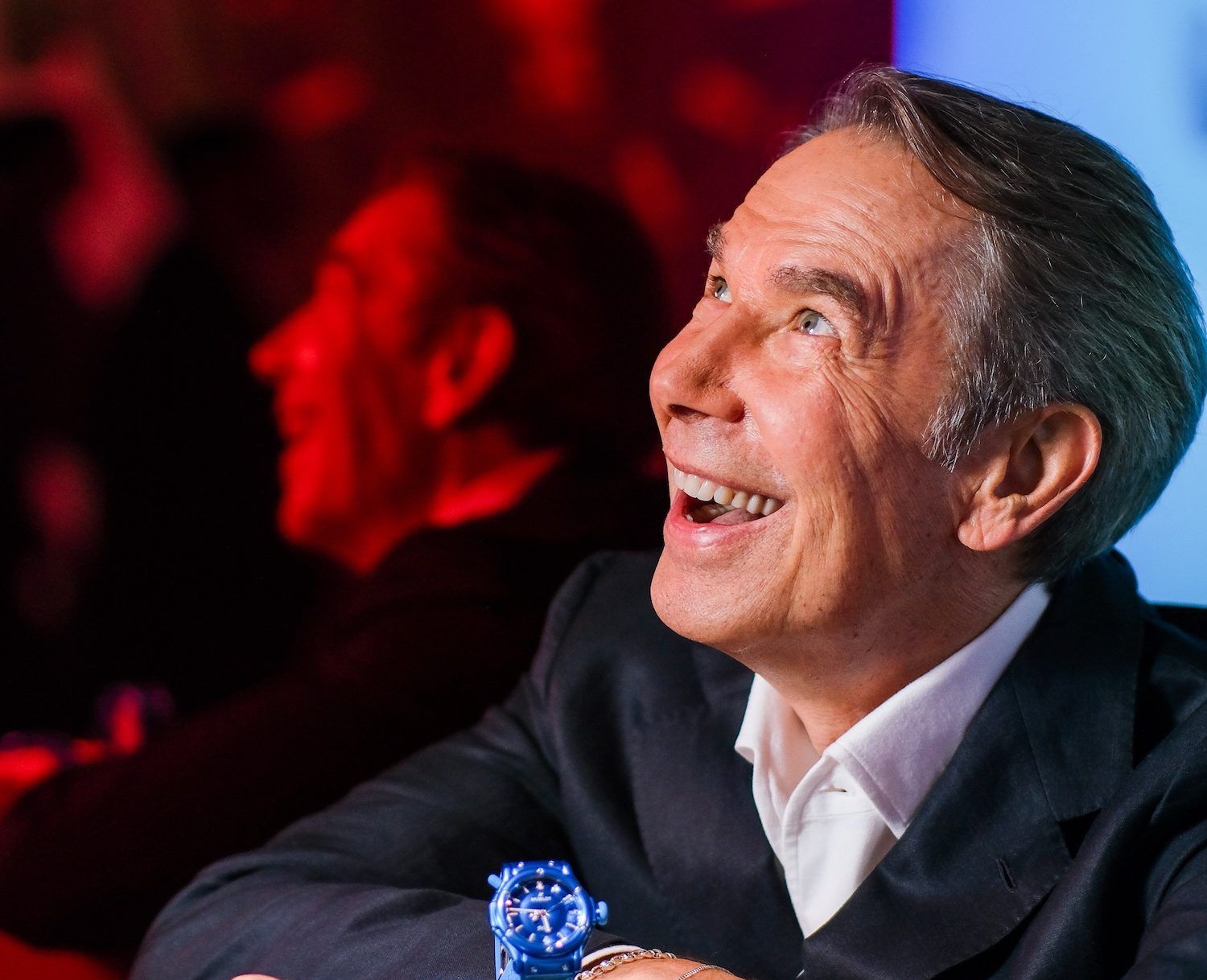
Jeff Koons On Balloons, Time and Why He Changed His Mind About Luxury
Last week in New York City, Swiss watch brand Hublot and American artist Jeff Koons celebrated their recently announced partnership with a packed event at Studio 525 in Chelsea. The event was star-studded, with Pamela Anderson, Future, Saweetie, Gunna and Olivia Jade among the guests; Tinashe performed and later took over the DJ booth. Koons’s sketches lined one wall, while others came alive with animated projections of his famous Balloon Dog sculptures—imagery that was particularly apropos. The big reveal of the night was the Hublot Classic Fusion Balloon Dog by Jeff Koons collection, which translates one of the artist’s most recognizable works into unusual watches in red, blue and silver that look as if they are inflated with air. Produced in a limited edition of just 200 pieces in each color, they retail for $25,100.
(There was another, decidedly more serious watch on display, in a dramatically lit back room, where projections evoking the universe set the mood. The $488,000 MP-14 Origin by Jeff Koons is an extraordinarily complex gem-set center tourbillon watch inspired by his Gazing Ball sculptures and conceived around ideas of time, space and perception.)
The collaboration between Koons and Hublot, both known to offer somewhat controversial works, began a little more than two years ago, when Koons traveled to Hublot’s manufacture in Switzerland. There, he met with designers, engineers, material specialists, watchmakers and gem setters and came away impressed by what he calls their commitment to making something as fine and distinctive as possible.
When we sat down with Koons to discuss the collaboration and his take on art, the conversation was almost a stream of consciousness about the challenges of translating his art onto something as tiny as a wristwatch, and what a wristwatch is really all about: time and our attempts to measure it.
“Plato would always say that the first thing you deal with in art is scale,” Koons tells Observer. “What I love about dealing with this timepiece is we’re really dealing with a scale that, yes, it’s on our wrist, but there’s something that also is very profoundly internal and it’s within our mind. It’s within our concept of being.”
Scale has, of course, long played a role in Koons’s work. His Balloon Dogs take something as fleeting and familiar as a child’s balloon animal and turn it into a monumental, mirror-polished sculpture—some as large as 10 feet tall. A watch might seem like the opposite exercise. Yet for Koons, a watch’s relatively small physical dimensions open onto something much larger: mankind’s centuries-long attempt to understand time.
“I hope these watches carry the beauty and the appreciation of humanity’s accomplishment in creating and being able to define time through mathematics and through engineering and to conceive through observation,” he says. “We have a concept of time, but without timepieces we wouldn’t have the understanding. All of the human history of endeavors in science and mathematics is being celebrated [in a watch].”
Even the idea of balloons and his Balloon Dog and other sculptures takes on a rather more existential meaning when he talks about it. Koons suggests time and even biological memory come into play in his Balloon Dog sculptures (part of his famous Celebration series) and in the watches he designed. “This aspect of life cycle, biological memory that’s really profoundly important to all of us, I think is embedded within the design.”
He goes on to describe the surface of a balloon as a membrane, comparing it to human skin and the boundary between our bodies and the outside world. “Within our body we have a sense of denseness. We’re made of blood and organs, our tissue. And outside this space feels much more vacuous to us, more open and it feels denser inside. But when you look at a balloon dog, it’s the reverse. All of a sudden the inside, it’s kind of vacuous. It’s a balloon, it’s empty. And the external space seems to be denser. What I enjoy about that is that it gives us kind of the security to be more open to the external door. I believe these watches also make reference to human history of defining what’s a symbol of life, taking a deep breath. It’s a symbol of optimism and of life, and of deflating: it’s a symbol of death.”
That’s a lot of philosophical weight for a Balloon Dog to carry, but Koons’s work has never been quite as simple as its shiny surfaces suggest. It has also long divided audiences, something he is well aware of. Asked about the polarizing nature of his work and whether provocation plays a role in what he creates, Koons pushed back on the premise.
“If somebody really just tries to make something shocking, disjointed in some way, clashing in some way, it doesn’t succeed. It has to be a natural thing. It would come from the curiosity, the interest in everything. So, I know that I like dislocated images. I like to just celebrate it because it can create kind of a third element, but it’s not for shock’s sake. The most shocking thing is honesty.”
Perhaps one of the more surprising admissions from Koons, though, concerns luxury itself. Despite having collaborated with luxury companies in the past, he says he wasn’t always convinced of its value: “When I was younger, I didn’t know how much I believed in luxury goods. I thought people should maintain their own political power, economic power. But I came to understand just the relevance of the luxury goods industry today.”
What changed his thinking, he remarks, was recognizing the role luxury companies can play in maintaining crafts and technologies, as well as the care involved in making something to the highest possible standard. “That caring is a way to show respect to other people. At the end of the day, we love luxury goods, but what we care about even more, and what is more relevant, is each other,” he says. “We’re involved in being able to have a dialog about what it means to be a human being and find our place and to find meaning within existence.”
For Koons, those ideas about care, objects and human connection circle back to time itself. “The commodity that I care about is us, the human individual and the respect for the opportunity that we have,” Koons reflects. “And that’s why time is so important. It makes us more aware of our past, where we are at this moment and how we can use our time to really achieve, make the gestures we want to make, do the things that we’d like to do in the future and give us a sense of planning.”
Koons keeps returning to the idea that the object itself is only part of the equation; what matters is what it communicates and what the person experiencing it takes away. So where does that leave a watch bearing his artistic language? Does Koons consider it art? He doesn’t hesitate.
“I do think it’s art,” he says. “Art is something that really happens within us. We can become appreciative of experiences that we have, things that we come across, but art is really when we experience the essence of our own potential.”