
Asian Games Day 7: Japan Takes Four Skateboarding Medals
NAGOYA –
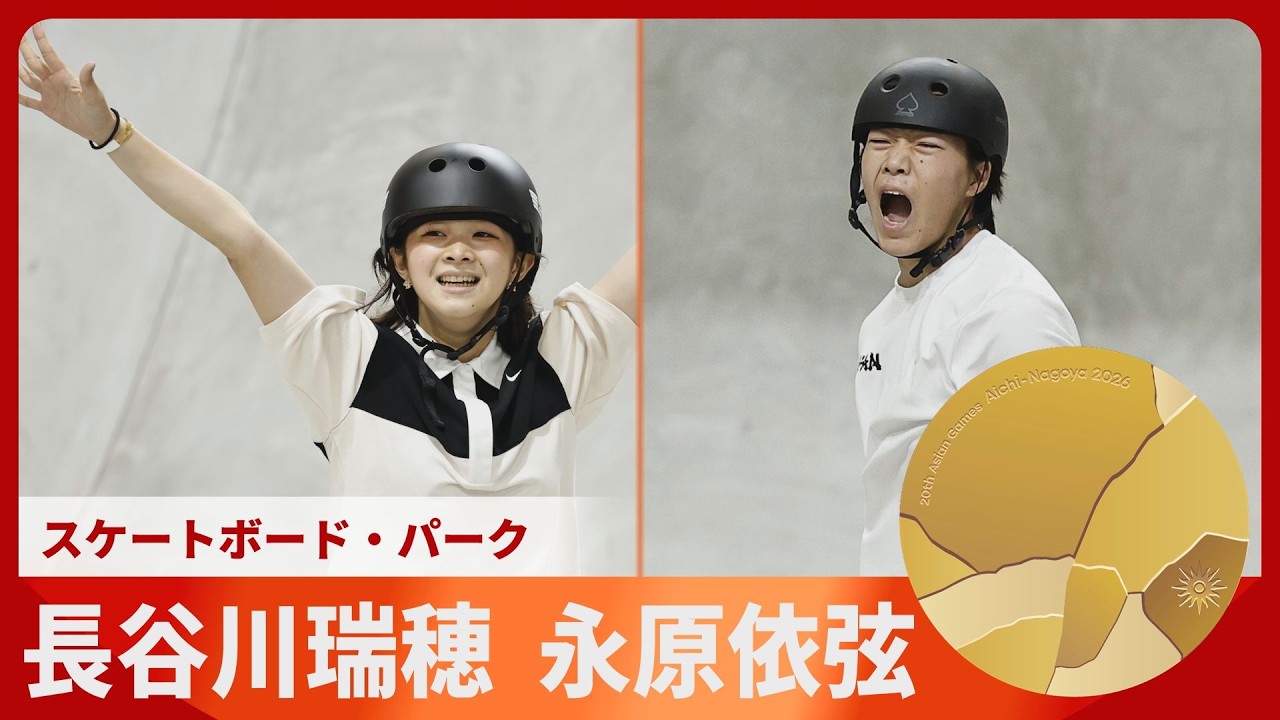
Japan’s teenage skateboarders delivered two gold medals and two bronze medals on September 25, with 15-year-olds Mizuho Hasegawa and Ian Nagahara winning the women’s and men’s park competitions at the Aichi-Nagoya Asian Games.
All four Japanese skateboarders reached the podium, providing one of the host nation’s outstanding performances on Day 7 as swimming concluded its six-day program and athletics, gymnastics, fencing and team sports entered a decisive stage.
The day’s biggest confirmed successes came at Aichi Sky Expo, where Japan’s young skateboarders dominated both park finals.
Hasegawa, the world’s top-ranked women’s park skateboarder, won gold with an exceptional score of 94.03 points, finishing well ahead of Chinese Taipei’s Lin Yi-fan, who took silver with 85.15. Japan’s Misugu Okamoto completed the podium with 82.86 points.
Hasegawa had qualified first and immediately established herself as the competitor to beat. Her opening run included a successful 540, a trick involving one and a half rotations in the air, earning her 88.83 points.
She improved considerably on her second attempt, successfully completing her signature front-flip Indy and receiving 94.03 points. She was the only competitor to score above 90, and no challenger surpassed her during the remaining runs.
The victory gave the 15-year-old high school student her first Asian Games title and reinforced her position among the leading contenders in international women’s park skateboarding.
Okamoto’s bronze was another significant result for Japan. The 20-year-old, who finished fourth at the Tokyo Olympics after falling while attempting a difficult trick, had temporarily stepped away from competitive skateboarding before returning to the sport.
She recovered from an unsuccessful opening run to complete a 540 on her second attempt, scoring 82.86 points and securing third place.
The men’s final produced an equally impressive Japanese performance.
Nagahara, also 15, won gold with 88.96 points after qualifying third. He opened with an error-free run worth 87.33 before improving on his second attempt to take the lead.
None of the remaining competitors could exceed his score, giving Japan a second park gold within a few hours.
Nagahara, a third-year junior high school student from Hakuba in Nagano Prefecture, is the younger brother of Tokyo 2024 Olympian Yuro Nagahara. He had already established himself domestically by winning the Japanese championship in 2025.
Japan’s Gunjo Shiji, another 15-year-old, took bronze with 86.03 points. The Aichi Prefecture native received enthusiastic support from local spectators as he attempted several difficult aerial tricks.
The combined results meant that every Japanese competitor entered in the men’s and women’s park competitions won a medal, an exceptional outcome for a team composed largely of teenage athletes.
Swimming’s final day brought particular attention to 17-year-old Shin Ohashi, who was pursuing a clean sweep of the men’s breaststroke events after winning the 100-meter and 200-meter titles.
Ohashi had produced one of the performances of the entire Games on September 24, breaking the men’s 200-meter breaststroke world record in 2 minutes, 4.83 seconds. His time improved the previous record held by China’s Qin Haiyang by 0.65 seconds.
The Japanese teenager entered the September 25 men’s 50-meter breaststroke competition seeking a third individual gold medal. He qualified second overall in the morning heats, securing a place in the evening final.
Rikako Ikee also returned to the pool for the women’s 50-meter butterfly after withdrawing from the 50-meter freestyle the previous day. The 26-year-old progressed through the morning heats, earning a place in the evening final.
Tomoyuki Matsushita qualified for the men’s 200-meter butterfly final, adding another event to his demanding Asian Games program.
Japan entered the final day of swimming with 31 medals, consisting of six gold, 13 silver and 12 bronze, already exceeding its 30-medal total from the previous Asian Games.
The final evening featured seven medal events, including the women’s 800-meter freestyle, men’s 200-meter backstroke, men’s 400-meter freestyle and women’s 4×100-meter medley relay.
Artistic gymnastics also reached its final day at Nagoya’s Rainbow Hall, with five apparatus titles to be decided.
Olympic champion Shinnosuke Oka was entered in the men’s parallel bars and horizontal bar finals, while Shoma Tsukiyama was also competing on the horizontal bar. Aiko Sugihara, Japan’s women’s all-around gold medalist, was contesting the balance beam and floor exercise.
Japan had already enjoyed a productive gymnastics competition, including Sugihara’s historic individual all-around victory, silver medals in both team events and several apparatus medals.
In fencing, Japan’s men’s foil team began its campaign with an opportunity to add another title following the country’s individual success earlier in the Games. Kazuki Iimura and Kyosuke Matsuyama were among the leading Japanese competitors as the team competition moved through its knockout rounds.
The women’s epee team was also competing, with both team finals scheduled for September 25.
Athletics reached one of its most anticipated evenings, with the men’s and women’s 100-meter semifinals and finals at Mizuho Park in Nagoya.
Japanese national champion Shuhei Tada had qualified for the men’s semifinals after running 10.41 seconds in his opening heat on September 24. Yuki Koike also progressed, recording 10.33.
Thailand’s Puripol Boonson established himself as a major contender by clocking 9.95 seconds in the heats, the only athlete to break 10 seconds during the opening round.
Japan entered the competition seeking its first men’s 100-meter Asian Games gold medal since Koji Ito’s victory at the 1998 Bangkok Games.
In the women’s competition, Midori Mikase and Fuuka Ido-Abigail were among Japan’s representatives.
The athletics program also included the men’s 10,000 meters, women’s pole vault, women’s shot put, men’s hammer throw and the conclusion of the women’s heptathlon.
Japan suffered a setback before the men’s 10,000 meters when Mebuki Suzuki withdrew after contracting influenza. The 25-year-old Toyota athlete had been selected for the event alongside Yamato Yoshii.
In women’s hockey, Japan lost 3-1 to India in its preliminary-round match, a significant result in a competition featuring several of Asia’s strongest national teams.
The Japanese women’s side had opened its campaign with commanding victories over Indonesia and Singapore, but India provided considerably stronger opposition.
Japan’s women’s soccer team, meanwhile, faced the Philippines in the quarterfinals at Shizuoka Stadium Ecopa on September 25.
Nadeshiko Japan entered the knockout stage with a perfect record after defeating Thailand 8-0, Vietnam 8-0 and Chinese Taipei 4-0 in the group stage.
The team is attempting to win a third consecutive Asian Games women’s soccer championship.
Basketball also moved into its decisive stages, with Japan’s women’s national team competing in the semifinals after winning all three preliminary matches and defeating Thailand 86-29 in the quarterfinals.
Japan had previously beaten Hong Kong 114-37, Kazakhstan 88-23 and the Philippines 89-67. The team is pursuing its first Asian Games women’s basketball gold since 1998.
Baseball provided another major Japan-Korea encounter as the two countries met in the opening game of the Super Round at Toyohashi Municipal Stadium.
Japan had advanced unbeaten through the preliminary stage, defeating China 11-3, Palestine 15-0 and the Philippines 7-0.
South Korea also entered the Super Round with three victories, having defeated Chinese Taipei 5-0, Hong Kong 13-0 and Thailand 18-1.
The game carried significant implications for qualification for the September 27 gold-medal contest. Japan is seeking its first Asian Games baseball championship since 1994.
The hosts are scheduled to face Chinese Taipei in their remaining Super Round game on September 26.
Table tennis continued its individual competitions following Japan’s historic victory over China in the men’s team final on September 24.
Tomokazu Harimoto and Sora Matsushima had led Japan to a 3-2 victory, ending China’s run of eight consecutive Asian Games men’s team titles and giving Japan its first gold in the event since 1966.
On September 25, Matsushima partnered with Miwa Harimoto in the mixed doubles, facing China’s Wang Chuqin and Sun Yingsha in the quarterfinals.
The Japanese pair, both teenagers, entered the contest seeking to extend Japan’s successful table tennis campaign and secure another medal.
Shooting produced a gold medal for India through Suruchi Singh and Kamaljeet in the mixed 10-meter air pistol competition. The Indian pair scored 484.6 points in the final, finishing ahead of South Korea.
India also took silver in the men’s 50-meter rifle three positions team competition through Niraj Kumar, Aishwary Pratap Singh Tomar and Rudrankksh Patil.
Surfing began its Asian Games program on September 25, with Japan represented by Kanoa Igarashi and Connor O’Leary in the men’s competition and Mirai Ikeda and Minami Nonaka in the women’s events.
The competition marked the beginning of another important medal opportunity for Japan, whose surfers have established a strong international presence since surfing made its Olympic debut at Tokyo 2020.
Japan also competed across boxing, badminton, squash, mountain biking, canoe sprint, equestrian dressage, handball, kabaddi, beach volleyball and esports as the Games expanded into their second weekend.
September 26 will bring further Japanese medal opportunities and important fixtures, including the baseball team’s meeting with Chinese Taipei, the men’s soccer quarterfinal against North Korea and the opening of softball competition for Japan.
The women’s softball team begins its campaign against the Philippines, while the men’s hockey team faces India.
With two gold medals and two bronze medals confirmed from skateboarding alone, September 25 highlighted the emergence of a new generation of Japanese athletes capable of competing at the highest level. The day’s swimming, athletics, gymnastics and team-sport finals added an extensive evening program to an already crowded Asian Games schedule.