Tim Kent’s New Show “Sojourn” Is About Rest But He Can’t Stop Working
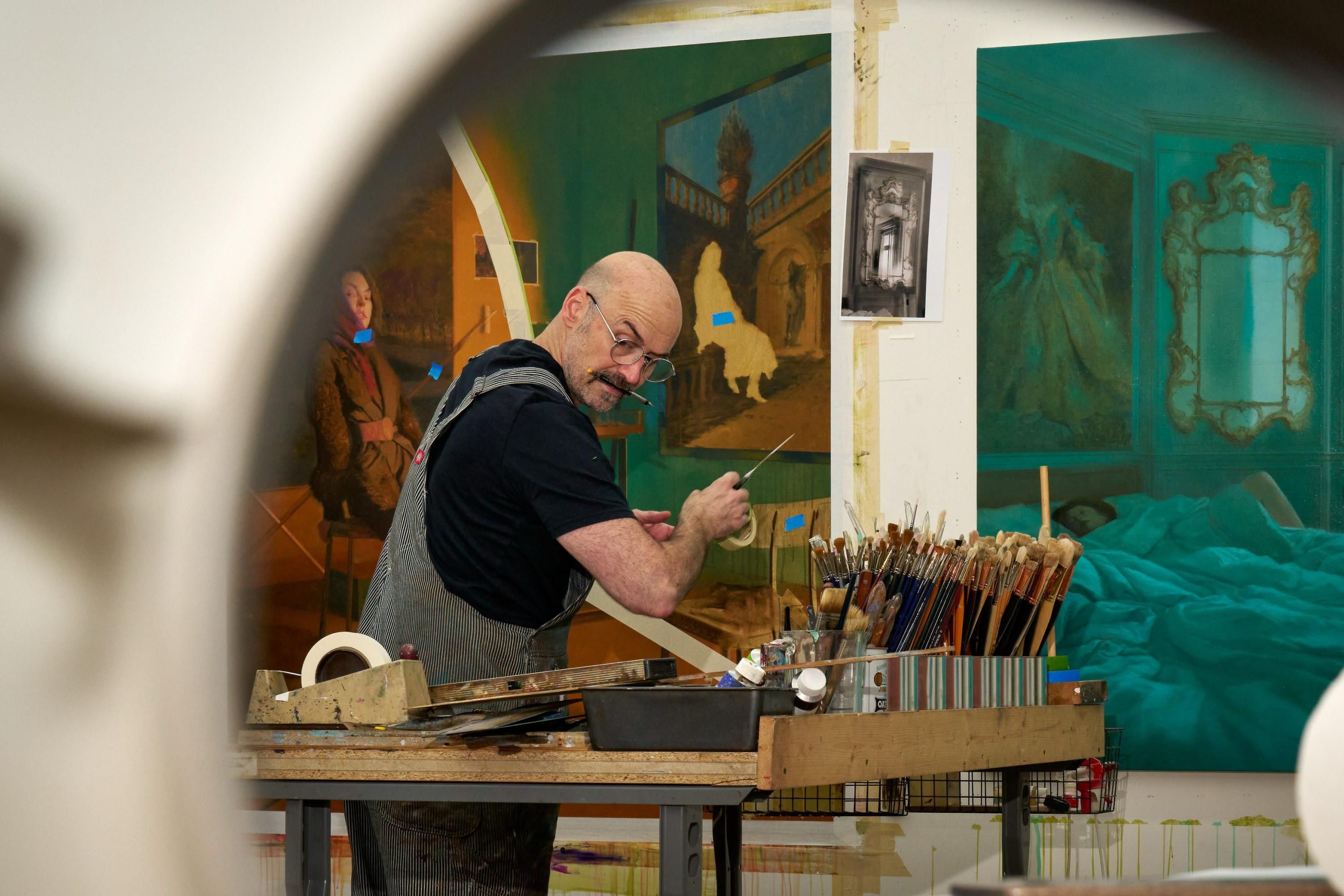
Before he started painting full-time, Brooklyn-based artist Tim Kent spent six years playing bass for The Giraffes, one of New York’s most unhinged early-2000s rock bands, playing shows before the Strokes and the whole rock revival that followed “We were four tough kids from New York, and we were genuinely good. No rules. Small rooms, 100 people, cranked to 20,000 decibels. People still say the craziest show they’ve ever seen was a Giraffes show,” he told Observer shortly before the opening of his new solo exhibition, “Sojourn,” which opened this month at Hollis Taggart’s Chelsea location. These days, the hype is around his quietly moody paintings. (He has works in public and private collections, including those of the Museum of Contemporary Art, Beijing; Laura Lee Brown and Steve Wilson’s 21c Museum in Louisville; and the Rockwell Museum in Corning, New York.) In the middle of one of the city’s busiest art weeks, artists, designers, critics and collectors packed the gallery to see his new works focused on rest—a paradoxical subject, perhaps, for a former rocker. What follows is our conversation, lightly edited.
When did you first realize painting was going to be your life?
Everybody with a little bit of talent has to figure out whether they’re going to pursue it. I used drawing and painting as a way of dealing with all the traveling I did moving from city to city, as a kid with my mother. I grew up with a single mom; she was busy and I understood that. In my early twenties, I was working odd jobs, painting and trying to sell pictures on weekends. I had to decide: was I going to give it a real shot? When people started actually buying them, I decided to try painting full-time. Getting into the gallery system anywhere is hard, but living in New York gives a young artist the chance to start exhibiting and give whatever talent you have room to grow. I basically thought, if I can keep this going as long as possible, I’m lucky.
|
“Sojourn“ |
Do you remember the first piece you ever sold?
A relative commissioned it. It was an old blues player meeting the devil. I got about $100 for it. I remember thinking, my God, I’m selling! But selling to a relative isn’t the same as selling to a stranger. Part of the fun of making paintings now is figuring out who’s actually being honest with their checkbook. Either someone buys it because they love it, or they don’t buy it at all. Now, I think about that with long term collectors, too. Plenty of great paintings never sell and only get appreciated later. That tells you something, though not everything.
What’s the most expensive painting you’ve ever sold, and did the number mean anything to you?
I’m not telling you the number. But it means a lot, for sure. Yesterday, an Amazon guy delivered a package to the studio for someone else in the building. I looked at his shoes and thought, this guy needs new shoes. And I realized the painting I got paid for would cover a year or two of his life. That’s ridiculous in a way, but also why I try to help out those who ask—especially in my neighborhood. I didn’t get into this business to not try to succeed.
You’re Canadian, Turkish and English and now you live in Brooklyn. Which one shows up most in your paintings?
Brooklyn, honestly. I’ve been American since 2003. I moved here in 1990, when I was 13. I’ve lived here longer than anywhere else. But there’s a cultural memory your parents give you, whether or not you’re aware of it, and it shapes how you understand who you are. I’m close to my mother’s English side, and I’ve done a lot of work in England. I’m connected to the Turkish side too, through the family I visit. The Canadian side is mostly vague memories at this point, though my mother lives there again. It’s a beautiful, stable, sane country, but it doesn’t have the same excitement as living in New York. Maybe I’ll retire there eventually. Living in New York catches up with you. It’s non-stop, and at some point you start wondering if you can afford to still be here in your seventies and eighties, or if you’d rather spend that stretch doing something easier. Carpentry. Painting. Canoeing on a lake somewhere.
What was your first real memory of New York?
Flying in from Istanbul and thinking, my God, what a dump, just looking at this brown city from the air. My mom picked me up, we drove through the Holland Tunnel and the first thing that happened was some guy crossing the street saw me staring and said, “What the fuck are you staring at?” I was just a kid. Then I discovered every bodega would sell a teenager beer and cigarettes and porn, and I thought, I’m home. The neighborhood had Albanian kids, Puerto Rican kids, Irish kids, German kids. It educated me in some ways. NYC is where I grew up.
Who actually shaped how you see the world?
I had an uncle who was a painter, ex-military, and later successful in advertising in London. There is my friend, Damien Paris, the guitar player, who showed me how hard you actually have to work to be good at something. My wife Charlotte, who is persevering, extremely thoughtful and perhaps the most brilliant person I know. And there were strangers along the way who’d teach me something at the right moment without expecting it. My mother Philippa, who sacrificed a lot to give me a stable home while working as a secretary through a string of difficult jobs, while she struggled with her own issues. We learned to take care of each other.
Before painting, you spent six years as the bassist for The Giraffes. What did that experience teach you?
The biggest waste of time of my whole life. I’m kidding. Damien, the guitar player, is the one who taught me about discipline, how hard you actually have to push yourself. Playing in a band, when it’s good, is the best feeling there is—everyone locked into one moment, making something together. We were four tough kids from New York, and we were genuinely good. Our shows were insane, before the Strokes and that whole rock revival happened here. There were no rules. Small rooms, 100 people, cranked to 20,000 decibels. People still say the craziest show they’ve ever seen was a Giraffes show. I produced a couple of their later albums. They’re 100 percent better without me. If I tried to rejoin, it’d take me 10 years just to get my fingers back to where those guys play. These days, I’ll occasionally go out, smoke a joint, have some whiskey with them, and talk about jamming again.
Does the music show up in how you paint?
Composition, harmony. The hard work ethic, mostly. I listen to drum and bass when I’m working, and that comes through. I went through a serious jazz phase—Art Blakey and the Jazz Messengers. I don’t like a lot of vocals in music but I am always listening to hundreds of hours of audiobooks when I’m painting. I don’t want to hear what someone else is feeling. Pink Floyd, Radiohead—that’s the exception, but that’s also just my generation.
What’s the main idea of “Sojourn,” in your own words?
It’s about taking a break. Of course, there’s the irony. Most of the people that I captured weren’t actually resting. They tried to capture moments of rest while nonetheless working. The art world is hard.
How personal is this show to you?
I’m literally taking snapshots and pulling memories and putting them together. It doesn’t have the same historical layering a lot of my other work has. This is about what we’ve all been talking about. The ceaseless demands…
Do you rest, or just paint people who do?
I only paint people snagging some rest. It’s a fantasy. Especially in New York. Maybe the fantasy is something we need to actualize though. Everyone is so damn tired.
After three shows about how art gets made, you suddenly made one about rest. Why? Was it simply a change of pace, or was something else going on?
There were a lot of practical constraints making this show. One was scale, the size of the works. If you’re making big works, many people can’t collect them. We live in New York, and space is precious. I also tried not to be as busy with the canvases as I was in my last six shows. Though at the end of the day, I still spent just as much time on these as I normally would. I can’t get away from it.
Someone once said of your work, “He can paint, but it’s difficult, well-trodden territory he traverses.” What do you make of that?
That’s fair enough. Who cares? Show me any territory in the art world with its global expanse and constant messaging that hasn’t been well-trodden in some form or another. Please.
What’s the nicest comment you’ve gotten about the show?
Somebody told me, half-joking, “You’re finished. Congratulations, your career is over.” I was like, great, so I’m done. Maybe now I get to take a break. Think about what’s next. A lot of people hate what I do. They think it’s boring or plain. Other people really like it. The one thing I can say about the art world is that the idea of “new” is a myth. If you’re judging a painting on whether it’s new, you’re fooling yourself. The only genuinely new work being made right now—at least formally—is probably by new media artists, people actually working with the language of technology, because the medium itself is a new way of talking about things. Painting is painting. There’s always some variation of history folded into it. I’m not sure that’s a bad thing given the gross indifference to the past these days.
Do you have a place to disappear, even in this city?
My studio. My sofa. My bed. My bathtub. And the cat, though I can’t disappear from him. He always finds me. Every time I run a bath, he’s sitting there like, hey! He’s a big fat cat. How can I not like him?
Does it ever get uncomfortable having a wife who’s a professional art critic?
No, not at all. The only hard part is keeping up with how much information she’s processing. I live in a pretty small bubble as a painter. Her bubble is much bigger. She’s a theorist, she publishes books and academic writing and her sense of the art conversation is more sophisticated than mine. And it’s not always about aesthetics the way I care about aesthetics. For a while, we were very symbiotic, trading ideas about what technology was doing. After the whole net-art explosion in 2022, she went further into her world and I went further into mine, which actually worked out. She has a more competitive and intellectually rich environment to develop in, and I got to just go back to making paintings. We are lucky because art is our common ground so we still exchange ideas.
Who are the women in your paintings?
I love women, thank goodness for them. They make the world better. A few of the figures are my wife. She shows up in almost everything in some form. Others are friends who’ve passed through the studio. It happened to be women this time. Maybe next time I’ll paint all men. I did that a dozen years ago. It doesn’t really matter to me. They’re figures in space, but people insist it has to mean more than it does.
What’s your favorite painting of all time?
A World After Its Own Image, a mountain range with a system of perspective orthogonals at its bottom. I think that is a genuinely good painting because it references the history of images and the process of making the painting itself.
You’ve shown in New York, Istanbul, Dubai and London. Does America still decide how the rest of the world reads art?
Having traveled and exhibited internationally I think I can say with some certainty that New York is still the global center of art. It’s enormous. There’s a sophisticated critical culture here that has been developing since the postwar period making its version of the art world the dominant voice, for better or worse. Maybe because of the market? There is a very fluid market for art here, enabling artists to live off the sales of their work, which in turn creates a positively competitive environment.
What’s your ambition for the future?
Make better work next time. Right now, I’m basically resetting to zero, figuring out what worked in this show and what didn’t. I liked some of the colors. I am debating a couple of compositions and wondering why the concept remains so difficult for so many. Those ideas, that’s going into the next body of work. I might do something in Miami next year, maybe Japan. Depends who says what. It could all fall through too. We’ll see.