
Setting Colorado homes on fire to make them survivable
When the men dripped burning gasoline onto the woodpile and added turbofans to whip the flames toward the corners of two brand-new homes, the fire insurance executives on-site might have experienced some extra feels.
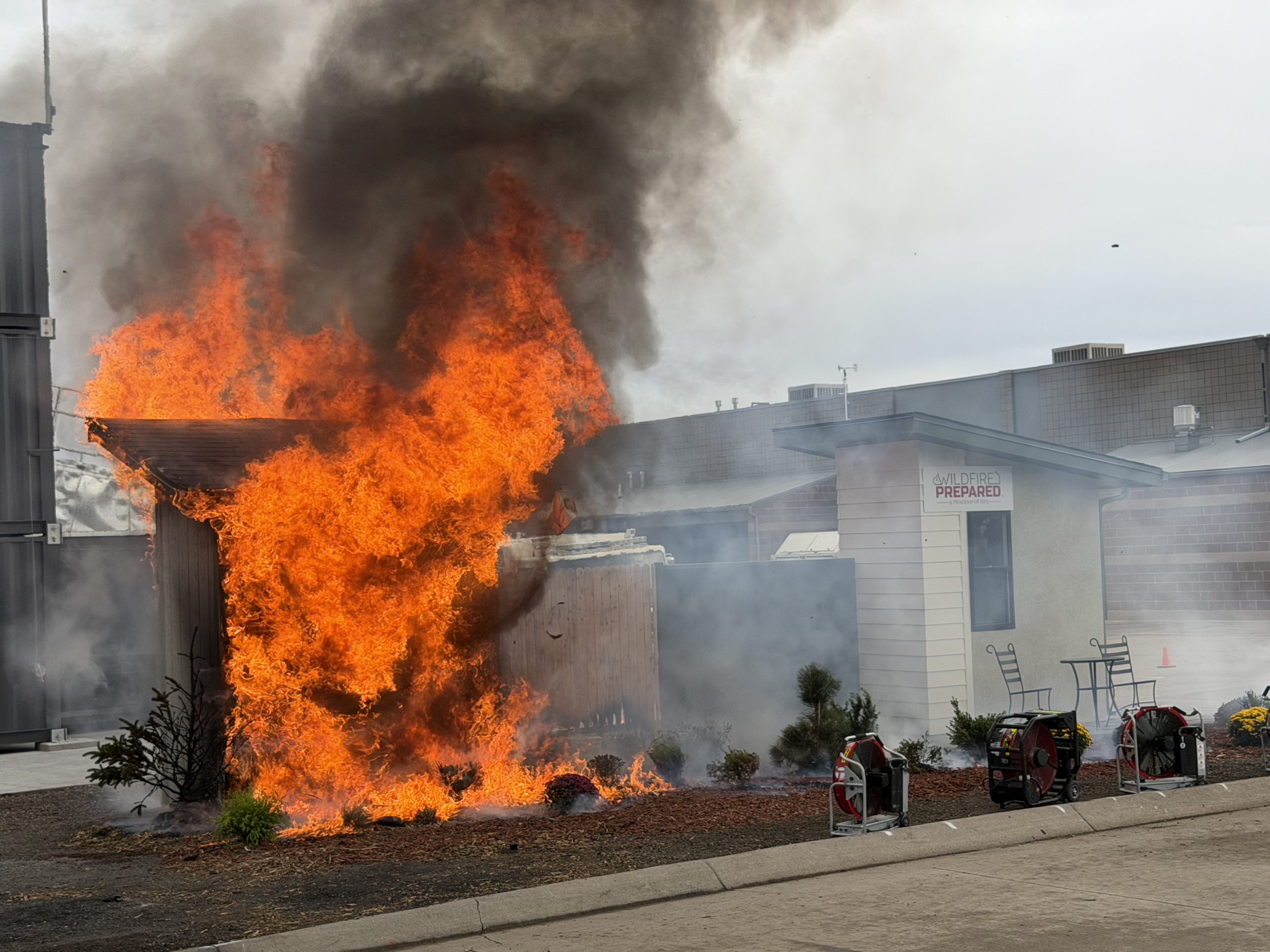
But it was all for a good cause, as wind-whipped flames crept toward two demonstration “homes” and landscapes in the training lot of West Metro Fire on Thursday.
The home on the right — or the corner of one, the size of a large shed — was made with metal gutters instead of vinyl, stucco and fire-resistant siding. The fence touching the side was made of metal. A paved patio ran up to the outer wall, no flower planters hung at the metal-clad kitchen window, and plantings were low and well away from the house, no dusty, dried-out junipers or spruce in sight.
Doomed and awaiting its clear fate on the left was a home with a wooden fence and vulnerable vinyl gutters, flammable siding, a tall, crispy spruce tree reaching to the wall, and an ominous pile of tinder-dry wood stacked against the corner. Not to mention the window flower basket with its straw liner beckoning to the fire like a siren.
It was a rare damp morning in a record-hot Colorado summer, so the firefighters in their yellow wildland shirts had to make a few passes with the drip torches to finally get things going. But the Tale of Two Homes unfolded exactly as predicted by the developers, county officials and insurance trade groups who set up the demo: Homeowners on the right could have sipped ice tea on their patio throughout the conflagration, if they didn’t mind a little smoke.
Homeowners on the left? Let’s hope they got the photo albums, pets and bank records. Because in a half-hour, the flaming 2-by-4 studs collapsed into a sobering pile of embers.
8555
“As a county commissioner, the No. 1 issue that keeps me up at night is wildfire and the impact on our community, because it’s not a matter of if, it’s when,” Jefferson County commissioner Leslie Dahlkemper said just before the firefighters lit their torches. “How do we think about growth and development in a way that keeps communities safe, using fire-ignition resistant materials, hardening homes and creating more defensible space around those homes? So we’re working with our community and developers on those issues.”
More than one speaker mentioned the devastation and subsequent policy overhauls that followed the late-2021 Marshall fire in Boulder County, when 100 mph winds torched more than 1,000 structures and caused billions in damage. Thursday’s demonstration was organized in part by the Insurance Institute for Business and Home Safety, where leaders are talking with state and local officials around the country about how to mitigate homes and tame runaway home insurance rates. One developer is creating the Mountain Village subdivision in Jefferson County where dozens of new homes will be built with the newest fire-resistant materials and optimal landscaping.
As shocking as the flames can be in person, said Carole Walker of the Rocky Mountain Insurance Industry Association, the lessons learned should give people more hope.
“To see it with your own eyes, I think so many people think, ‘Well, my home’s in the path of a fire; it’s going to burn no matter what.’ And I think what this really shows you is a properly mitigated home versus one that isn’t. One that’s really just made out of common Colorado construction materials, it’ll burn faster, and then it’ll burn the other homes,” Walker said. “That home becomes the fuel that spreads the fire in a community. I’ve been on the scene of so many tragedies, from the Hayman fire, to Waldo Canyon, and then East Troublesome, and then the Marshall fire, where people are heartbroken. They lost everything. People die, or they’re in harm’s way. What this really shows is homes can be saved, and also it’s going to help the firefighters save your home and other homes.”
There are ongoing cost studies in Colorado in conjunction with university experts, Walker said, with some preliminary results. A very basic mitigation, focused on landscaping and other less costly materials, adds about 1% to the cost of a new home in Colorado, she said. The next level of more intense mitigation, using more of the expensive materials used for the home at West Metro that remained standing, would be about 1.8% additional cost.
“When you look at a home, people are going to spend more on granite countertops than they will want to on this stuff,” Walker said, waving toward the intact home visible behind a curtain of smoke. “But we talk about the value of your home, the insurability of your home. That’s why I’m excited that the realty people are here. I think that should be a selling point right now, for all people.”