Delivery riders welcome guidelines for condo parking bays
SINGAPORE – Delivery riders welcomed new guidelines that call for dedicated parking spaces and collection points in condominiums and malls, but experts and condo management said cost, security and residents’ expectations could be stumbling blocks.
Delivery riders The Straits Times spoke to said the latest guidelines issued by the Land Transport Authority (LTA) and Urban Redevelopment Authority (URA) will help ease the hassles they face when they go to condos to deliver food or drop off parcels.
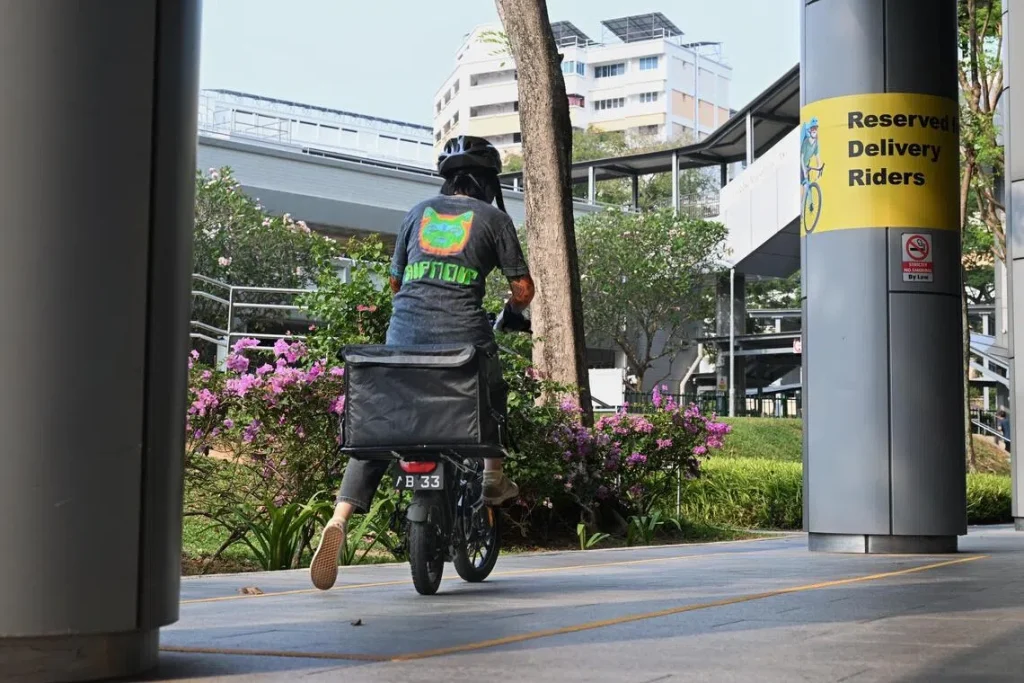
For instance, delivery rider Mika Khor, 34, said she often parks her e-bike – or power-assisted bicycle – on public paths outside condos whenever she makes deliveries.
Despite fears of incurring a fine for parking illegally, it is a risk she takes, even if it is more troublesome and takes more time – up to eight minutes – to walk up to the customer’s doorstep.
And many customers often do not pick up when she buzzes them on the condo intercom system, leaving her stranded outside. She has no choice but to wait and tailgate a resident entering or leaving the block – which in turn, wastes her time, Khor said.
That is why collection points can be helpful, unless security guards make it tough for riders to enter the condo, she added.
In early September, LTA and URA issued a fresh set of recommendations to building owners, managers and developers in a bid to smoothen last-mile food and parcel deliveries in malls, offices and condominiums.
The guidelines include providing facilities like delivery waiting bays where riders can park their vehicles for free within a grace period of at least 15 minutes, and setting up collection points near guardhouse entrances.
Alex Seow, 26, who has been making food deliveries for five years, said he often worries about having to pay for parking at malls when picking up orders from vendors.
If dedicated parking areas are set up at more malls, Seow said it would help ease his worries.
But such parking spaces for e-bikes and motorcycles are better if under shelter to prevent incidents of vehicles catching fire in the sweltering heat or exploding, he added.
Implementing new building guidelines like allocated parking spaces and collection points in condos is likely to vary across developments, said management corporation strata titles (MCSTs) and experts.
Any change is likely to be “gradual and uneven” because estates differ in their layouts and residents’ expectations, said Samuel Chng, head of the urban psychology lab in the Lee Kuan Yew Centre for Innovative Cities at the Singapore University of Technology and Design (SUTD).
Older developments with limited space and residents who cannot agree on how to divvy up common spaces to mark out new parking spaces for delivery riders can also pose a problem, he added.
Clearer signs and simpler security registration procedures – among the guidelines issued by the authorities – could be some of the easier options to get condos to adopt.
Winnie Wong, senior managing director for property management at Savills Singapore, said the roll-out of the new guidelines is likely to differ between new and existing developments.
Some measures – like clearer wayfinding signs and dedicated delivery facilities – are likely easier to implement when a project is still in the planning or development stage, she added.
If it involves a completed condominium, the MCST needs to work with existing physical constraints, while considering factors such as space, cost, security and residents’ needs, said Wong.
For instance, smaller condos might have less flexibility to carve out additional space for dedicated parking spots, she added.
Dennis Tan, president of the MCST Association of Singapore, said condos near MRT stations that might have less space and need for carpark spots, and those with features like multiple-basement carparks, could face challenges in creating dedicated parking bays for delivery riders.
As for delivery lockers or collection points, MCSTs would need to consider if there is suitable space, and how much it will cost to install and maintain the facilities, said Wong.
Chng said the suitability of collection points depends on the type of delivery and the needs of residents.
For instance, food deliveries require timely collection, and self-collection can be difficult for residents with limited mobility or for caregivers who cannot leave their homes most times.
In the end, for collection points to work, a change in the customer mindsets is needed, said industry research director Mark Goh, from the Logistics Institute Asia Pacific at the National University of Singapore.
Doorstep deliveries also should cost more, he added. The idea of making a delivery to the nearest locker also needs to be embraced as the new norm, he said.
While the new guidelines set by the authorities are not mandatory, Tan said condos that do not look into solutions to improve deliveries will inconvenience residents and tenants.