At Independent 20th Century, the Biggest Draw Is the Rediscoveries
<img decoding="async" class="wp-image-1694930 size-full-width" src="https://observer.com/wp-content/uploads/sites/2/2026/09/F4-001_Install_I20C_2026_004_V1.jpg?quality=80&w=970" alt="A spacious gallery installation at Independent 20th Century pairs blue monochrome and sculptural works with a suspended rod installation framed by the Breuerâs distinctive window.” width=”970″ height=”647″ data-caption=’Independent 20th Century runs through 27, 2026, at the iconic Breuer building at 945 Madison Avenue. <span class=”media-credit”>Photo: Alexa Hoyer, courtesy of Independent</span>’>
Since this fair’s conception, founder Elizabeth Dee has carefully considered its potential impact, asking first and foremost whether New York even needed another fair. And if the answer was yes, what type and where? The first edition of Independent 20th Century at the iconic Breuer Building, now Sotheby’s headquarters, feels thoughtfully and purposefully curated despite the number of exhibitors increasing 50 percent to a total of 54. The result is a focused and reasonably paced unfolding of narratives across four floors that invites new readings of the art of the 20th Century and the society it reflected.
The Brutalist architecture of the Breuer, which has housed several museums, could hardly have been a better setting for the series of discoveries and rediscoveries the fair offers this year. For art economist Magnus Resch, the lack of booth signs brought a particular sense of equality to the event. “You stop focusing on gallery names and start focusing on the art,” he told Observer, describing Independent and the Breuer as a “perfect match.”
“I thought this year’s Independent was particularly strong,” said art advisor Angelica Sammelbauer when Observer asked for her thoughts at the close of the opening day. She pointed to the quality and depth of the gallery presentations, which she found intellectually engaging without feeling overly academic. “There was,” she added, “a real sense of discovery.” Notably, advisor Maria Brito took her clients to Independent first this year. “It is a very curated art fair with some hits and some misses,” she commented when Observer ran into her later at The Armory Show, noting that there are also a lot of fillers and works that looked extremely dated, but that the overall experience leaves plenty of space for discoveries.
“Independent was such a pleasant surprise,” advisor Adam Green echoed, reporting that several galleries mentioned they were inspired by the opportunity to show in the Breuer building. “As a visitor, being back in the Breuer was nostalgic, and the fair’s focused approach was a refreshing change of pace from the mega fairs we’ve grown accustomed to.” The setting was certainly a draw—the aisles buzzed throughout the day.
Starting on the fifth floor, Michael Hoppen Gallery is presenting “Out of Chaos: Paper From the Floor of Francis Bacon’s Studio,” a selection of rare photographs and archival material of Francis Bacon from the personal collection of founder Michael Hoppen. Much of the material comes directly from Bacon’s 7 Reece Mews studio in South Kensington, where he lived and worked from 1961 until his death in 1992 and which was notably covered in layers of photographs, books, newspapers, discarded canvases and painting materials. “We wanted to present it in a photography context,” a representative explained, noting how all the materials illuminate important aspects of the artist’s practice and the psychology behind it.
Bernard Goldberg Fine Arts LLC is showing the bucolic landscapes and joyful views of early 20th-century urban life in the watercolors and embroideries of Marguerite Zorach, showcasing her work alongside that of her better-known husband, modernist sculptor William Zorach. Some of the watercolors were donated to the Museum of Modern Art in 1935 and remained part of the collection until 2010, when the gallery purchased them. A few of her smaller works sold by the afternoon.
Hollis Taggart has Frank Diaz Escalet’s colorful leather collages; the work of the Puerto Rican-born, self-taught artist and leatherworker first resurfaced earlier this year at the Outsider Art Fair. Priced under $30,000, a desert landscape composition was already sold. Raised in New York during the Great Depression, Escalet began by drawing comic books to support his family before developing a career as a skilled artisan, first in copper and silver and eventually in leather, the medium that defined his success. In the 1950s, he opened the House of Escalet in Greenwich Village, gaining international recognition and designing for figures such as the Rolling Stones, Pablo Casals and Aretha Franklin. It was only after the tragic death of his son that he began making art using his craft skills in the 1970s, producing extraordinarily vibrant inlaid-leather compositions that celebrate and elevate the ordinary working-class and immigrant experience.
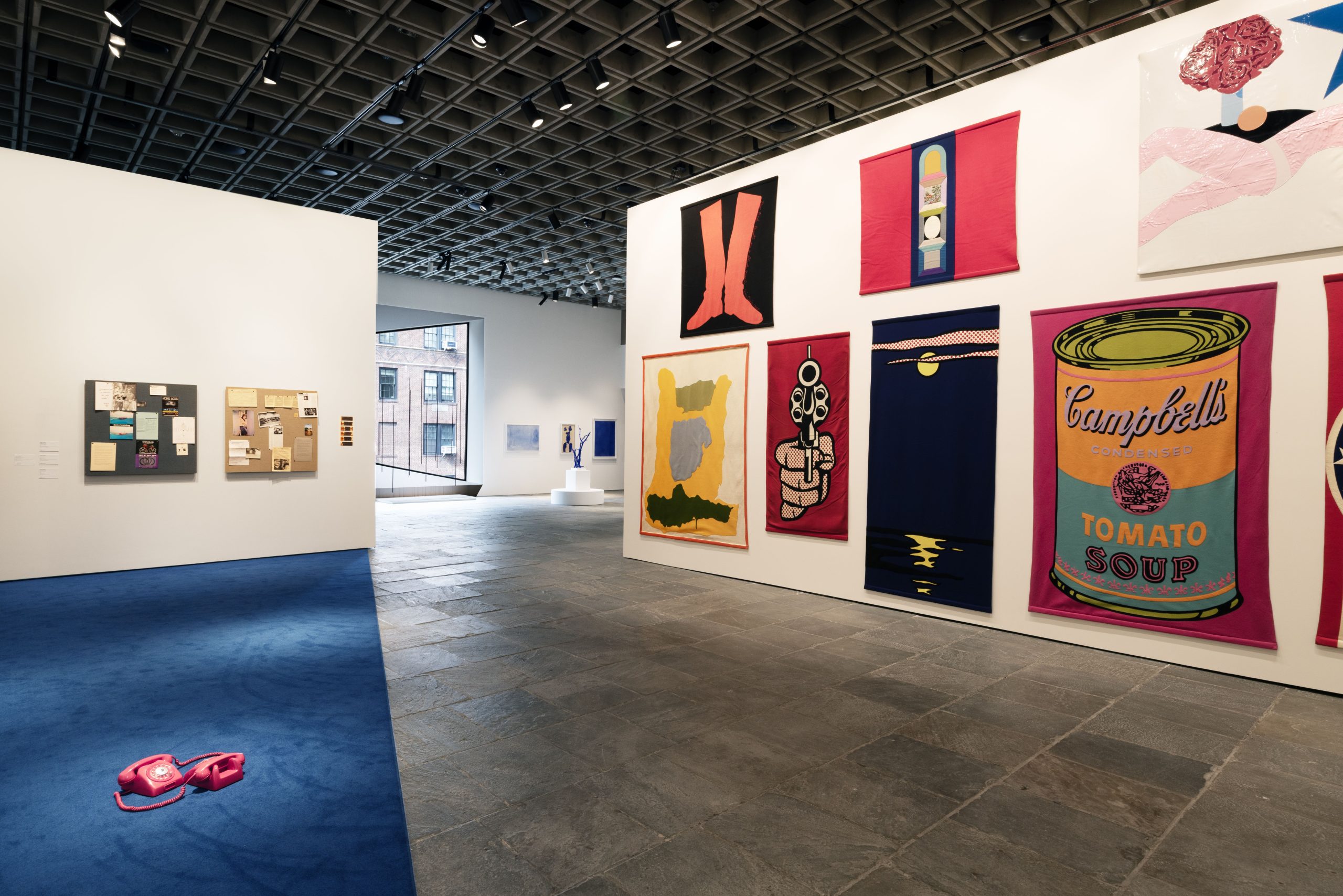
<img decoding="async" class="wp-image-1694933 size-full-width" src="https://observer.com/wp-content/uploads/sites/2/2026/09/F4-009_Install_I20C_2026_012_V2.jpg?quality=80&w=970" alt="A gallery wall displays brightly colored textile banners and graphic works, including a large Campbellâs Tomato Soup motif, with a pink telephone placed on a blue carpet below." width="970" height="647" data-caption='Marian Goodman Gallery presenting a selection of artists’ banners she commissioned in the ’70s under Multiples Inc. <span class=”media-credit”>Photo: Alexa Hoyer, courtesy of Independent</span>’>
One floor down is the highly anticipated presentation of the artist banners Marian Goodman commissioned under her imprint, Multiples, Inc., before founding her legendary gallery. Hanging throughout the booth are editions by some of the most established names of that generation, from Pop Art giants such as Roy Lichtenstein, Andy Warhol, Jim Dine and James Rosenquist to Gerald Laing, Arman, Helen Frankenthaler, Miriam Schapiro, Marisol and Robert Indiana. Produced between 1963 and 1972, each banner began with a design and materials chosen by the artist, who then oversaw its execution by artisans to ensure every banner in the edition remained consistent with the others. They are the embodiment of a pioneering and clever strategy by the legendary gallerist to create an access point to artists who would become established names by laddering offerings across different price tiers and making contemporary art available to a wider audience, including middle-class households.
Meanwhile, Esther Schipper is presenting a whimsically playful booth centered on the pioneers of “Relational Art,” featuring a mix of historical works by Dominique González-Foerster alongside works by Angela Bulloch, Liam Gillick and Pierre Huyghe, as well as a rare restaging of Philippe Parreno’s Iceman in Reality Park (1995-2023). The result is a surreal environment that builds a mysterious narrative across works that already go beyond form and content to become sites of action and social interaction.
In tandem with the current curatorial bent toward Surrealism, an entire section of the fair focuses on the overlooked, often female artists whose practices intersect with mysticism, healing rituals and alternative forms of spirituality—part of a broader attempt to read and reinterpret the history of modernism through a more symbolic, psychic and visionary framework.
<img decoding="async" class="wp-image-1694932 size-full-width" src="https://observer.com/wp-content/uploads/sites/2/2026/09/Unknown-6.jpeg?quality=80&w=970" alt="A pale blue wall displays five framed geometric drawings arranged in a symmetrical grouping at Independent 20th Century." width="970" height="727" data-caption='Hauser & Wirth presenting Emma Kunz. <span class=”media-credit”>Photo: Object Studies, courtesy Hauser & Wirth</span>’>
Among the artists recently brought back into the spotlight is self-taught artist Emma Kunz from rural Switzerland, who regarded her artistic creations as vehicles and tools for healing rituals. Her mandala-like forms suggest this channeling and a shift in perspective from the individual toward a cosmic and universal order. Hauser & Wirth is showing a rare grouping of nine geometric compositions and placed several immediately, with prices ranging from $280,000 to $310,000. The presentation serves as a prelude to the forthcoming major exhibition of Kunz’s work at Hauser & Wirth Somerset, conceived in partnership with the Emma Kunz Foundation and opening in November.
San Francisco gallerist Wendi Norris is well-versed in this field, having been behind the rediscovery of artists such as Leonora Carrington and Remedios Varo. At the fair, the gallery has mounted a solo booth of the visionary work of American Surrealist Marie Wilson, following a successful solo show at the gallery last February. Wilson draws mandala-like, kaleidoscopic forms that encapsulate within a system the interconnection between the micro- and macrocosmos. She arguably expanded Surrealism’s horizons from the individual toward a more universal subconscious, forging a mystical engagement with universal structures articulated through an ancestral and archetypal symbolic language, as well as through a connection with nature and its cycles.
After a first spotlight in Europe during the Swiss edition of Art Basel, Richard Saltoun is showing the powerfully mysterious symbolism of the recently resurfaced Austrian-Italian Surrealist Manina. Born in 1918, Manina got into art and painting only after meeting Frida Kahlo in 1946. Facing rising antisemitism in France, she fled to Los Angeles in 1938 with her husband, the screenwriter Robert Thoeren, where she stayed for a decade before moving to New York. Returning to postwar Europe in the ’50s, first to London and then Paris, Manina eventually settled in Venice, where, with her second husband, French Surrealist poet Alain Jouffroy, she founded the city’s first Surrealist group. Gaining early recognition for her dream-like visions, Manina last exhibited in New York alongside René Magritte at legendary Surrealist dealer Alexander Iolas’s gallery in 1952. The gallery’s expansive presentation immediately received strong interest from both private and institutional buyers for its group of luminous mixed-media canvases from the ’50s and ’60s, with prices ranging from $40,000 to $100,000. One sold and several were on hold by the afternoon.
David Nolan and March Selwyn have brought a shared presentation of the expansive, rich symbolism of the art of Guatemalan artist Rodolfo Abularach. Planetary and mandala-like forms, as well as his best-known subject, the eye, become portals connecting the inner world with something broader, repositioning the human presence within a mysterious cosmic order of vital relations, interdependence and exchange. His interest in the mysteries of the earth also led him to depict volcanoes, emblems of the artist’s homeland and ancient history, resulting in timeless cosmic visions. Prices range from $20,000 for works on paper to $350,000 for larger paintings.
Nolan is doubling down at the fair with another collaborative booth with Gio Marconi. “The Obsessive Image” explores the recurrence of images, forms and artistic preoccupations in 20th-century art through the work of artists from different geographies, including Joseph Beuys and Bruce Nauman, as well as Italian postwar figures such as Gio Colombo and Lucio Del Pezzo.
Meanwhile, Lévy Gorvy Dayan highlights the more spiritual and mystical essence of Yves Klein’s practice, with a solo booth anchored by the seldom-seen sculptural installation Pluie bleue (Blue Rain, conceived 1957), in which 12 elongated rods coated in International Klein Blue pigment are suspended in midair to evoke falling water, hanging right in front of the window in confrontation with the Upper East Side architecture outside. The booth also includes works from his Cosmogonies series (1960-61), in which dry pigment and binder on paper and canvas evoke the primordial alchemy of natural phenomena, as well as bronzes from Klein’s Reliefs planétaires (Planetary Reliefs, conceived 1961-62), extending that same search for a more elemental, cosmic order.
Berry Campbell, well-positioned for this moment, has built its entire gallery program around a mission of rediscovery of the feminine side of American modernism. Here, the gallery pays homage to the role of Stable Gallery founder Eleanor Ward and the women artists she championed. Anchoring the presentation is a smaller Joan Mitchell abstraction, priced at around $2 million, presented alongside a 1956 canvas by Elaine De Kooning, priced at $745,000, and a 1976 Grace Hartigan abstraction priced at $650,000. Also included in the booth are works by other figures whose markets have recently been revived, such as Janine Biala, Dorothy Dehner, Perle Fine, Mercedes Matter and Charlotte Park. Pieces by Biala, Park and Yvonne Thomas all found buyers on day one, priced at $75,000, $15,000 and $60,000, respectively.
Bueno & Co. has brought an exhibition of Joan Mitchell’s sketchbook drawings in colored marker, while Olney Gleason is presenting a focused solo presentation of Elaine de Kooning’s work, highlighting her celebrated Bacchus series. De Kooning started the series during her time in Paris, inspired by walks around the Jardin du Luxembourg and the subtle shifts of light and color she encountered against a 19th-century bronze statue of Bacchus, the Roman god of agriculture, wine and fertility. The different canvases capture these dynamic transformations day by day, moment by moment, as light encounters the sculpture and interacts with the shifting surroundings. The result is a vibrant body of work that critic Lawrence Campbell would compare to Claude Monet’s paintings of Rouen Cathedral (1892-1894).
“Elaine de Kooning has long deserved to be in the center of the conversation about Abstract Expressionism. With all of the major AbEx exhibitions happening in New York this fall, we felt there was no better time for this reawakening, and no better series to put forward than the complex and dynamic Bacchus paintings,” gallery co-founder Eric Gleason told Observer. “The rarity of these paintings is evidenced by this being the first solo presentation dedicated to the Bacchus series in more than 30 years.”
During the VIP opening, Olney Gleason placed two canvases: Bacchus #4 from 1980 and Bacchus #6, made two years earlier in 1978, priced at $750,000 and $375,000, respectively. Other works from the series are now in the collections of the Museum of Fine Arts in Boston; Kemper Museum of Contemporary Art in Kansas City, Missouri; National Museum of Women in the Arts in Washington, D.C.; Guild Hall in East Hampton, New York; Tufts University Art Gallery in Medford, Massachusetts; and Georgia Museum of Art, in Athens, Georgia.
Thaddaeus Ropac asks fairgoers to consider a perspective on abstraction outside the Western canon with a focused presentation that pairs the more meditative and contemplative Korean masters, such as Lee Ufan and Dansaekhwa artists Ha Chong-Hyun and Lee Kang So, with the viscerally expressive gesturality of Gutai artist Kazuo Shiraga.
Among the other rediscoveries beyond the Western and European-American-centric canon at the fair, Bogotá and New York gallery Instituto de Visión is bringing greater international attention to the work of Ana Mercedes Hoyos, a historical Colombian artist whose cinematic frameworks encapsulate more surreal and metaphysical visions of fragmented memories across different places and times. With the evocative title “Un verano en Nueva York” (“A Summer in New York”), the presentation focuses on the artist’s short period spent in the city, which nourished her imagination and visual lexicon, giving her access to post-Pop movements as well as an intellectual freedom she was not accustomed to back home.
The fair pushes its art-historical dialogue even further, with Upper East Side gallery Craig Starr, which pairs the minimalist geometric abstractions of Myron Stout with Early Cycladic works in an elegant, stripped-down conversation across centuries, drawing out a shared economy of form, balance and essentialist abstraction.
Marking a historical first for the nonprofit, the Andy Warhol Foundation is also presenting at the fair, having brought a curated selection of Warhol’s more intimate and essential homoerotic drawings from the 1950s, many of which are never before seen. Affordably priced between $5,000 and $16,000, proceeds from the sale of the works will support the foundation’s programming as well as ongoing research and academic discourse.
<img decoding="async" class="wp-image-1694981 size-full-width" src="https://observer.com/wp-content/uploads/sites/2/2026/09/imgi_3_825178478_18437944615134133_3524180935000547903_n.jpg?quality=80&w=970" alt="A white-walled gallery installation pairs a bold black-and-white geometric abstraction with small Early Cycladic sculptures and vessels displayed on pedestals." width="970" height="970" data-caption='Craig Starr Gallery presenting “Myron Stout & Cycladic Art.” <span class=”media-credit”>Courtesy Craig Starr Gallery</span>’>
More in art fairs, biennials and triennials
-
While Some Traditional Fairs Scale Back, the Other Art Fair Keeps Growing
-
The Armory Show’s Strongest Argument for Relevance Comes From Its Youngest Galleries
-
Art Fair Confidential: An Insider’s Look at Staging the Armory Shows of Yesteryear
-
The Women of the Legendary 1913 Armory Show
-
Sales at Tokyo Gendai Reflect an Evolving Market Surprisingly Resistant to Trend-Chasing