
ASEAN transport digital connectivity and net-zero initiatives
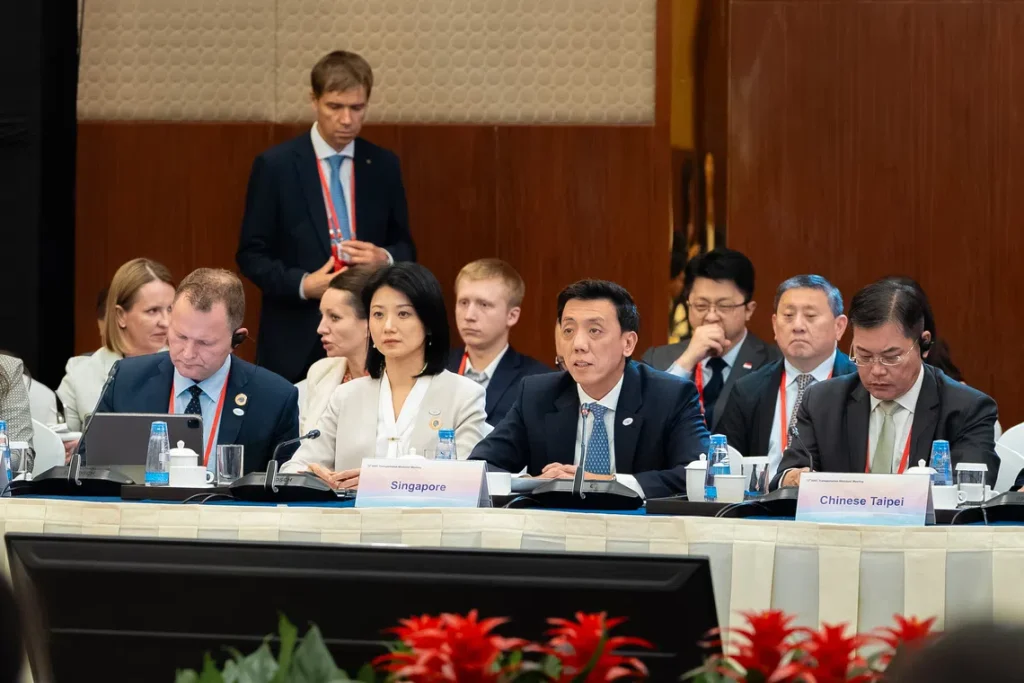
SINGAPORE – While transport connectivity has largely centred on physical infrastructure developments, digital connectivity has become equally important as transportation and logistics increasingly depend on data and technology, said Transport Minister Jeffrey Siow on Sept 22.
Speaking at the 12th iteration of the Asia-Pacific Economic Cooperation (APEC) Transportation Ministers’ Meeting in Beijing, he highlighted three ASEAN technology-driven initiatives that could be adopted across Asia-Pacific for enhanced digital connectivity.
The first is the adoption of digital trade documentation. ASEAN uses an electronic exchange for trade among its 11 members, reducing average transit time by four days per transaction, while saving businesses over US$6 billion (S$7.65 billion).
It is currently extending these systems to other countries, including China, Japan, South Korea and the US.
Siow noted that four billion paper documents are still used internationally every year for cross-border trade.
ASEAN is also looking to improve interoperability in airspace management.
Because air navigation service providers use different systems, air traffic controllers in different flight information regions rely on voice calls to facilitate aircraft movement.
ASEAN is setting standards under an initiative that allows various information to be shared digitally, giving air traffic controllers across the region better perspective of the skies.
While the initiative is still a work in progress, Siow suggested that APEC could build upon existing structures to further connect aviation systems.
The third ASEAN initiative Siow highlighted was in cybersecurity.
Pointing to recent cyberattacks that forced Malaysia’s Port of Tanjung Pelepas to suspend operations and ransomware strikes at UK airports that exposed customer data, he stressed that a system is only “as strong as its weakest link”.
To counter these weaknesses, ASEAN set up an emergency response team to share threat intelligence on critical infrastructure.
Urging APEC economies to develop similar collaborative platforms, Siow stressed the need to improve coordination when responding to such cyber threats.
“Our transport systems are becoming more digital, interconnected and interdependent. Our cooperation must evolve in the same direction,” he said.
Earlier on Sept 22, Siow also spoke at the Global Sustainable Transport Forum in Beijing, where he reiterated Singapore’s commitment to its net-zero objectives.
He cited how the Republic is implementing the use of sustainable aviation fuel, requiring all passenger flights departing the country from Jan 1, 2027 to use at least 1 per cent of the green fuel.
This will progressively increase to 3 to 5 per cent by 2030. The higher cost of using such fuel will be offset by a levy imposed on travellers leaving Singapore from Jan 1, 2027 with tickets sold from Oct 1.
In the maritime sector, the city-state has taken steps to introduce alternative fuels such as methanol.
Siow also highlighted the importance regional cooperation for clean energy supply, citing the ASEAN Power Grid as a crucial initiative connecting clean energy demand with supplying nations.
But he acknowledged the project faced regulatory hurdles, and Singapore – which assumes chairmanship of the regional bloc in 2027 – will work with member states to address them.
“Transport has always been about connection. But the transition to net-zero demands that we deepen those connections – integrating not just people and goods, but our energy systems, our markets, and the rules that underpin them,” he added.