A tiny home community in Colorado is just part of a small town revival project
Story first appeared in:
ARRIBA — For years when he was younger, Ben VanderWerf dreamed of starting a town somewhere out West, the kind of place where cool rivers wind through mountains and the roar of cities is a distant echo.
It was easy enough to imagine: He’d lived in towns all of his life. Visited dozens. Passed through them as he grew up, left Indiana and worked as a contractor capturing birds trapped in the high indoor eaves of big box stores.
But by the time he was in his late 20s, he was ready to start putting down roots. Gone was the dream of creating the quintessential mountain town from scratch. He and his new wife needed affordability. So they settled in Arriba, population 300, about 70 miles from the Kansas border just off Interstate 70 in Lincoln County.
In truth, Arriba couldn’t have been more different than the picture that drew VanderWerf west, nor did it fit into any mold he knew of. “There is no quintessential prairie town look and feel that I can point my finger to,” he said one blustery day in January.
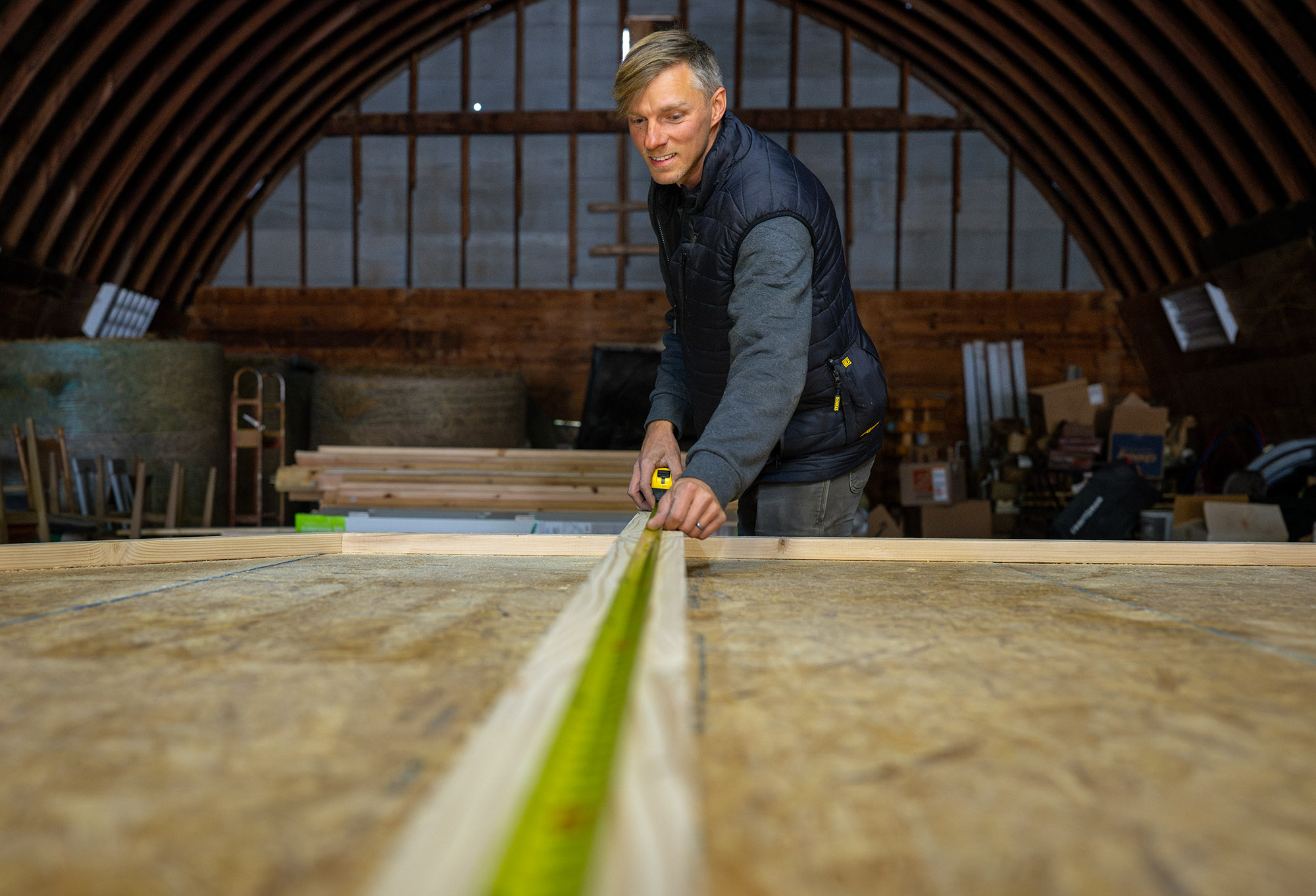
But he’s landed in a prairie town and he’s building a village with 65 recreational vehicle spots and 33 pads for tiny homes, for people like him. He lives with his wife and four kids in a 550-square-foot tiny home prototype he built in 2021.
In September, he said he was “enjoying the blessings of having a mostly full RV park and a clubhouse nearly built” that when finished will have two bathrooms, four washing machines and “a freezer vending machine a local rancher wants to put in with pork chops, ground beef, steaks and sausages.”
But some Arriba residents are critical of what VanderWerf is trying to do, which is curious at a time when many Eastern Plains towns — including Hartman, 140 miles to the southeast — are struggling, and few — like Flagler, 15 miles east — are thriving.
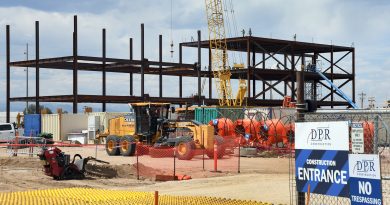
Big Ben’s RV Park and Tiny Home Community is rising from a campground at the bottom of Arriba’s Interstate 70 exit ramp that, when he arrived, had been dormant for decades.
He found the owner of the land, signed a lease for $800 a month and went to work bringing the site back to life. With the wind and solar energy development boom on the Eastern Plains — not to mention the 230-mile fuel pipeline ONEOK, Inc. is building from Kansas to Denver International Airport and the transmission lines Xcel Energy is building to bring renewable energy from the plains to the Front Range — there was a proven market for traveling crews that post up in their travel trailers and RVs wherever work is near.
After cleaning up the campground, prepping the ground, putting in pads with hookups and scouring the existing “clubhouse” — a couple of filthy bathrooms with the windows busted out — he opened Big Ben’s on Labor Day of 2023 with 32 sites. He said it took two years to see major activity, mainly from green energy workers coming to the Eastern Plains to make a buck.
He also set aside an area for the tiny home community — a utopia on the prairie where families could live for $650 a month, utilities, internet, use of the clubhouse included.
And all of a sudden, he was fulfilling his vision, just a little differently than he’d first imagined.
Today, nearly all of the hookups are rented with both monthly and nightly residents. One tiny home is under construction and more are on the books. They’re at 90% capacity and will be for the next two months, he said, until the contract workers move on.
At build-out, he plans to have a community garden with a chicken coop, tiny home Airbnbs, 24-hour amenities, a clubhouse with a restaurant and convenience store, an outdoor stage for bands he’ll bring in, a pavilion, playground, dog park, dedicated propane lines for RV resident sites and a mini golf course and pickleball court.
“I guess you can say I have a town unto myself at the moment, a town within a town,” he said as the wind tousled his hair and he gazed upon his creation-in-the-making.
What lessons can Hartman or Flagler offer as VanderWerf pushes on with his vision? And will Arriba accept the developer who waltzed into town with a dream of creating paradise on the Eastern Plains?
Arriba: “a diamond in the rough”
Not long ago, Arriba attracted visitors with Grampa Jerry’s Clown Museum, which had more than 3,000 artifacts including a clown head made out of a hairball removed from a cow stomach.
Grampa Jerry’s was so quirky it was featured in state and national media, listed on Yelp and highlighted in the International Clown Hall of Fame & Research Center.
But after “Grampa” Jerry Eder died in 2010 and his wife, Dale Ann, tired of keeping it open, it closed in 2016, leaving the tiny pink shack where the clowns were displayed to wither.
Founded in 1918, Arriba (originally pronounced Ah-ree-ba, then Anglicized by late-coming English-speaking settlers to Air-uh-buh) was once a boomtown with a saloon, a school, a market, a newspaper (The Arriba Record), a lumberyard, four churches, restaurants and motels.
But the town lost traction when the last section of I-70 opened in 1973, pushing Front Range-bound traffic right past it. In 1983, the Arriba school district consolidated with Flagler’s “and then the kids grew up and went off to Denver or college somewhere and didn’t come back,” said Marilyn Lightsey, Arriba’s mayor and postmaster, local real estate agent and owner of Myrt’s Place coffee shop — one pot brewed at a time.
When VanderWerf showed up in 2019, only a handful of businesses existed in the town he calls “a diamond in the rough.” Today, there’s a locksmith, welding shop, agriculture chemical dealer, gas station, the local grain co-op, Myrt’s and, at the opposite end of town, another RV park.
Many houses, streets and sidewalks are in need of some repair. A persistent wind wafts dust and the occasional puff of chaff from the local grain elevator into the air. Rows of windmills powering the Front Range fan out in the distance. And almost all of the I-70 traffic still speeds by, hell-bent for Colorado Springs and Denver.
Lightsey loves it. “It’s a slower pace than the Denver area and most of the people here are older in age,” she said one morning while sipping coffee at Myrt’s with her friend Karen Kovar, who years back landed in Arriba. There’s a little vegetable garden in the town park and twice a week, seniors can get a low-cost meal made possible by the Meals on Wheels program and East Central Council of Local Governments in Stratton.
With Amazon, Walmart and Sam’s Club online, Arriba residents can get almost anything they want, but a hospital and a small grocery store with fresh veggies could be nice.
This story first appeared in Colorado Sunday, a premium magazine newsletter for members. Experience the best in Colorado news at a slower pace, with thoughtful articles, unique adventures and a reading list that’s perfect for Sunday morning.
As for tourists, “we get them coming through, but there’s nothing for them to come look at or do or anything like that,” Kovar noted (although there is this single-room museum in town hall visitable during town hall business hours). And housing is an issue.
But Lightsey says she wouldn’t want to live anywhere else. There’s a hospital in Hugo, 25 miles to the southwest, and more doctors in Stratton, 37 miles east. Limon, with 2,000 people, is 25 miles to the west and Colorado Springs is 100 miles south. Despite the challenges “you just figure out how to adjust because the payoff is the community and solitude,” Lightsey said.
With remote work options, lower real estate prices and excellent connectivity thanks to new high-speed fiber optics across the Eastern Plains, flight from rural towns to cities “is starting to finally run its course,” said Troy McCue, executive director of the Lincoln County Economic Development Corporation in Limon. “I think people are going to start looking for the quintessential small town.”
And VanderWerf believes Arriba could be it.
Arriba’s wastewater challenges
That said, business isn’t exactly booming in Arriba, and a looming huge expenditure could stand in the way of a brighter future.
The town’s sewer system is outdated and McCue said new state wastewater rules will force Arriba to address the issue. The existing sewer ponds are operating normally but will need sludge removal in the next couple years.
VanderWerf said the state is putting some pressure on Arriba to build a new $3 to $5 million evaporative sewer pond setup. And McCue said “the town indeed has some expensive compliance measures it will need to meet that will be difficult to afford.”
Lightsey calls the ponds “awful” and said if the town doesn’t meet the state’s improvement deadline of 2029 there could be penalties.
The pressure is on, and VanderWerf said Big Ben’s has become a target with its RV hookups that plug into the sewer system. The town charges him a $7 flat fee per month for each sewer drop on top of other fees he pays for sewer and water. But some residents are upset, he said, because “that amount is nowhere near the residential rate and (they think) it needs to be 100 times more than it is.” The fees are out of his hands, however, because town ordinance sets them for water and sewer hookups.
“So the constant trying to increase something that was already set in an ordinance is frustrating,” he said. “This play of ‘Oh, hey, wait. You’re successful over there. Well, what are you gonna do for us?’”
“Some people have a short-term mindset,” he added, “where my mindset is, let’s build that sewer pond, but instead of having one business be the savior of the town, why don’t we just have us as a piece of the puzzle, and let’s grow our town, and we’ll have the revenue eventually?”
McCue said the rest stop on the other side of the I-70 overpass at Arriba impacts the wastewater flow more than all of the campers combined at Big Ben’s. (The sticker board, clean toilets and a ½-mile trail there also make it a Colorado Fan Club favorite.)
So are some in Arriba creating a problem where there isn’t one? And could the Eastern Plains town of Hartman be a cautionary tale for Arriba on how to handle conflict?
Hartman: A town with no trust
Keeping up with the latest water and sewer regulations is hard enough, but they can become overwhelming when people can’t work together and don’t trust each other anymore.
In tiny Hartman,140 miles southeast of Arriba, squabbles over water quality and town finances got so ugly that its remaining leaders quit earlier this year and its government officially ceased to exist.
Years ago, railroad cars filled with sugar beets rolled through town and there was a factory that made alfalfa pellets. There were two grocery stores, a lumber yard and a bank in Hartman, which was incorporated in 1910 and named for a railroad employee.
Now there are about 50 residents in Hartman, but no businesses.
Arguments flared at board of trustee meetings, with board members sometimes talking back to angry residents. Others would pipe up, shushing the critics and telling the board to keep the meeting moving. The board’s critics accused trustees of failing to take care of Hartman’s troubled water system, financial mismanagement and ignoring a petition to recall them.
Kevin Bommer, executive director of the Colorado Municipal League, compared the situation to the “Hatfields and McCoys.”
The town racked up more than $100,000 in fines from the state for failing to keep its water system operating properly. Meanwhile, because the town didn’t audit its finances, the state wouldn’t allow it to spend any of the property taxes it collected for nearly four years.
At a meeting in December, the arguing started before the meeting officially began, with a woman questioning the town’s insurance costs.
The discussion about insurance and the water system paused as people recited the Pledge of Allegiance but then it picked right back up again, according to an audio recording. The woman who had been speaking out, resident Shawna Casey, said she wanted the minutes to reflect that she was not there to be disruptive, adding “you guys just don’t want to hear the truth.” Another woman responded “Could you please be quiet and let us have the meeting?”
A month later, after a physical fight over a water bill following a meeting in January, all three of the remaining trustees resigned. The town used to have six trustees but then reduced that to four. The board didn’t replace the fourth after that trustee resigned, said Dean Simmons, who served as a town trustee until 2012 and whose family has lived in Hartman for decades.
There was no one left to pay the bills, call an election or maintain the water system. Birds and bugs were flying in through holes in the water tank. Residents had to boil their water to drink it, as they have off and on for years. Showers smelled like rotten eggs because of the sulfur in the water.
“You come out of the shower smelling worse than you go in,” Simmons said. His wife, Jessie Simmons, who grew up across the street, is also a former trustee. She filed the petition to have Hartman declared abandoned under a new expedited process approved by state lawmakers this year.
“You can’t run a town if you can’t run a meeting,” she said.
Hartman last held a trustees’ election in 2024 but not without controversy. There was a recount and a resulting tie between two trustees candidates was broken with a hat draw. A vote to unincorporate the town narrowly failed in that same election.
Normally a town needs to go five years without having an election before it can be deemed abandoned and return to being an unincorporated part of a county. But state lawmakers passed a law allowing Hartman to be declared abandoned without waiting in order to keep the town’s water system operating.
The Secretary of State’s Office decreed Hartman abandoned in July, allowing the Colorado Department of Public Safety, working with the Colorado Department of Local Affairs and Prowers County, to assume emergency control of the water system.
Casey has appealed the abandonment decision. In the meantime, the water system is being operated by the Colorado Rural Water Association with $100,000 funding from the state health department. The money is also paying for testing and making sure the power bill is paid to keep the well pump working, said Kaitlyn Beekman, a spokesperson for the state’s water quality control division. Chlorine has been added, which got rid of the sulfur smell. But residents still must boil their water until the system is flushed with enough chlorinated water and more tests can be done to confirm it’s safe for drinking, Beekman said.
Dawn Railsback, who moved to Hartman to join her son there 12 years ago and was the candidate who lost in the 2024 election, faulted the trustees for not taking action on grants to repair the water tower for years.
“They should not have shut down the town the way they did because they couldn’t do their jobs,” she said.
The town seemed to grow more divided as some people seemed threatened by newer people who moved in and bought property, she said. Some residents wanted people to keep their lawns manicured but Railsback said she likes living “country,” keeping a pile of wood for burning stacked in her yard, growing vegetables and not worrying too much about weeds.
“We were a divided town. One wanted to push what they wanted at the other side and the other side said no, you’re not dictating to me,” she said.
Earlier this month, the new water operator and the county commissioners held a meeting below the water tower to update residents on their progress so far. They explained that the heavy chlorination of the water would eventually be scaled back, Prowers County Commissioner Ty Harmon said. Two residents became boisterous and others began walking away so the commissioners decided to end the meeting, he said.
“Everyone is pretty tough down here in this part of the state so we can get through it,” Harmon said.
Flagler is the opposite of its next door neighbor Arriba — a town just a little bit bigger (the population hovers around 500) and so sure of itself it has a sign offering land to the right person, believing it’s good enough that whoever comes will want to stay.
Nevermind the offer has been up since 2012 and no one has succeeded in taking it.
It’s not them, it’s Flagler.
The land is strictly designated for business and industrial development that will create jobs and boost the local economy.
“Even though people have come in with all these different ideas, the town is pretty particular about the vision they see for that land,” said Cheryl Witt, Flagler’s postmaster, librarian, owner of the Flagler Theatre and unofficial town historian. New business would be good because Flagler could use more people, who could contribute tax money for infrastructure improvements.
While the town waits for the right business, it rents three parcels to farmers, with a precious commodity: water.
Just like Arriba, Flagler has wastewater issues, with new regulations coming from the state.
They also have much greater revenue, because they’re a town full of businesses.
“Basically we have everything you need here,” said Chris Huelskamp, Arriba-Flagler K-12’s business teacher, Future Business Leaders of America adviser, Knowledge Bowl coach and golf coach when he isn’t dryland farming and helping his wife raise their kids.
“We have a little meat shop and a spice shop and Wagner’s Wild Bird Food, a national company sold in Lowe’s and Home Depot.”
There’s also a medical center, two auto repair shops, two gas stations, restaurants, salons, clothing stores, an assisted living facility, a bank, daycare, motel, library, museum, swimming pool, six churches, several other businesses and a town newspaper produced by high school students, the Flagler Forward, which replaced the Flagler News when it shuttered in 2024.
The median home price is also a relatively affordable $230,000, up about 2% over the past year, according to Zillow. Indeed listed several jobs on Sept. 18. And offering children a quality education and safe place to grow up is paramount, said Doug Hill, 39, who grew up in Flagler, left in his teens, tried life in the big city and returned to raise his two kids on his own.
Left: Kayci Huelskamp paints the face of Hanna Fritzler during the Flagler Days communtiy celebration Aug. 8. Top right: The Flagler Co-Op dominates the landscape along Interstate 70 in eastern Colorado. Bottom right: The Flagler Theatre features murals painted in 1930, seats up to 99 patrons per showing and plays first-run moving pictures like “Spider-Man: A Brand New Day.” Theatergoers can also rent the facility and view their own DVDs or play video games on the silver screen. (Mike Sweeney, Special to The Colorado Sun)
Residents sometimes compare Flagler to the fictional perfect town of Mayberry because you can let your kids play outside until dark, community comes first and the most popular movies at the Flagler Theatre “aren’t the top 10 movies that do well nationally,” Witt said, “but relationship movies, family movies. We like really good kid movies and Christian movies.”
During Flagler Days in August, community was on full display with dads challenging kids to cornhole matches, people cheering as Kent Schlichenmayer, in a full face helmet, drove his modified garden tractor in the tractor pull competition and residents strolled Main Street, lined with tables some had set up selling their art, other wares or religion.
It’s not like they haven’t had shouting matches at town meetings, Witt said, “but I don’t think any person that runs for town council would abandon the town.”
There have been struggles, though. The Lion’s Club recently shut down because there wasn’t enough interest.
“That was a big loss,” Witt said, “because it was such a social aspect of our town, as far as all the projects that they do, like (free vision tests). They were active. They helped build our football stadium. They gave money for the park structure in our main park. They were a kind of nucleus where people could find problems and try to resource them out to the right people.”
Flagler doesn’t know where the funding will come for new liners it needs to put in its wastewater plant, Witt said. But, like Arriba, the town council has raised meter costs for residents and businesses to put some money away for matching funds if they do get grants.
“I guess it is a little like a utopia here, but it’s a little limited on what we can get for sales tax,” she said.
Even so, even the wastewater ponds in Flagler seemed touched by a little Flagler magic.
“The ponds are on the east side of the highway overpass near the golf course, which is, you know, a good hazard,” Witt said laughing. “There are horror stories I could tell you about people thinking they’re natural lakes and stuff. But I guess that’s a good point. The wastewater looks really good.”
Arriba and Big Ben’s future
At the end of the day Arriba is Arriba, not Flagler nor Hartman.
And McCue says that will be its key to success, which he sees coming. Maybe not anytime soon. But in the not-so-distant future.
He says Colorado’s Front Range has boomed and “the activity that radiates out from it” has increased as well. He thinks all of Lincoln County is in the “crosshairs of some beneficial economic growth,” particularly in the warehouse and distribution sector.
He also sees more folks like Lightsey migrating east — people just wanting to escape the fast pace and congestion of Denver while still having access to services and goods and some human interaction (see: Limon, 20 minutes away, or Aurora, an hour and 10 minutes — or the Tuesday night dinners Lightsey has started to sell at Myrt’s Place).
And he believes VanderWerf and Big Ben’s are key pieces in both supporting Arriba and bringing more people to it.
“Ben’s timing was really good because the pipeline projects and the green energy projects were coming on, which filled many of his spaces and helped him begin to have a successful business,” he said.
“And then those people were able to say, ‘Oh yeah, he has a great shack (what he calls the bathroom facility) with new laundry and a kind of community gathering space on site … all conveniently situated on Interstate 70.”
Would some Arriba residents like VanderWerf to kick down more of the profit he makes from Big Ben’s? Sure.
But he already pays his water and sewer fees for hookups, plus a 2% town sales tax for all goods he sells, not to mention the town gets sales tax from everything he or his parents or his sister’s family or anyone who stays at Big Ben’s long enough to get an online purchase delivered, thanks to a U.S. Supreme Court ruling in 2018 and Colorado’s own online tax rules that followed.
When McCue hears people criticizing VanderWerf, he says, “What was that campground doing before Ben got involved and got it leased? Nothing. What was the town receiving for water and wastewater money off of that campground? Zero dollars. Now, I don’t know exactly what Ben’s bills are, but I can guarantee you between water and wastewater, his fees are a couple thousand bucks a month at least.”
VanderWerf says “let’s bring more families in. Let’s make this a bedroom community. Let’s make this something we can grow from here, and get our grocery store and our restaurants and some more entrepreneurs, like the Limons of Colorado.”
And even Lightsey said VanderWerf has been sending business her way.
“I’m on Google — I think Ben put me on — so people can Google coffee shops and find me when they’re coming down the highway,” she said as sunlight streamed through the window at Myrt’s.
“When the pipeline people were in, they’d come to my Tuesday night dinners every week. And lately, one of the wind farm workers (whose 12-hour schedules fall outside of Myrt’s 7 a.m. to 1 p.m. hours) called and said, ‘Hey, if I come over at a quarter to six could you have 10 breakfast burritos ready?’”
“I said ‘You betcha.’ And then she asked for some orders of biscuits and gravy to go, too.”