“I SPY! Walter Wick’s Hidden Wonders” at Atlanta’s High Museum of Art
I know for a fact that “only ’90s kids” will remember the I Spy books because I was going through the recent Mark Dion exhibition at Tanya Bonakdar Gallery with a younger colleague and pointed out that one of the open crates of detritus resembled one. Standing over a dead rat paired with a pearl necklace, it was clear that my companion had never heard of the series. For the similarly deprived, the books were image-rich, large format, and featured colorful tableaus of household items arranged in a way that challenged the young viewer to look deep within the photographs. In my family they were used the same way some people use iPads today: something to give the kids in the back seat so that they would shut up.
The man behind the pictures is Walter Wick (b. 1953), now the subject of “I SPY! Walter Wick’s Hidden Wonders” at the High Museum of Art in Atlanta, the largest survey of his work to date. (The riddles were written by Jean Marzollo, who died in 2018.) The show is the latest entry in the High’s series on the art of children’s books, which since 2013 has covered a range of beloved illustrators, but this is the first devoted to a photographer, which feels overdue given that Wick may be the most widely absorbed photographic illustrator alive.
Born in Hartford, Connecticut, he began in commercial photography and became obsessed with the technical end of studio work—mirrors, time exposures, composites, the whole toolkit of tricks for making a camera describe things that aren’t quite possible. That work led to the first I Spy book, A Book of Picture Riddles (1992), and from there to more than 26 titles over 35 years, sold in the millions. The exhibition is organized by the New Britain Museum of American Art, which in 2015 received 84 of his photographs as a gift from the artist and his wife and collaborator, Linda Cheverton Wick. It pairs beloved plates with rarely seen material—including his early photographs of optical illusions found in nature—and, best of all, a number of the three-dimensional models from which the photographs were made, proof that these worlds were built before they were shot, demonstrating IRL this body of work’s chunky tactility.
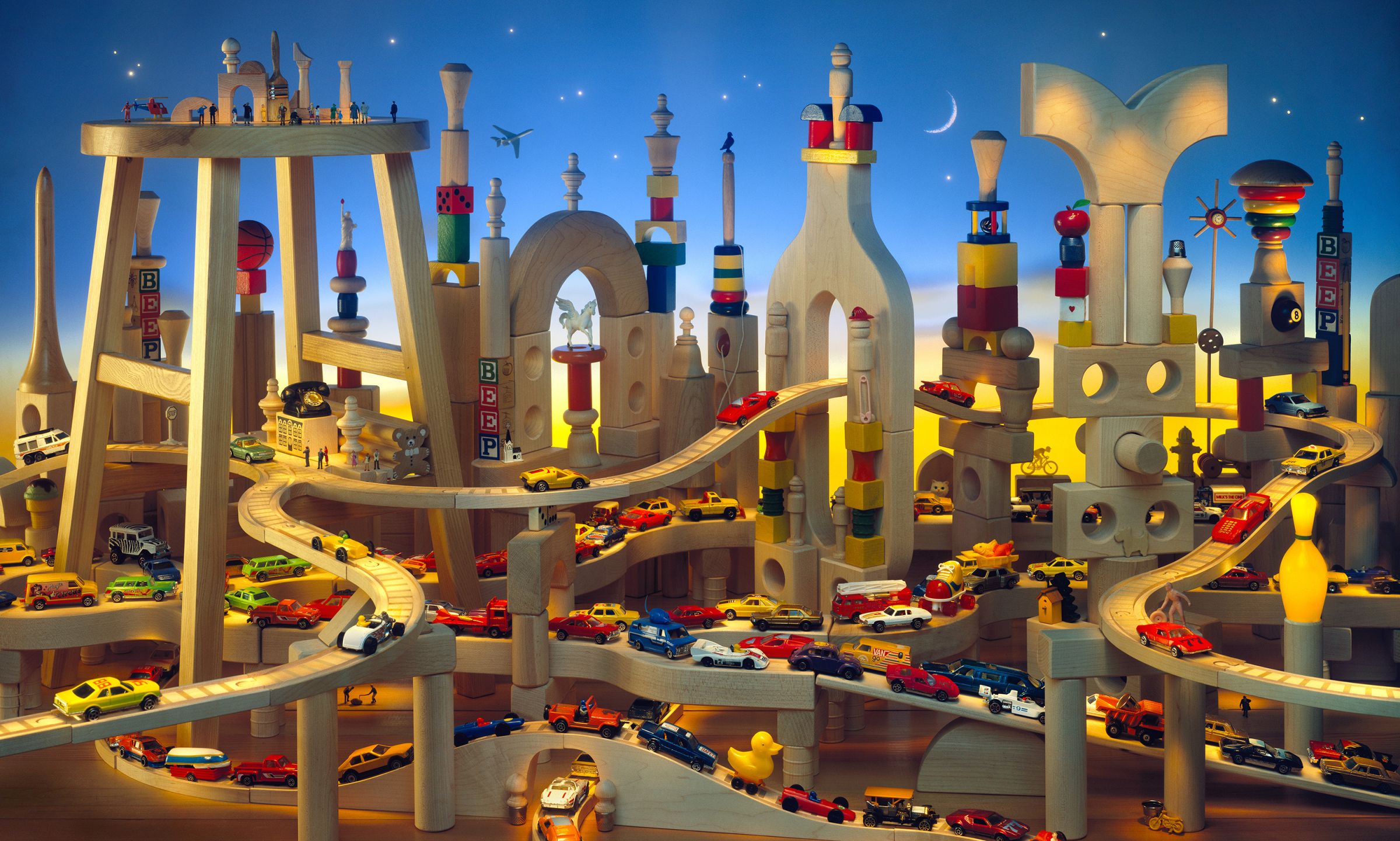
City Blocks (1994) is representative. Here Wick has created a rush hour skyline at dusk, complete with cars and people, from the wooden blocks familiar to kindergarten classrooms. The image doesn’t try to hide that it’s an assemblage of toys, but Wick’s use of color and his creativity in staging make it feel like a real place. Yes, we can find joy in the Easter eggs of letter blocks that spell out BEEP, but for a child the attraction is probably more in the way he’s imbued their world with life.
Yikes! (1994) is an elegant illusion that again uses childhood blocks, this time to achieve the effect of a mid-air collision. Everything is frozen, but it’s hard to tell if these objects are hovering off the ground or collapsing to it. Some of them sport googly eyes and seem concerned; others seem to be in a state of play. But Clouds (1994) may well be his masterpiece. Through cotton and white baubles he’s achieved the effect of a Titian. The atmosphere draws us in and softens everything at the edges of the frame. It could not be further removed from the harsh jangling photographic language of Instagram.