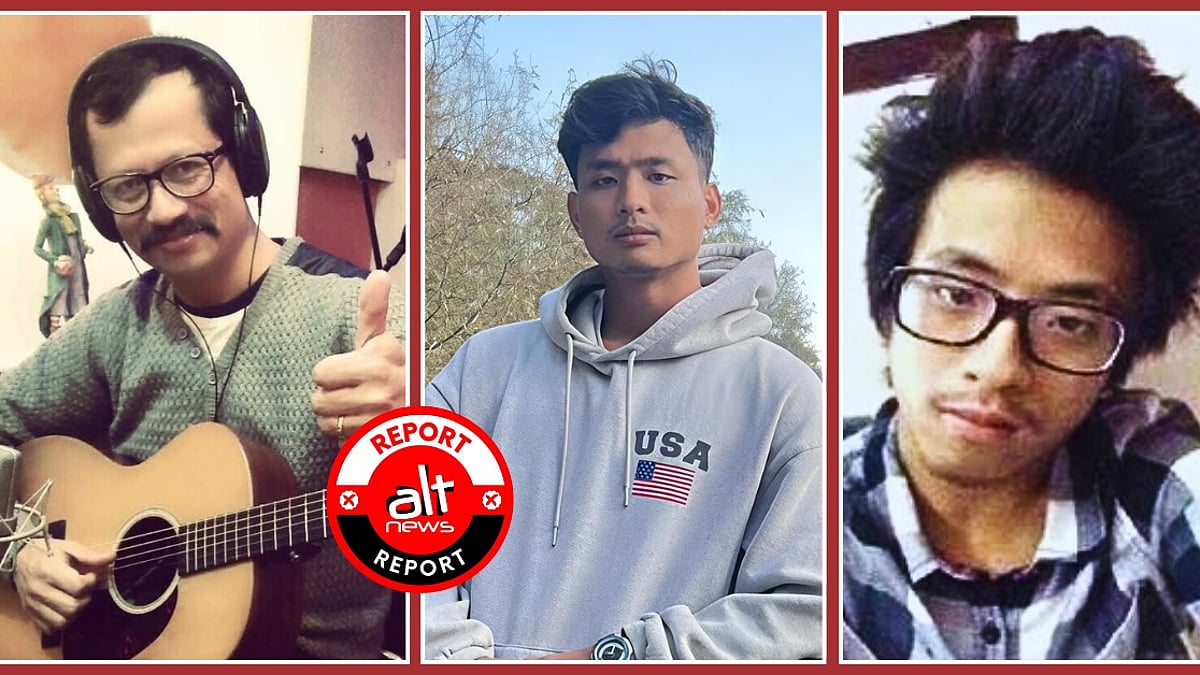
Manipuri musician’s killing reignites concerns over racism against Northeasterners and govt inaction
The autopsy report revealed that Singh died of massive internal bleeding caused by severe physical trauma to his chest and abdomen. The accused allegedly after he fell to the ground. During questioning, they told the police that they wanted to teach Singh a lesson.
While the police investigation so far has not revealed any racial motive behind the violent attack, his death has brought to the fore larger concerns around hate faced by people from the Northeast in the nation’s capital and beyond. It also brings the Bezbaruah Committee’s recommendations, and the fate of those recommendations, back into focus.
The Bezbaruah Committee and Administrative Inaction
The Bezbaruah Committee was formed in February, 2014, after the killing of , a 20-year-old hailing from Arunachal Pradesh, who was beaten to death with iron rods and sticks by three men after a verbal altercation in Delhi. The accused hurled racial slurs at Tania during the attack. The committee was constituted “to look into the various concerns of persons hailing from the Northeastern states who are living in different parts of the country, especially the Metropolitan areas, and to suggest suitable remedial measures which could be taken by the Government.” It to the MHA of the BJP government in July, 2014. It can be read .
The most crucial among the recommendations, perhaps, was a proposal to amend the provisions of the then IPC by adding Sections 153C and 509A. Section 153C would criminalise words, signs or acts that promote discrimination or violence on grounds of race or place of origin, with up to five years’ imprisonment and a fine. Section 509A would criminalise any word, gesture or act intended to insult a member of a racial group, with up to three years and a fine.
On January 2, 2015, then Union home minister that the amendments were accepted and Sections 153C and 509A would be added as recommended by the Committee. However, In 2017, minister of state, home, in the Rajya Sabha the proposal was still under examination, with states’ views being sought. Later, when the IPC was being officially changed to the Bharatiya Nyaya Sanhita (BNS) in 2024 and discussions were being held from 2023, the recommended amendments were entirely overlooked. The provisions were never enacted.
On September 8, 2026, two days after Singh’s killing, the MHA’s monitoring committee on Northeast issues convened a meeting to discuss the recommendations made more than a decade ago. Joram Maivio, a special invitee to the monitoring committee, MHA, and member of the Bezbaruah Committee, spoke to Alt News.
“We were expecting most of the recommendations of the Bezbaruah Committee to be slowly implemented after we received a confirmation from the MHA in 2015. We deliberated extensively on this with the judicial division of the MHA, after which the recommendation was sent to the law commission and the law ministry. It kept going from one department to another. We were verbally, or in principle, informed that it had been accepted and that it would be included when the comprehensive amendment of the IPC took place,” Maivio said.
“The discussions continued through 2017, 2018 and 2019 as the Supreme Court had ordered the committee to meet at least every three years and in serious instances, meetings can be called at any point. In every meeting we kept discussing the issue of racial discrimination and questioning when the law would be amended so as to criminalise racism against Northeasterners. So when the comprehensive criminal law amendments came in 2023 — the BNS, BSA and BNSS — we were expecting this recommendation to be included. But surprisingly, it did not come up,” he added.
Maivio said that he had flagged this on the two or three MHA monitoring committee meetings and questioned the ministry why the amendments had not taken place, but did not receive any concrete answer.
Meanwhile, Delhi police data accessed by in June 2026 showed that more than half of the accused in cases registered over the past 12 years for crimes against people from the Northeast in Delhi remained “untraced” despite “the creation of a specialised police unit intended to address such cases”. Out of the 2,656 FIRs filed between 2014 and April 30, 2026, in 1,465 (or 55%) cases, the accused were classified as untraced. Only 33 cases resulted in conviction, producing a conviction rate of 1.82 per cent.
Asked about what transpired at the September 8 review meeting, Maivio said, “The committee director and joint secretary said that the amendments would be taken up but we were not given any clear timeline as to when.”
“We will keep following up to ensure justice to people from Northeast as incidents of racial violence are chronic and recurring. There is no quick-fix solution, but by denying the reality, we cannot solve the problem. The Government must continue to act decisively to address it and prevent such incidents,” he asserted.
Maivio noted that some measures were implemented in Delhi, including the creation a Special Police Unit for North East Region (SPUNER) with the helpline number, 1093, two special Delhi Police recruitment drives in the Northeast, and plans for a Northeast Social and Cultural Institute in Dwarka. However, he acknowledged that implementation has largely remained confined to Delhi, with little progress in other states.
Northeasterners Condemn Killing, Speak out Against Discrimination
The North Eastern Students’ Organisation (NESO) condemned Vikram’s killing and demanded an impartial probe. Chairman Samuel B Jyrwa, who in 2024 also that Prime Minister Narendra Modi “breaks his silence” and visits the crisis-struck Manipur, told the media: “It is deeply disturbing that a person can lose his life merely for raising an objection to disturbance outside his own home…For years, Northeastern citizens living, studying and working outside the region have repeatedly reported being subjected to racial slurs, verbal abuse, physical attacks, social discrimination and other forms of humiliation because of their appearance, identity and place of origin.”
“It is a very big loss not just for us but also for the music fraternity…We want justice and we want the government to ensure that people from the Northeast are treated as Indians in Delhi,” said Singh’s brother, Chongtham Vivek, as the former’s mortal remains were brought back to Imphal.