What ‘begging’ for $2 taught me about surviving on Singapore’s streets
For the first time in my life, I realised I’m not above begging.
And I actually begged for money – or rather for what passes as money.
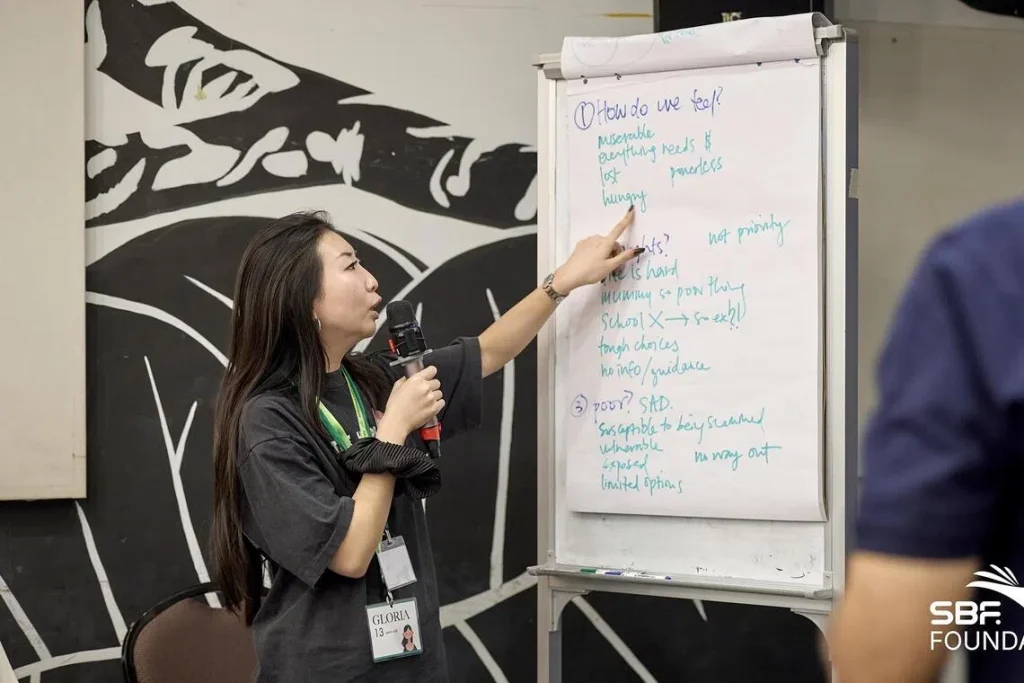
In August, I participated in a poverty simulation session, where I took on the persona of an 80-year-old widow named “Doreen”. Doreen’s life had unravelled after a renovation contractor ran off with all her money and left her one-room flat uninhabitable.
Her only child lived overseas and was uncontactable, and Doreen ended up sleeping outside her flat.
Organised by the Singapore Business Federation Foundation (SBF Foundation), New Hope Community Services and the Singapore Association of Mental Health, the session, called “In Their Shoes”, compressed four days of simulation into about two hours in real time.
As Doreen, I was given $15 in make-believe cash, a few tokens that stood in for ez-link cards, a torchlight, a pair of glasses and a sleeping bag, which were supposed to last for the next four days.
Participants in the exercise took on various personas, which were loosely based on the real lives of people experiencing homelessness who were helped by New Hope Community Services, a social service agency that runs shelters and other services for this group.
Volunteers played the roles of staff at a family service centre (FSC), homeless shelter, supermarket, pawnshop, workplaces and even the Immigration and Checkpoints Authority (ICA).
On day one of the simulation, I naively thought all I needed to do was to go to the homeless shelter and my problems would be solved. I was so wrong.
I needed a referral from the FSC to secure a place at the shelter.
And I needed to produce my identity card to verify my identity before the FSC would take on my case. It was only then that I realised Doreen’s IC had been stolen while she was sleeping on the streets. Replacing my stolen IC would cost $20, but all I had was $15. At this point, I was told I could find a daily-rated job, pawn my valuables (of which I had none) or pick cardboard to sell.
I instinctively chose the first option. I mean, how hard could it be to get a gig job?
Then I realised I was role-playing an 80-year-old unskilled worker without an IC, without food and shelter, without kith and kin. Thinking back, just the thought of how alone and vulnerable Doreen was sends chills down my spine.
The only job available to Doreen was manual labour – rolling a bolt down a long metal rod for $2 per completed unit.
After a full day of this tedious task, I’d earned only $4, leaving me $1 short of the $20 I needed to replace my stolen IC. That was the moment I started begging.
In the grip of desperation, I pleaded with the man next to me in my most piteous whimper: “Have pity on me, this old aunty. I have not eaten for two days.”
The man, another participant in the simulation, gave me $2. He was flush with cash, having earned at least $10 from the same job. Perhaps he gave because he was embarrassed by my constant pleading? Maybe I begged because I felt I wouldn’t be judged or humiliated by a fellow participant?
Would I beg in real life? I hope I will never ever have to find out.
In my feverish drive to cobble together $20, I went hungry – and disobeyed the simulation’s rule that we had to buy food every day.
When there are no real hunger pangs to contend with, spending even one precious dollar on food seems like a waste of money.
But in real life, those living from hand to mouth have to make hard choices. Paying one bill, meeting one need, means giving up something else.
And having savings is a luxury they can only dream of.
With the $2 that I begged for, I finally had enough money to make a replacement IC and get a referral to the homeless shelter.
But that was not the end of the story.
The mental cost of scarcity
During the role-play, the fear and desperation of not having a place to sleep at night and food to fill my stomach warped my thinking.
I couldn’t think straight, weigh my options properly or plan ahead.
I was just so fixated on finding $20 for the new IC.
This is what behavioural economists call the bandwidth tax: the severe toll chronic poverty and scarcity takes on a person’s mental capacity.
Scarcity forces the mind to focus on immediate crises, leaving the person with limited mental capacity for rational decision-making, learning or long-term planning.
What looks like poor decision-making among the poor may not be a lack of reasoning capacity, irresponsibility or laziness. When survival consumes every ounce of energy, there is just no mental bandwidth to really plan or think things through.
This can be a vicious cycle, with repeated bad decisions entrenching people further in poverty.
Lilian Ong, New Hope’s senior director of services and transformation, noted that real-life rough sleepers deal with protracted sleep deprivation and constant hyper-vigilance over their safety and belongings. Not to mention all the problems that led them to sleeping on the streets in the first place.
“Being in a constant crisis state, they are unable to think clearly. It’s a fight or flight mode, so they can think only of immediate needs like food and shelter,” she said.
“Or, when they think of a job, they think of daily-rated jobs where they can get their pay each day, instead of thinking of career pathways or progression.”
Restoring their sense of agency
Stepping into Doreen’s shoes changed how I saw social support for the down and out.
Ensuring there are policies and programmes to help them is important, but what is equally critical is that these people can navigate and access these schemes easily.
If we want social interventions to work, they have to be designed with the lived realities of those with very limited bandwidths in mind.
On their own, with their myriad of problems and limited mental bandwidth, these people would probably be lost at sea.
Such interventions should also involve more accompaniment by professionals and volunteers to support them through real challenges and even perceived barriers, such as thinking it is futile to ask for help.
Already, this is happening among some quarters.
There has been a “deep shift” in how the Ministry of Social and Family Development (MSF) delivers social services, said Minister-in-charge of Social Services Integration Desmond Lee in 2022.
The focus has shifted to meeting the needs of low-income families in a proactive and coordinated manner across different Government and community agencies and putting these families at the centre, instead of organising social services around agencies or programmes, Lee said.
The ComLink+ scheme, which provides financial and other incentives to low-income families with children if they take steps to better their lives, is an example of this shift.
For example, family coaches motivate and support ComLink+ families to work towards their goals, like finding a stable job, while helping them navigate the network of resources. Volunteers also befriend these families to offer support in different ways.
New Hope’s Ong said that the poverty simulation exaggerated the administrative barriers those experiencing homelessness face in real life. In reality, there is more support to help them navigate the system.
For example, those who are found to be in dire financial need will often get help from social service offices to replace their stolen IC, she said.
The PEERS (Partners Engaging And Empowering Rough Sleepers) Network – which brings together government agencies, social service groups and community partners to help the unhoused – has also coordinated efforts to make access to the shelters and aid much easier.
For example, when groups such as the Homeless Hearts of Singapore and the Catholic Welfare Services go on their night walks to reach out to rough sleepers, New Hope staff are on standby to admit those seeking shelter.
The move gives rough sleepers immediate access to the shelter even before the paperwork is finalised, Ong added.
New Hope also has job coaches to help their charges prepare for employment in big and small ways. This includes helping them find jobs, assisting them with their resumes, getting them the necessary attire for work and checking in regularly with them after they start work.
The social service agency is also hoping to train more volunteers to befriend rough sleepers and support them in different ways.
Promoting inclusive hiring
Beyond the Government and social service agencies, businesses can also step up to drive social change.
For example, the SBF Foundation organises In Their Shoes to help business leaders better understand the realities and barriers vulnerable groups face to promote inclusive hiring.
Besides the poverty simulation workshop, In Their Shoes also involved a visit to a homeless shelter and a vocational training centre for people with mental health conditions.
As SBF Foundation chief executive Yap Su-Yin said of inclusive hiring: “It does not mean lowering hiring standards or hiring someone simply because they come from a vulnerable group.
“Rather, it is about making sure that a person’s circumstances do not become an automatic reason for excluding them.”
The two-hour simulation gave me an insight into the indignities of poverty, but I know I can go back to my middle-class comforts after the session is over. Yet, as Doreen, I realised that true assistance also goes beyond receiving food, shelter or financial aid. At the heart of it, effective social support is about restoring a besieged person’s sense of agency and dignity.
By guiding vulnerable individuals through the support system and empowering them to rebuild their lives, we are building a humanity where no one should feel they have to beg for their basic human worth.