TMC symbol war: How Mamata Banerjee’s rebellion legacy has come back to haunt the party she found
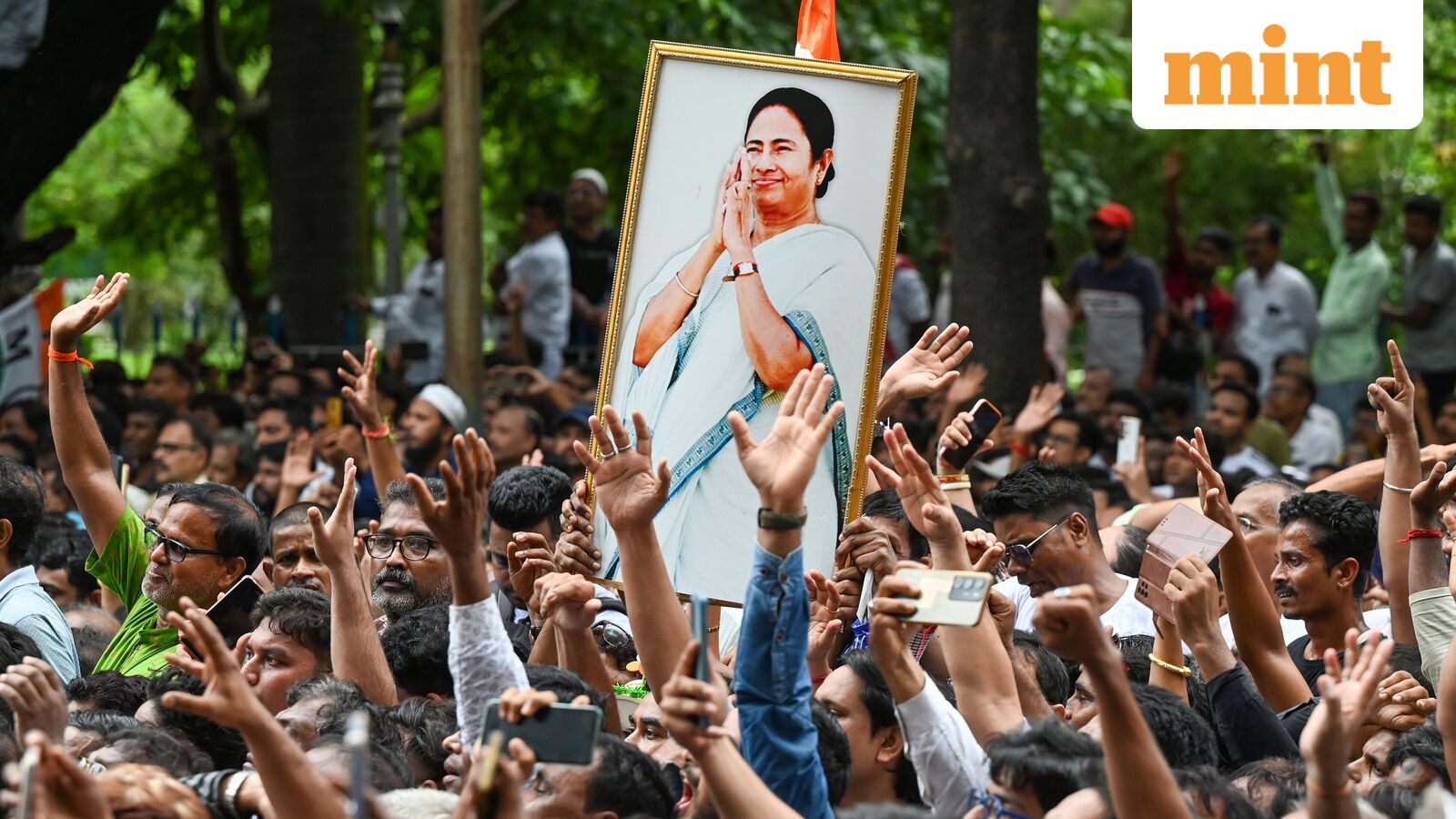
Mamata Banerjee began her political journey by making rebellion her political weapon. In 1998, she broke away from the Congress to build the Trinamool Congress.
Twenty eight years later, after weathering a string of revolts, she finds that weapon turned inward, striking at the very party identity she created and made synonymous with her political journey.
On 18 September, the Election Commission of India (ECI) allotted new names and symbols to the rival factions of the Trinamool Congress – one led by former West Bengal Chief Minister Mamata Banerjee and another by rebel leader Arup Roy.
The development comes a day after the poll panel barred both groups from using the party’s name “All India Trinamool Congress” and its “Flowers and Grass” symbol ahead of the 6 October bypolls.
The group led by Mamata Banerjee has been allotted the name “Mamata All India Trinamool Congress” and the “Football Player” symbol and will be treated as a recognised political party in West Bengal, Meghalaya and Tripura.
The group led by Arup Roy has been allotted the name “Democratic Trinamool Congress” and the “Envelope” symbol and will also be treated as a recognised political party in West Bengal, Meghalaya and Tripura.
The poll panel’s decision ahead of October 6 West Bengal bypolls is not just about dispute over electoral nomenclature but it reflects a manifestation of a larger struggle over the political inheritance of a party Mamata has dominated since its birth about three decades ago.
The ECI order means that for the first time ever both Mamata’s camp and the rebels would seek votes without the name and symbol under which the Trinamool Congress has contested elections until now – Grass and a flower.
For Mamata, rebellion is hardly an unfamiliar political language.
1984 onwards – Mamata’s political journey
Mamata shot to fame for the first time in 1984 when she defeated the veteran communist Somnath Chatterjee to win the Jadavpur Lok Sabha seat. That was her first Lok Sabha election. And in 1998, she broke away from the West Bengal Congress to set up her own party — a ‘Trinamool’ or grassroots, Congress that claimed to be closer to the people.
In the mid-1990s, she fought a bitter organisational battle with then West Bengal Congress president Somen Mitra over control of the state unit. Mitra retained the position. Mamata walked out.
“Life has come full circle, as we know history always repeats itself. She broke away and tried to finish off the Congress despite being born out of the Congress. Karma has strange ways of getting back at you,” a senior Congress leader told PTI.
Mamata’s gamble had then succeeded. The TMC grew and emerged as the principal challenger to the Left Front and eventually became central to the political movement that ended the CPI(M)-led regime’s 34-year rule in Bengal.
Mamata’s party swept assembly elections in 2011, 2016 and 2021. Even in the 2024 Lok Sabha polls, the TMC won 29 of the 42 seats in West Bengal. This was 7 more than it won in the 2019 Lok Sabha polls.
The rebellion streak
Pankaj Banerjee, the party’s founding chairman, left soon after its formation and returned to the Congress before eventually coming back. Ajit Panja, another founding figure, clashed with Mamata over her political strategy in 2001 and unsuccessfully attempted to build a separate platform.
Sudip Bandopadhyay was expelled after falling out with Mamata and returned years later. Subrata Mukherjee, once regarded as one of her political mentors, led a breakaway before rejoining the TMC and later serving in her cabinet.
The pattern was repeated with Dinesh Trivedi and Mukul Roy.
Trivedi’s confrontation with Mamata over the 2012 railway fare increase ended his tenure as railway minister. Roy, once the party’s organisational number two, fell out with Mamata as Abhishek Banerjee’s influence grew, joined the BJP in 2017 and later returned to the TMC after the 2021 assembly election.
Some rebellions damaged the party electorally; others exposed tensions over strategy, ambition and succession. But none displaced Mamata as the political centre of the organisation, news agency PTI said.
Political analyst Shubhomoy Maitra believes the latest rupture has exposed a vulnerability that earlier rebellions did not.
“There was little surprise involved in the disintegration of the party once it suffered electoral defeat,” Maitra told PTI adding that after the TMC achieved its central objective of removing the Left Front from power, it was left without “an ideological fulcrum” or “a long-term development vision for the state”.
The post 2026 defeat rebellion
The timing is significant. The TMC’s defeat in the 2026 assembly election saw its strength fall from 215 of the 294 seats in 2021 to 80, sharply weakening the organisational dominance that had helped contain competing ambitions.
Within weeks, 58 MLAs backed expelled leader Ritabrata Banerjee as their legislature party leader. He was subsequently recognised as leader of the opposition, while Mamata’s nominee Sobhandeb Chattopadhyay was rejected by the rebel group.
The revolt then travelled to Parliament. Twenty Lok Sabha MPs, led by Kakoli Ghosh Dastidar, joined the little-known NCPI and announced their support for the BJP-led NDA. The TMC challenged the move before the Lok Sabha Speaker and sought their disqualification.
Rebel TMC MLA Sandipan Saha has sought to give the revolt an ideological dimension, arguing that the party has drifted from the principles on which it was founded and criticising an “increasingly centralised style” of functioning.
Saha questioned the shrinking space for internal discussion. His criticism of dynastic politics and Abhishek’s influence adds another layer to the succession battle.
The Mamata camp sees the matter differently, describing the rebels as “a bunch of traitors” and stressing that the same legislators had contested the election only months earlier on a TMC ticket.
Mamata’s political history was built on breaking away, building anew and then holding together what she had built. The irony of the present moment is that the rebellion she once used to create the TMC has now returned from within, reaching the very name and symbol that came to define her political journey.
For the founder who spent 28 years making the TMC synonymous with her leadership, the battle over the party’s identity has become the most direct challenge to the political legacy she created.
Here is a timeline of TMC’s journey since 1998
1998 – Mamata rebels, forms TMC
Mamata Banerjee leaves the Congress and forms the All India Trinamool Congress (TMC) on 1 January. 1998.The party fought the general elections for the first time and, significantly, won eight seats in the Lok Sabha from Bengal.
1999 – Mamata becomes Railways Minister
After the 1999 general election, Mamata Banerjee became the Union Railways Minister, a post she held until 2001. TMC allies with the Bharatiya Janata Party-led National Democratic Alliance, and Mamata Banerjee serves as India’s Railways Minister
In 2001, TMC fought the State Assembly election for the first time, and won in 60 seats.
In 2006, the then state government acquired 1,000 acres of prime farmland from farmers in Singur for a car factory. The Trinamool Congress, led by Mamata Banerjee, launched a large-scale movement to compel the government to return the plots to unwilling farmers.
26-day hunger strike in 2006
Banerjee undertook a 26-day hunger strike against the forcible acquisition of 1,000 acres of farmland in Singur by Tata Motors for a car factory.
In a rerun of Singur, the then state government tried to forcibly acquire agricultural land in Nandigram in 2007. A movement built up, again led by Trinamool Congress. On 14 March of that year, police fired indiscriminately on protesters, killing 14 people.
In the 2009 general elections, Trinamool Congress won 19 of the 42 Lok Sabha seats from Bengal.
TMC wins assembly election
In 2011, Trinamool Congress won a historic Assembly election, bringing to an end 34 years of Left Front rule. It formed the first Ma-Mati-Manush Government in Bengal under the leadership of Mamata Banerjee.
In 2014, the Trinamool Congress won 34 of the 42 seats in the Lok Sabha election, which is currently the fourth-highest number in the Lok Sabha.
In 2016, Trinamool Congress won the Assembly election for a second consecutive time, this time more overwhelmingly than ever.
The party won 211 of the 294 seats, decimating the opposition with the power of the people. Mamata Banerjee became the Chief Minister for a second consecutive term.
In 2016, the Election Commission recognised the party as a national party. Trinamool Congress thus became the seventh national party.
May 2026: Electoral Defeat
TMC loses the West Bengal Legislative Assembly election, ending its long run in state. Chief Minister Mamata Banerjee lost her Bhabanipur assembly seat to BJP leader Suvendu Adhikari by 15,105 votes. Adhikari becomes first BJP CM of Bengal.
June 2026: Organisational Overhaul
Following a wave of internal legislative rebellion, TMC dissolved all of its organisational committees in West Bengal.
September 2026: Symbol Frozen , new names
The Election Commission freezes the TMC name and its twin-flower symbol due to a formal organisational split and competing factional claims.
The group led byMamata Banerjee been allotted the name “Mamata All India Trinamool Congress” and the “Football Player” symbol and will be treated as a recognised political party in West Bengal, Meghalaya and Tripura.
Life has come full circle, as we know history always repeats itself.
The rebel group led by Arup Roy has been allotted the name “Democratic Trinamool Congress” and the “Envelope” symbol and will also be treated as a recognised political party in West Bengal, Meghalaya and Tripura.