Sultana Disaster Museum in Marion to host grand opening on Saturday
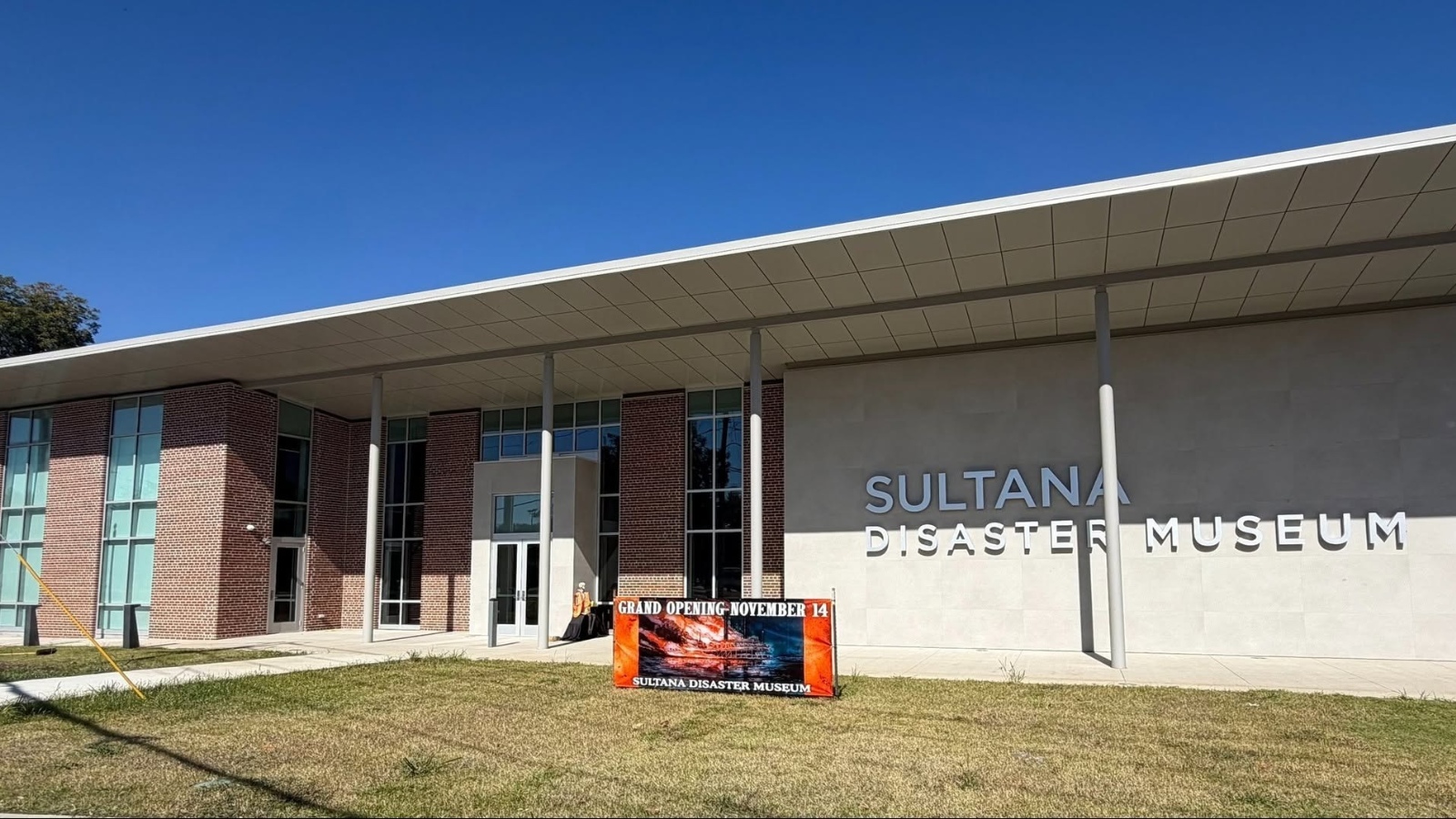
Due to a number of other important events that took place in April of 1865, America seems to have collectively forgotten the explosion of the steamboat Sultana on April 27, which killed 1,164 people, making it the deadliest maritime disaster in U.S. history. But in Marion, where the wreckage sank on the west bank of the Mississippi River, the disaster’s victims and survivors are being memorialized in the new Sultana Disaster Museum, which will host a grand opening for the public from 10 a.m. to 4 p.m. on Nov. 14.
The new 21,000 square foot museum is located at 114 Military Road, just across the railroad tracks from the original Sultana Disaster Museum, which opened in 2015. John Fogleman, president of the Sultana Historical Preservation Society, said the space is housed in the former Marion High School auditorium and gymnasium, a Workers Project Administration building that opened in 1939.
Construction for the $10 million renovation began in March 2024. It includes an addition to the front of the building, which features about 9,000 square feet of exhibit space and boasts a 14-foot replica of the Sultana and an actual 1835 steamboat engine, similar to the one whose explosion caused the disaster. Dozens of artifacts, photographs, survivors’ possessions and a few items from the Sultana are also on display.
Fogleman said the new building does a significantly better job of illustrating the complexity of the Sultana Disaster than the museum’s former home, which he said had less than 1,000 square feet of exhibit space.
“Before, because of the limited space, you almost had to have a personal tour to be able to understand all the different aspects of this story,” Fogleman said.
The steamboat had a legal capacity of 376 passengers and 85 crew members, but when the Sultana backed away from Vicksburg on April 24, she was overcrowded with a total of 2,127 people. Many were recently released Union prisoners of war who had been held in Confederate prison camps in Alabama and Georgia. Because the U.S. government would pay steamboat captains up to $8 per soldier to take a group north, a Union Army officer in Vicksburg struck a deal with James Cass Mason, captain of the Sultana, to take on a large group of prisoners in exchange for a kickback.
“This story teaches us a lesson about the unintended consequences of these political favors, and also of greed and corruption,” Fogleman said. “The exhibits also tell the stories of the rescue of the soldiers and other passengers by Union people on the Tennessee side and Confederate people on the Arkansas side. It tells the story of the Memphis medical community, who rushed in and prevented the disaster from being even worse than it was.”
Despite the high death toll, the Sultana Disaster did not achieve anywhere near the cultural notoriety of, say, the Titanic (ever heard of it?) in 1912 or even the sinking of the S.S. Edmund Fitzgerald in 1975. Fogleman speculated that this can largely be attributed to the disaster’s timing shortly after the end of the Civil War.
“April of 1865 was a month in our history like nothing else,” Fogleman said.
On April 9, Robert E. Lee surrendered the Army of Northern Virginia to Ulysses S. Grant at Appomattox. On April 14, Abraham Lincoln was assassinated, and just hours before the Sultana disaster on the early morning of April 27, John Wilkes Booth was captured and killed.
“You combine all of that with this bloody civil war, with brothers fighting brothers, neighbors against neighbors,” Fogleman said. “People were sick of the war, they were sick of death, and they were ready to move on. I think that’s why people were so ready to forget about the Sultana.”
Fogleman said a group of survivors attempted to get recognition for the disaster by petitioning Congress at every session from 1897 to 1914 with only two requests: the creation of a commemorative monument somewhere along the Mississippi River and monetary aid for the families of soldiers who died or were injured in the explosion.
“Because this didn’t take place during war, they weren’t entitled to pension for war-related injuries, and the bill never made it out of committee,” Fogleman said. “I felt like an injustice was done to these men and women, and that is what has really spurred me to work on this.”
In 1987, descendants of passengers on board the Sultana formed the Sultana Association of Descendants and Friends, and Fogleman said the group has met every year since their inception. On Friday, Nov. 13, the morning before the public grand opening, the Sultana Disaster Museum will host a special opening for 160 of these descendants from all over the country.
“In a sense, it’s a memorial to their ancestors, and we wanted to give them their own time,” Fogleman said. “When they talk about their ancestry, it’s amazing – the emotion that comes from these people, not only about their ancestors and what they experienced, but also about the fact that our city and our nonprofit have built a museum to memorialize this.”
Fogleman also has a familial connection to the Sultana. Two of his great-great-grandfathers assisted in rescuing survivors from the burning wreckage of the steamboat as it drifted downriver.
“According to the Memphis newspapers at the time, it came to rest about 400 yards from my great-great grandfather’s home,” Fogleman said. “He and his sons lashed together a few logs because they didn’t have a boat, and he negotiated with the people on board: not for money, but he knew that the raft they had cobbled together couldn’t hold them all, as there were about 40 people still on board. So he got them to agree to only go seven at a time, and he made multiple trips. As it got further along, the boat was getting in more danger, and because the river was at flood stage, he would take people to the treetops close to the shore, rather than going all the way to shore. According to the survivors, as the last group of survivors left and got on board the raft, the boat sank.”
One silver lining to come from the Sultana Disaster, Folgeman said, is the establishment of the Hartford Steam Boiler Inspection Company, which a group of Connecticut scientists and businessmen formed in June of 1866 in response to the Sultana’s fiery fate. With the goal of combining insurance with boiler inspections to increase safety, the group tried to find an insurance company to agree to insure boilers after inspection, but no company would touch it because of the high risk. The group decided to form their own insurance company and became the Hartford Steam Boiler Inspection and Insurance Company (HSB), which still exists today and donated $1 million during fundraising efforts for the Sultana Disaster Museum renovation.
“Our mayor, Tracy Brick, said to the president of HSB, ‘We don’t want people to ever forget the Sultana,’” Fogleman said. “And [the president] said, ‘At Hartford, we never forget the Sultana.’ For decades, any new person they hire goes through training that includes learning about the Sultana disaster.”
Fogleman said he hopes the new Sultana Disaster Museum will “forever memorialize the disaster and these men and women who suffered and endured so much,” and that it brings more people to Marion and “exposes what Marion has to the world.”
“Marion has been in the shadow of Memphis, probably since its founding in the 1830s,” Fogleman said. “We get confused with Marianna all the time. And I hope that people will see the value in us remembering our history, in learning from our mistakes, and will support us. We’re a nonprofit, and we’ve had support from all levels of government, but there’s no guarantee that will continue.”
Source link