CT inspector general finds shooting of Hartford man was ‘justified’
The state’s Office of the Inspector General released a report Tuesday concluding that a Hartford police officer who fatally shot a city resident while responding to a call in February was “reasonable and legally justified” in his actions.
Hartford police officer Alexander Clifford shot and killed 53-year-old Everard Walker on Feb. 19 at Walker’s apartment. According to the report, Walker, who was experiencing a mental health episode, was swinging a knife toward an officer who had fallen to the ground. Nearby, other police officers were engaged in a struggle with Walker’s adult children.
“Officer Clifford’s use of deadly physical force was in response to Everard Walker’s imminent use of deadly force against others,” the report reads. “There is no doubt that a reasonable police officer in the same circumstance would have shared that belief.”
The Walker family disagreed with the report’s finding.
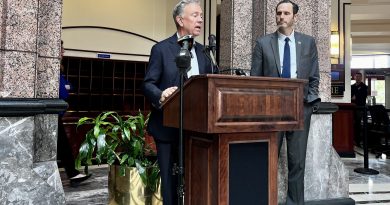
“A cry for mental health should not end with bullets being sprayed into a person in his own home,” said Jose Rojas, one of the Walker family’s attorneys, at a press conference held at City Hall Tuesday afternoon. “There was no danger to the public, there was no danger to anyone in that home. This was simply a family that was trying to help their father. And their father is dead.”
That morning, Walker’s son, Jahdane Walker, had called 211 to seek assistance when his father was having a mental health episode. He agreed that social workers from the Capitol Region Mobile Crisis Unit were needed to assess his father. Those mental health professionals asked Hartford police to accompany them.
In a statement to The Connecticut Mirror, Mayor Arunan Arulampalam said, “Now that the state has concluded its investigation, the City of Hartford will conduct its own pursuant to city policy. I remain committed to building a police force that is rooted in accountability and trust within the community.”
Earlier this year, Walker’s death brought up questions about the police officers’ response and de-escalation efforts during mental health calls, especially after a second man was shot and killed by another Hartford officer in a separate incident later that same month.
Hartford resident Steven “Stevie” Jones was fatally shot on Feb. 27. Both men, who were Black, were experiencing a mental health episode and had knives in their hands when they were approached by police.
The deaths even drew the attention of Rev. Al Sharpton, who spoke at Jones’ funeral in March.
According to the inspector general’s report, social workers responding to Walker’s apartment asked for police officers to accompany them on the call.
The officers, Giovanny Rivera and Sheryl Lessard, stayed in the hallway outside the apartment and let social workers assess Walker’s mental health state. The social workers determined that Walker was showing signs of mental illness and needed to go to the hospital.
But during the assessment, the 53-year-old “became upset” and tried to close the door and when his son tried to stop him, the two got into a physical struggle. Police entered the apartment to try and separate the two, but the report states that Everard Walker’s daughter Nzinga interfered. The report states she was pushed aside when she tried to prevent the officers from entering and shouted “racial and homophobic insults” at police.
Everard Walker then grabbed a pot of boiling hot liquid from the stove and threatened to throw it at officers, prompting them to retreat back out into the hallway. They then called for backup.
Walker’s daughter continued to block the entrance to the apartment and shout at officers, even as other officers arrived on the scene, including Clifford.
Officers were then given the order to arrest Nzinga Walker for interfering in police work and body camera footage shows they pushed their way into the apartment.
“Nzinga resisted and Jahdane intervened and pushed officers away. A chaotic struggle then ensued among Nzinga, Jahdane, Everard, and the officers,” the report states.
At some point, Everard Walker got a knife. During the struggle in the cluttered apartment, Clifford and Rivera fell to the floor. Everard then began swinging the knife in Rivera’s direction and Clifford “feared that Everard was going to stab an officer, Jahdane, or Nzinga,” according to the report.
From the ground, Clifford fired four rounds at Walker, who fell to the floor. The police officers started medical aid on the victim while waiting for an ambulance. He was pronounced dead at 11:55 a.m. at Saint Francis Hospital.
The inspector general wrote that no further action would be taken on the matter.
While Walker’s family has waited months for the inspector general’s investigation to conclude, the office’s investigation of Jones’ death was released months ago. In that case, the inspector general determined the officer who shot Jones, Joseph Magnano, was not justified in his actions.
“Officer Magnano’s actions were not objectively reasonable because, among other things, he did not engage in de-escalation measures, he failed to make reasonable attempts to use non-lethal force, and his conduct increased the risk the occurrence of the situation that precipitated the need to use deadly physical force,” the inspector general found.
Arulampalam also fired Magnano, a new officer who was still in his probationary period, just weeks after the shooting. Magnano has since been charged with first-degree manslaughter.