CA pension funds were hedging Nvidia even before affair
Does the global economy hinge on one leather-clad CEO’s affair with an alleged Chinese spy? You might find it reassuring that your pension fund has been preparing for some kind of AI downturn, if not that specific scenario.
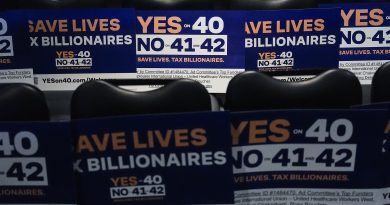
We have some breaking news today. California voters officially rejected Prop. 40, the measure that would have levied a wealth tax on billionaires.
In other news, the 9th Circuit Court of Appeals scaled back a California climate law and we have a new survey for you from our friends at Your Local Epidemiologist.
California’s biggest public pension funds were already shaving their holdings in high-flying tech companies before news about Nvidia CEO Jensen Huang’s affair with an alleged Chinese spy sent the AI giant’s stock plunging.
After last week’s Democratic blue wave, stocks — particularly for artificial intelligence companies — tumbled largely due to investors’ fears over regulation. In a single day, the S&P 500 lost $2.8 trillion.
But even in the months before Election Day, worries about an overheated market triggered selling: In the first half of 2026, the California Public Employees’ Retirement System sold off 26% of its holdings in the top-performing tech companies, known as the Magnificent 7, according to an analysis by the Financial Times.
CalPERS’ deputy chief investment officer, Anton Orlich, reportedly told the Times it was to diversify equity risk. That analysis followed a September meeting where CalPERS board members talked openly about the tradeoffs they saw in the fund’s AI investments.
Another behemoth fund — the California State Teachers’ Retirement System — has been eying the inflated stock market and trying to assess when to shift its holdings.
In September, CalSTRS heard from advisers who pointed out that seven public companies accounted for one-third of the total value of the U.S. markets. Only the 1999-2000 tech boom — which was followed by a bust — had a greater gap between companies’ earnings and their valuations.
CalSTRS Chief Investment Officer Scott Chan at that meeting warned against putting more money into that sector.
- Chan: “I believe now in a bull market that it is even more important for us to diversify the portfolio rather than move more in a bull market that has been running for some time.”
Stocks for the Magnificent 7 haven’t been doing too hot recently. While Apple, Microsoft and Amazon have risen between 2% to 4%, artificial intelligence chip-maker Nvidia dipped this month by 22% and continued to decline as Huang confirmed his affair. Tesla, Alphabet and Meta stock also slumped this month, with the latter two falling by double-digit percentages.
But the stock market is a major reason why CalPERS and CalSTRS have been beating their earning targets as of late. CalPERS portfolio is currently valued at more than $650 billion, and in July it announced it gained an investment return of 14.8% for the 2025-26 financial year, more than doubling its target of 6.8%.
CalSTRS’ assets total more than $415 billion as of September, with a 13.9% investment return for the same period.