Art Collaboration Kyoto 2026: The Galleries, Sales and Temple Shows
Amid a packed November calendar of art events in Asia, a visit to Art Collaboration Kyoto (ACK) highlights the fair’s success in bridging Japanese galleries and the global art world, delivering on its name through meaningful international exchange. As many insiders, creatives and collectors made their way to Kyoto after the opening of Art Week Tokyo, the city became an informal meeting point for some of the most prominent people in the industry. It’s a smart follow-up: ACK and its expansive citywide program unfold at a more relaxed pace, set against the evocative backdrop of Kyoto’s temples and the autumn colors that transform the city at this time of year.
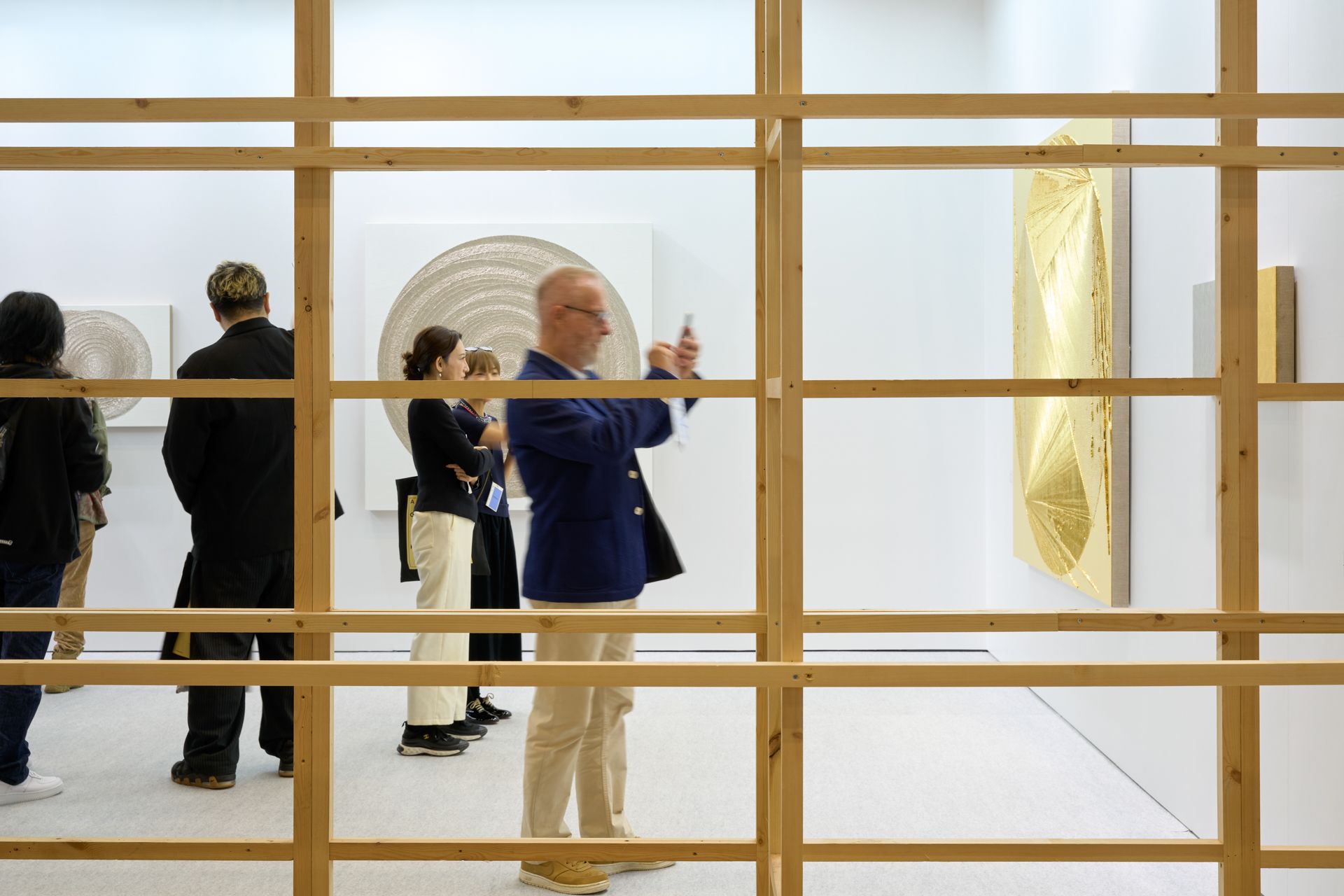
For its sixth edition this past weekend, ACK brought together 63 galleries from 17 countries at the Kyoto International Conference Center (ICC Kyoto). Seventeen were newcomers, including notable international galleries Jeffrey Deitch, Hauser & Wirth and Modern Art. While it aims to showcase domestic galleries that play an important role in the Japanese market, the fair’s selection committee deliberately includes members well-versed in the international market—Kiang Malingue, based in Hong Kong and New York, and Brazil’s Mendes Wood DM came on in 2026—bringing a global perspective to the process.
Since its launch in 2021, Art Collaboration Kyoto has grown steadily in both participation and popularity, inspiring increasing interest from galleries in Europe and North America. That expansion coincided with a push toward internationalization in the Japanese market and renewed attention to homegrown artists, both emerging and established, whose often-overlooked practices are now being discovered (and rediscovered) by the international art world. The market for the country’s blue-chip names has held steady as well: Yayoi Kusama and Yoshitomo Nara, among today’s top sellers, drew lines around the block for openings at David Zwirner in New York the same week.
Asked how ACK balances its local commitment with its international ambitions, Miho Doi, the fair’s director of experiences, told Observer that the two are closely interconnected and the fair’s organizers “believe that the growing international dimension of ACK is creating new opportunities for Japanese galleries, artists and collectors.” Several Japanese galleries report having overseas galleries approach them about participating in ACK together, and she thinks “this is a good indication that ACK is helping to raise the profile of Japanese galleries within the international art scene, and creating new opportunities for them to connect with their international peers.” Doi acknowledged, however, that ACK cannot achieve this alone. “The experience of visiting the fair, as well as Kyoto’s appeal as a cultural and tourist destination, are also essential,” as are the city’s many art universities and vibrant communities of artists.
ACK’s main section, Gallery Collaborations, is where the fair shines as a cultural meeting point, with Japanese galleries hosting international peers, often building on existing collaborations and shared artist representation—or laying the groundwork for new ones. This year, 25 host galleries from Tokyo, Kyoto and Osaka welcomed 27 guest galleries from Asia, Europe, North America and South America.
Japanese gallery KOTARO NUKAGA shared its booth with Almine Rech, presenting new works by Keita Morimoto, a young painter in such demand among international collectors that he has a waiting list. On view was a stunning hyperrealist, cinematic painting of a nocturnal urban landscape steeped in the atmosphere of a bygone Japan, part of a new body of work he is developing for his forthcoming show at Almine Rech’s Paris space. Alongside it stood a new mixed-media installation of a hooded young man in front of a replica of a typical Japanese vending machine, bringing a frame from one of his canvases to life in three dimensions. Nukaga told Observer that both works sold ahead of the VIP preview, priced at around $50,000.
Almine Rech also brought two six-figure canvases by Tom Wesselmann, a painter increasingly popular with Japanese collectors, along with a light portal by James Turrell, who has an exhibition opening at the gallery’s New York space this week and will be the inaugural artist at the forthcoming Superblue Kyoto. The gallery returned to ACK three years after an earlier collaboration with KOTARO NUKAGA, a solo presentation of works by Tomokazu Matsuyama, another Japanese artist the two galleries share.
The Turrell and the Wesselmanns were among the most expensive works at the fair. Another booth in the six- to seven-figure range was the collaboration between Hauser & Wirth and Japanese gallery Taro Nasu, which together mounted a showcase of text-based works that share an emotional strain of minimalism by Glenn Ligon, Roni Horn, Jenny Holzer, David Horvitz and Ryoji Ikeda, alongside a beautiful late work by Louise Bourgeois from 2009. The booth’s centerpiece was an entire wall covered by Horvitz’s Nostalgia series, answered on the opposite exterior wall by Lawrence Weiner’s monumental blue text work COVERED BY CLOUDS. By the weekend, a work by Marcel Broodthaers had sold for €65,000, along with a Ligon print ($32,000) and two works by Horvitz for $3,500 each.
Nearby, Mitochu Koeki Co. and Annely Juda Fine Art staged a deeper dialogue around true gems from the “non-objective world” of geometric abstraction, bridging craft and design, East and West. Named after a series of exhibitions the London gallery began in 1970, the booth combined Mitochu Koeki’s focus on ceramics with a selection from Annely Juda’s early 20th-century avant-garde program, including Kazimir Malevich, László Moholy-Nagy, Alexander Rodchenko, Elena Semenova and Alexandra Exter. Highlights included three rare Suprematist works on paper by Malevich based on motifs from 1915 to 1917, Moholy-Nagy’s painting Trb 1, Rodchenko’s Composition and the cover designs he and Semenova created for Sergei Tretyakov’s book Zhongguo, alongside Exter’s stage design for Romeo and Juliet.
Among the few historical presentations, Tokyo Gallery + BTAP teamed up with Korea’s Gallery Hyundai on a booth that revealed the aesthetic and philosophical affinities between the Korean avant-garde and Japan’s Mono-ha movement, bringing works by Kishio Suga and Susumu Koshimizu into dialogue with Seung-taek Lee. Lee’s concept of “non-sculpture,” which extends sculpture beyond physical objects to encompass immaterial phenomena and actions, aligns with the concerns of the Mono-ha artists, who explored the relationships among materials, objects, space and human perception.
Berlin gallery neugerriemschneider offered one of the most brilliant cross-cultural, intergenerational dialogues between East and West, collaborating with Shibunkaku on a series of unexpected, thoughtful juxtapositions of historical Japanese and contemporary works. An early 20th-century kakemono scroll by Yokoyama Taikan entered into dialogue with a recent experimental watercolor by Olafur Eliasson, while Léonard-Tsuguharu Foujita’s fusion of classical Japanese and modern European motifs from the 1910s engaged with Elizabeth Peyton’s finely drawn representations of the human condition. The two galleries also collaborated on one of the temple exhibitions, with new works by Billy Childish that grew out of his residency at Saga House in Kyoto.
Local gallery MISAKO & ROSEN and Meyer Riegger Wolff staged a booth evocatively titled “Young in Spirit,” pairing new works by Japanese artists Reina Sugihara and Kaoru Arima with works by German artist Katinka Bock and Korean artist Il-Joong Kang. Alongside them were the psychologically charged, ghostly images of Miriam Cahn, a recently rediscovered artist especially popular with Asian collectors. A painting by Cahn quickly sold for CHF 45,000. Other sales included a work by Yunyao Zhang (€10,000) and two paintings by Sugihara for $5,000 and $10,000.
The collaboration between Jeffrey Deitch and NANZUKA felt natural, as the two galleries share a similar aesthetic sensibility in many ways. Their booth brought together works by Zoé Blue M. and paintings by Aki Kondo, whose intuitive, almost Picassoesque characters were also part of last year’s collaboration. Kondo’s Over the bridge (2026), for instance, layers dermatograph, crayon, oil pastel, charcoal, graphite and colored pencil on paper, with a wide range of marks and gestures. The pairing gave the booth a distinct visual coherence while allowing the artists’ different approaches to figuration to remain apparent.
Sho +1 joined forces with New York gallery Olney Gleason, bringing the pop-inflected, surreal paintings of Japanese artist Sato Brian Katsuhiko into dialogue with works by Sara Anstis and vanessa german. The three practices converge on the body and its symbolic associations, though each approaches it from a different direction. Anstis’s intimate, psychologically charged allegorical worlds and German’s richly material, totemic sculptures, assembled from minerals and beads, each intrigued Japanese collectors in its own way.
A particularly poetic booth exploring feminine sensibility and fantasy came from Tokyo’s PARCEL, which hosted Paris-based sans titre with works by Urara Tsuchiya and Liselor Perez. The two artists conceived the presentation in dialogue, bringing their distinctive practices together around domesticity, intimacy and the ways familiar objects and spaces can turn uncanny, unsettling expected relationships among the body, scale and containment. The doll and the dollhouse are central to the booth. Perez uses miniature cabinets, vitrines and wardrobes to disrupt enclosed domestic worlds, while Tsuchiya turns to ceramics to play with the forms and associations of everyday femininity, from a constellation of bras and underwear to the miniature world of Polly Pocket. Priced between $2,000 and $8,000, her works attracted strong interest and early sales.
Equally charming and intriguing was a series of miniature dream paintings by Taiwanese artist Crystal Lupa. She conjures entire mythologies and magical scenes without preparatory drawings, using a few delicate gestures and fine threads of color that let them emerge like visions. Priced under $2,000 by Taipei gallery TPG+, several of the paintings sold to Japanese collectors in the first days, as did some sculptures by Chen-Hung Chiu. Hosted by Takuro Someya Contemporary Art, the booth paired their work with that of Japanese artists Mai Yamashita + Naoto Kobayashi, Motomasa Suzuki and Kaii Tsuji.
Also making its ACK debut, New York’s Margot Samel collaborated with Tokyo’s Satoko Oe Contemporary on a presentation that paired new ceramic sculptures and bas-reliefs by Kris Lemsalu with Shigeru Hasegawa’s symbolic, recurring motifs of fruit, vegetables, fish and other objects, arranged in playful, carefully balanced compositions. “The Japanese really do know how to host,” Samel told Observer, noting that the shared-booth format, which encourages dialogue between the galleries’ artists and programs, mirrors visitors’ particular willingness to engage with work they may not know.
A whimsical, frog-like ceramic creature by Lemsalu was also camouflaged in the garden outside as part of “Intersections,” which unfolded between and beyond the booths with more ambitious works. Curated this year by Leonhard Bartolomeus, who is also a curator at the Yamaguchi Center for Arts and Media, the show brought together nine artists under the theme “Out of Bounds,” reflecting on the invisible systems of control, social conventions and digital environments that increasingly shape our lives and how we relate to one another. Bartolomeus was inspired by the way video game characters sometimes slip beyond the edges of their space and plot. The project considered how art might challenge the rules that prescribe our behavior, flatten individual differences and keep us within familiar limits and established orders.
Setting a rebellious tone right at the entrance, Polish artist Piotrek Kowalski’s installation Out of Business Sale took the form of an improvised market stall, with small installations and assemblages made from objects and materials found at Warsaw flea markets. Challenging the conventional booth format, the work invited visitors to buy the installation whole or take it apart piece by piece. Also at the entrance, Shota Suzuki’s delicate bronze sculptures of three red maple leaves resting on rocks and a small flowering bush were so hyperrealistic they could pass for the real thing, despite appearing out of season.
The section also featured established names such as Brazilian artist Ernesto Neto, presented by São Paulo-based Fortes D’Aloia & Gabriel, which shared a booth with Tokyo’s Tomio Koyama Gallery, reflecting their longstanding relationship and joint representation of Neto and Japanese artist Hiroshi Sugito. Neto’s sculpture sold by the weekend for $70,000, along with a painting by Marina Rheingantz for $30,000 and two works by Sugito in the $10,000-15,000 range. Other sales included works by Antonio Társis ($7,000-12,000 each), Aiko Yuno ($3,800-8,000 each) and four works by Elena Tutatchikova priced at $1,400-2,300.
Brazilian powerhouse Mendes Wood DM contributed to “Intersections” with Chicago-based Chinese artist Leah Yi Zeng, whose video work combines frames of her luminous abstract canvases into a dialectical sequence, pairing them with words associated with feelings and sensations. After sharing a booth with Shibunkaku last year, the gallery is presenting in Kyoto Meetings this year. This second section of the fair brings together 11 additional local and international galleries, each with its own booth yet connected to the city and the broader Japanese context. Mendes Wood DM anchored its presentation in the historical ties between Brazil and Japan; Brazil is home to the largest Japanese community outside Japan, with nearly 2 million people of Japanese descent. The booth brought together works by Tomie Ohtake, born in Kyoto in 1913 and later one of Brazil’s leading postwar abstract artists, with those of Solange Pessoa, Daniel Steegmann Mangrané and Marina Perez Simão. By the end of the fair, the gallery reported several sales. A painting by Sanam Khatibi went to an American collector, a set of sculptures by Pessoa to an Asian collection, the violet painting by Perez Simão to a Malaysian collector and a work by Ohtake to an American collection.
A highlight of the curated Kyoto Meetings section was Kiang Malingue’s two-person presentation pairing promising Yale graduate Faye Wei Wei with Yang Chi-Chuan, both making their Japanese debuts. Conceived specifically for Kyoto and informed by Japanese literary and material traditions, Wei Wei’s new paintings were shown alongside Yang’s delicate, suspended ceramic works, inspired by birdwatching and the gentle poetry of everyday life that Japan so deftly celebrates. One of Wei Wei’s paintings was acquired by a notable private foundation.
Another talent worth following is Hou Yijie, presented by Shenzhen-based MANGROVEGALLERY. Japanese visitors showed particular interest in his distinctive narrative approach and visual language at the gallery’s collaborative booth last year, which encouraged it to bring him back with a solo presentation. His sketch-like, layered paintings bring together biographical elements and historical fragments, moving between legend and lived experience while balancing rawness and spontaneity with more deliberate storytelling. The gallery sold two medium-sized works for $3,000 each, one to a Hong Kong collector and one to a Japanese collector. His prices reach $13,000, and he recently exhibited at the He Art Museum in Foshan.
The section also included established Japanese galleries such as Tokyo’s SCAI The Bathhouse, which devoted its booth to Daisuke Ohba’s gold- and silver-toned monochromes investigating the physical and optical conditions of the medium.
Among the collaborative booths, Tokyo’s Anomaly and Margate-based Roland Ross staged a playful exchange between two and three dimensions, images and objects. Takuro Tamayama’s sculptural interpretations of food and familiar subjects found a perfect mirror in Victoria Smith’s detailed, life-size close-ups of teapots and Edward Kay’s cartoonish apples, which sold quickly on the first day. At a party later that night, Roland Ross attributed its successful debut in Japan to the collaboration with its Japanese counterpart.
Another experimental booth was shared by the young, dynamic Chicago gallery Good Weather and Warsaw’s TURNUS, both hosted by Tokyo-based 18 Murata, in a dialogue among the more conceptual practices of Margherita Raso, Yuu Takamizawa, Karolina Szwed, Andreea Anghel, Inga Danysz, Raque Ford and Jaehun Kim. Returning for a second year, Good Weather showcased new works by Danysz that blend art and design, following the interest they drew last year. When we spoke that evening, founder Haynes Riley was unconcerned about selling out: the work had found buyers, and, as in Tokyo, the gallery’s priority was building and fostering relationships with the country and the region. Riley was not alone in approaching the fair this way, echoing what Yukako Yamashita told Observer last year. International galleries come to sell, but they also take part in a genuine cultural exchange from which new commercial and institutional opportunities for their artists can emerge. TURNUS, for its part, had sold two paintings by Szwed by the weekend, for €3,000 and €2,500.
ACK’s sales may not come close to those of other international fairs, Tokyo Gendai included. But as Yamashita put it in the same interview, ACK is first and foremost “about collaborative intelligence,” and one of its most important functions is creating a temporary community that can grow lasting relationships. Yamashita continues to support the fair on the PR and partnership side. One of the most interesting developments this year is ACK’s transition from being overseen by a single fair director to a seven-member Leadership Committee, which brings together directors responsible for experiences, operations, educational programs, public affairs, gallery relations, VIP relations and partnerships.
“Since its early days, ACK has always made decisions collectively,” this board told Observer when asked about the new model. Bringing seven people with different roles and perspectives together to make decisions takes time, they acknowledged, but a shared understanding of what it means to be Culture Forward makes for constructive, productive discussions. “When we find ourselves with differing opinions, we always come back to a few fundamental questions: Is this Culture Forward? Will the galleries find it interesting? Will the artists be happy with it? Will it be engaging for collectors and art professionals? Ultimately, these are the criteria we use to guide our decisions.”
The model is unique among international fairs, and it recognizes the broader role a contemporary art fair can play in the cultural and economic development strategies of a city and an entire country. Notably, unlike most international fairs, ACK was founded as a cultural project of Kyoto Prefecture—a collaboration between government and private institutions designed to amplify the Japanese art scene and, in particular, Kyoto’s art and cultural ecosystems. This public-private partnership also led to Kyoto Art Month, a joint initiative by Kyoto Prefecture and Kyoto City featuring programs developed with art events across the city. Among them is CURATION⇄FAIR Kyoto, a fair staged inside three ancient temples that offers an increasingly hybrid mix of fine contemporary craft and contemporary art.
ACK may well be the only fair where one can start the day with Zen meditation in a temple while looking at art. Several participating galleries also staged solo presentations at heritage sites around Kyoto, turning the event into an exploration of the city’s broader cultural landscape.
On opening day, our morning began at Komyo-in, a subtemple of Tofuku-ji renowned for its Zen garden, where Yuka Kashihara presented “Mountains Walking on the
The next stop was Ryosoku-in, where Modern Art and Ingleby presented “Birds, Beasts and Flowers,” Scottish painter Andrew Cranston’s first exhibition in Asia. His diaphanous images, built through porous layers of paint and moments of accumulation, emerge from a contemplative observation of nature and other living beings, which become metaphorical presences inhabiting both physical and psychological landscapes. The exhibition takes its title from D. H. Lawrence’s 1923 poetry collection, which Cranston discovered at 19 and credits with opening up new modes of feeling and thinking, moving freely between objective observation and subjective experience. His paintings suggest another tempo of perception, beyond the strictly human sense of time, and reveal how dwelling in this physical and philosophical space of contemplation has shaped the artist’s way of seeing and representing the world.
As we learned during our visit, Ryosoku-in was among the first temples to welcome contemporary artists, years before the fair existed. It helped establish a model that has encouraged other monks and temple communities to open their spaces to contemporary art, recognizing how artistic interventions can resonate with, and even amplify, an existing atmosphere of meditation and contemplation.
There is a pragmatic dimension as well: the monks are business-savvy and quick to recognize fundraising opportunities. Exhibitions at Kyoto’s temples, shrines and other heritage sites are nothing new. Since ACK’s launch, however, organizers have reported growing interest from artists and galleries around the world, increasing year by year and fueled by a shared belief that these encounters with Japanese culture can inspire artists and lead to new forms of artistic expression.
Other highlights among the temple exhibitions included Tavares Strachan’s “Blue Keys” at Zekkei-in, a subtemple of Myoshin-ji. The site-specific selection extended Strachan’s ongoing investigation of visibility, absence and the systems through which knowledge and memory are preserved or forgotten. A group of paintings inspired by his grandmother’s word-search puzzles floated in the room, concealing letters within deep blue surfaces and inviting a slow, almost meditative process of looking. At the center, an automated West African balafon played without a musician, setting a rhythm amid the temple’s silence, natural light and passing breeze.
In a presentation lasting only two days and offering rare access to the historic subtemple of Daitoku-ji, Hauser & Wirth and Oscar Mouligne showed works by Lorna Simpson in dialogue with the architecture and Kanō Tan’yū’s celebrated dragon paintings. As Simpson shared during the visit, the dragons decorating the rooms reminded her of the Japanese folktale “The Boy Who Drew Cats,” which she first encountered as a child. The tale follows a boy who escapes his mundane life by hiding in a temple to devote himself to drawing cats, which eventually rid the temple of a ghost. It speaks to the power of art and its role in shaping an artist’s imagination. Simpson’s collages, assembled from archival images and unexpected juxtapositions, similarly unfold as a stream of consciousness in which small coincidences give rise to new narratives.
At Korin-in, Carlos/Ishikawa brought together two of the gallery’s leading artists, Issy Wood and Evelyn Taocheng Wang. In paintings anchored in the mundane material world, Wood explores and challenges the desires and projections we place onto objects, questioning the promises they make and what they can actually deliver. Wang plays with the structures of culture and society through acts of translation and appropriation, bringing references to Agnes Martin, Georgia O’Keeffe and traditional Chinese painting into her visual language. In one work, she imagines Martin and O’Keeffe together in the desert, two very different women whose lives were nonetheless shaped by the constraints of a male-dominated world. Both artists make deeply personal work that still leaves room for viewers to find something of themselves in it.
Other memorable presentations included Ugo Rondinone’s “shaping silence,” which brought 17 rough-hewn bluestone figures, a sun painting and a totemic monk sculpture into the contemplative landscape of Jōju-in, within Kiyomizu-dera. At Yuuhisai Koudoukan, a historic former academy rather than a temple, Meyer Riegger presented Miriam Cahn’s “STILL LEBEN,” a focused selection of lesser-known, earlier and more realistic paintings, drawings and notebooks devoted to everyday objects and interiors.
As the Agency for Cultural Affairs has begun to emphasize in its policies, putting cultural heritage to use can help preserve it. “We are seeing a steady increase in these kinds of initiatives, and I hear that many artists are interested in them,” Doi told Observer. The hope is that such exhibitions will continue to multiply, sustaining historic buildings and heritage sites in turn. “ACK is one part of this broader ecosystem, and we hope that by continuing to develop the fair, we can contribute to strengthening these connections and creating more opportunities for Japanese galleries, artists and collectors within the global art community.” Judging by the growing community of collectors, many from abroad, whom we encountered at this year’s fair, the pieces are falling into place. Six editions in, Doi added, long-term relationships and year-round cultural engagement are taking shape.