37 years after fall of Berlin Wall: How divided are Germans?
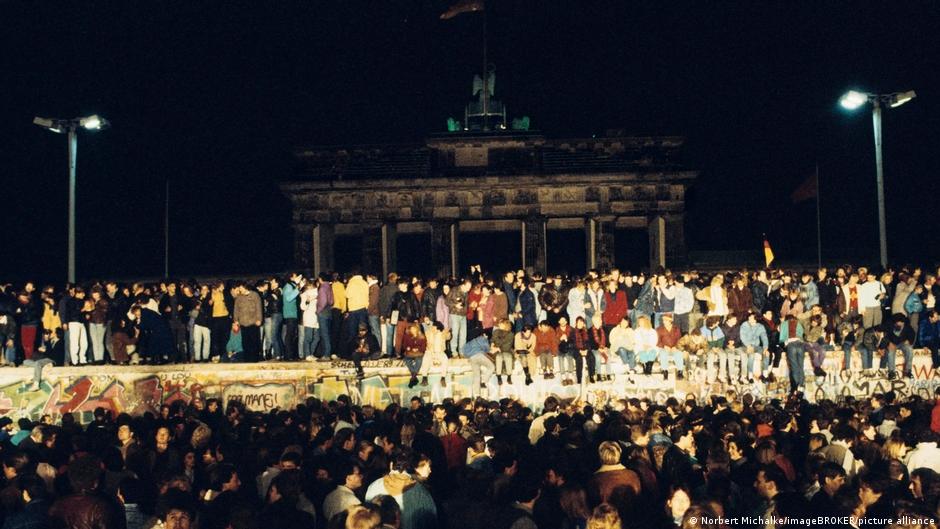
When the Berlin Wall fell on November 9, 1989, ending East Germany’s isolation from the West, the event was celebrated on both sides of the border. Yet, 37 years later, many people on both sides remain deeply skeptical of each other.
Surveys show that only a minority of respondents report feeling a strong sense of community between those from former East and West Germany, and many continue to perceive significant differences.
We asked three artists from Germany with different perspectives on the history of the country’s division to share their views.
Winter shoes? Candy!
Author Lea Streisand was born in 1979 and experienced the fall of the Berlin Wall firsthand while growing up in East Berlin.
In her books and essays, she has returned to her East German upbringing many times, using literature to process it.
The novel “Hufeland, at the corner of Bötzow” (2019, Ullstein), for example, recounts the period of reunification from a child’s perspective.
“November 9, 1989, was simply incredible,” she told DW. She was 10 years old at the time. When her mother bought her winter boots with the 100 Deutsche Marks she received from the West German state — a welcome gift given to all East German citizens — she was so disappointed that she felt like crying. But later, a friend of her parents’ let her buy so many sweets at the supermarket that they lasted until Christmas.
“The disappointment really set in afterwards, with what happened over the course of the following year. It was unbelievable how quickly an entire system was suddenly swept away and a new one built up, as if to say, ‘There you go. You’re welcome’,” Streisand recalled. “I think it was just too fast for people.”
The people of East Germany, or the GDR, had brought about the fall of the Berlin Wall themselves through a civil rights movement and numerous demonstrations. For many, however, the goal was not to dissolve the state immediately but to reform it.
Among them was Anke Feuchtenberger, born in 1963 in East Berlin. Her childhood was spent in East Berlin and in the East German region of Western Pomerania, where she now lives again and feels “very much at home.”
Today, she teaches at the University of Applied Sciences in Hamburg, meaning she spends time on both sides of the former divide. Feuchtenberger is often described as Germany’s most influential comic artist. Her work has also garnered international acclaim.
“Back then, as artists, we tried to bring about a change through posters and flyers — to gain more freedom without immediately abolishing socialism,” she explained.
At the time, the fall of the Berlin Wall stirred up mixed feelings in Feuchtenberger: “I soon realized that the creative and revolutionary aspects of our movement were very quickly being smothered by consumerism, and that nationalist tendencies — which had already been noticeable before — were coming to the fore,” Feuchtenberger recalled. “That made me afraid.”
Meanwhile, for photographic artist Simon Menner, born in 1978 in Emmendingen, in the West German state of Baden-Württemberg, Berlin was very far away. As Menner put it, he experienced the fall of the Berlin Wall as a child in a “rather abstract” way. Today, Berlin is his home.
In his experience, the way films and documentaries portrayed East Germany around the time of reunification was very bleak. “But West Germany in the ’80s,” he said, “was also bleak and very staid.”
Stasi’s photo treasure trove
This uneven portrayal of the two parts of Germany is an issue that deeply concerns Menner — partly because he unwittingly contributed to it in a small way. Among other things, Menner’s work explores the topic of surveillance and how it works.
In the archives of East Germany’s Ministry for State Security, or Stasi — which are freely accessible today as part of the National Archives — he discovered a massive collection of photographs that both fascinated and horrified him and which he wanted to bring to the attention of a wider public.
His photo book “Top Secret” (2012, from publisher Hatje Cantz) features a selection of photos that offer a unique insight into the work of the Stasi. Some are eerie, while others are curious or even absurd.
Menner also tried to look into the photo archive of West Germany‘s Federal Intelligence Service. “I spent a year trying to gain access — without success,” he said.
In hindsight, he now finds his artistic project problematic because he believes it is too one-sided, focusing exclusively on East Germany’s past.
According to Menner, West Germany’s intelligence services in the 1960s were not exactly models of virtue either, and he believes it is “actually high time” to critically examine this part of history as well. In his view, an honest examination of Germany’s past as a whole is a prerequisite for genuine reconciliation.
Streisand believes literature can help foster mutual understanding. “Literature opens a window into experiences we haven’t had ourselves,” she said. “You can immerse yourself in the mind of someone who has had a different life than you have and understand what happened.”
Interest in these stories remains strong. In 2023, Feuchtenberger published the nearly 500-page graphic novel “Comrade Cuckoo” (published by Reprodukt), which was the first graphic novel to be nominated for the Leipzig Book Fair Prize in the fiction category.
The story spans a childhood in the fictional East German village of Pritschitanow in the 1960s in the GDR to the post-Reunification era. In it, Feuchtenberger weaves autobiographical memories of her upbringing with fantastical and fictional elements.
The artist said she was surprised “that, so long after the fall of the wall, my stories have sparked such great interest in the West.”
In particular, the fact that the main character, Kerstin, rarely sees her parents because they both work full-time is a topic that often comes up at readings. In the GDR, everyone had the right to work, she said. At the same time, it was a civic duty.
Could the West German interest in this stem from the fact that full-time employment for both parents has long been less common in the West? It’s possible, said Feuchtenberger.
What does the future hold?
When looking toward their shared future, the two East German women are more optimistic than Menner, from West Germany.
“In Berlin, I often don’t even notice anymore whether I’m in the West or the East,” said Menner. “But when it comes to sociopolitical issues, politicians should listen to older and younger people more closely,” he added, referring to the recent election successes of far-right Alternative for Germany, or AfD . “Otherwise, things are going to get difficult in the near future.”
“It’s very important to step outside our own bubble because people all over the world are facing problems. Constantly focusing on this German-German divide that has emerged between the groups doesn’t help,” said Feuchtenberger.
“For me personally, the whole issue of borders has somehow dissolved,” she explained. This is due in no small part to the many trips abroad that have taken her to various places around the world.
Moreover, in her hometown near the Polish border, she observes how animals couldn’t care less about the border. “They come from the east and the west and do whatever they want,” she said. That’s why she also gave “Comrade Cuckoo” the working title “A German Animal in a German Forest,” “because I found the absurdity of an animal having a nationality so funny.”
“This East-West thing — our children won’t have any interest in it at all,” said Streisand. “Young people don’t care where their parents come from. Can I get a job that will support a family? Do I have to go to war? Right now, completely different things are relevant.”
This article was originally written in German.