Early mobilisation helps critically ill children recover
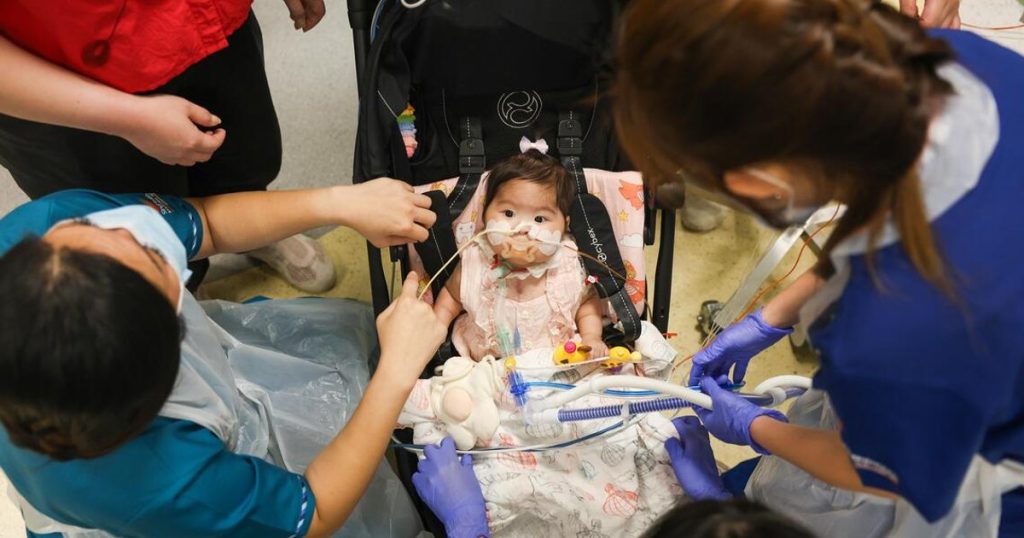
SINGAPORE – Eight-month-old Michelle Ng has spent most of her life in the children’s intensive care unit (CICU) of KK Women’s and Children’s Hospital (KKH).
She was born with a rare congenital heart defect called anomalous left coronary artery from the pulmonary artery (ALCAPA), where the left coronary artery is plugged into the pulmonary artery instead of the aorta. It can lead to a heart attack if the condition is not treated early.
Twelve-year-old Michelle Poh went through a bone marrow transplant for the blood disorder thalassaemia in August 2024, but was admitted to the CICU for severe acute respiratory distress syndrome in January 2026.
She needed extracorporeal membrane oxygenation (ECMO), a life-support treatment for those with life-threatening heart and lung failure that keeps the blood pumping and oxygenated outside the body.
Under a programme to get young patients out of hospital as soon as possible, both girls were made to exercise within the first 72 hours of being admitted.
The multi-disciplinary recovery programme aims to help critically ill paediatric patients and their families recover from the long-term impacts of intensive care, at a time when more children are surviving life-threatening conditions because of advances in medicine.
Since the programme’s launch in April 2021 when 44% of patients on respiratory support were being mobilised early, the hospital has seen this rate grow to 60% in 2024.
Senior consultant Joel Lim, who heads the CICU at KKH, said: “Today, we are able to mobilise some patients within a few hours of their admission, but there are situations where the patients are too sick to undergo early mobilisation so we do not attempt to do that for them.”
Although Michelle Ng is still in CICU due to her serious heart condition, Michelle Poh was discharged in just two months and was able to return to school.
Michelle Poh, 12, was made to sit up while undergoing extracorporeal membrane oxygenation. She was also moving to the music being played at the KKH CICU.
PHOTO: KKH
Lim said: “When it comes to helping critically ill children recover faster, we believe in and subscribe wholly to the adage that ‘movement is medicine’.”
Called Let’s MoveEM, the focus of the programme is to keep the patient awake and breathing on his or her own, and to be as comfortable as possible.
“We also want to prevent delirium, which causes acute confusion and disorientation in the patient, encourage early mobilisation, ensure there is family-centred care where we involve the parents, make sure the patient is given good nutrition and make them feel human,” he said.
Delirium is a serious, sudden disturbance in the mind that causes rapid confusion, trouble focusing, and changes in awareness of one’s surroundings. It is not a disease but a sign that the body or brain is under severe stress from an infection, medication, surgery or dehydration.
Lim said that traditionally, doctors in the ICU tended to be very focused on the patient’s medical problems, resulting in some patients undergoing rehabilitation only in the general ward or when they were discharged.
“Across hospitals worldwide, we began to recognise this condition called the Post-Intensive Care syndrome, which caused not only worsening physical health, but also learning and mental health impairments that persist in patients after they survived their stay in the ICU,” Lim said.
“It could last for weeks to years, affecting between 50% and 80% of ICU survivors.”
So when the Let’s MoveEM programme was launched in April 2021, the first focus was delirium, which was treated as “the next vital sign”.
“This is apart from temperature and blood pressure, which are the vital signs health professionals go to, to know when something is going wrong with the patient,” Lim said.
“In the same way, delirium is a vital sign because when delirium occurs, it is a sign that the child is turning very ill.”
From KKH’s own data, 60% of critically ill children develop delirium and “the impact is significant”.
“The patient would have a longer duration on mechanical ventilation and hence, a longer stay in both the ICU and hospital, a higher risk of infections, and develop issues in learning and social skills. Some may even develop post-traumatic stress disorder,” Lim explained.
He said the programme allowed for routine and systematic screening for delirium to help identify the risk factors early “so we can intervene to halt or reverse the delirium, reducing its impact”.
Lim noted that apart from delirium, worldwide data on helping an ICU patient move early had proven to work with their recovery.
“After being discharged from the ICU, anywhere from between 10% and 80% of critically ill children develop physical impairments such as difficulty in breathing, swallowing or movement. Early mobilisation programmes like ours helped to improve physical functions, reduced delirium and cut the length of stay,” he said.
Citing data from 2021 to 2024, Lim said the percentage of patients who were made to move physically while on breathing support has increased from 44% to 60%.
“Prior to the programme, the percentage was probably in single digits as very few patients were actually mobilised while on respiratory support,” he said.
Michelle Poh and her mother Supriyati (centre) with the KKH team (from left) CICU head Joel Lim, principal physiotherapist Yang Liying, senior staff nurse Chan Xin Ying and senior nurse clinician Linda Ang.
ST PHOTO: JASEL POH
Getting the sick child on his or her feet and exercising is a team effort where nurses and physiotherapists are involved.
“Over time, we’re also quite happy to better engage the parents and families in the mobilisation activities. It is important because their physical presence is a form of support for their sick children,” Lim added.
He said that getting the two girls moving and “on their feet earlier” gave them the chance to interact not only with the healthcare team, but also with their parents, and reduced the chances of muscle shrinkage.
“Michelle Poh started moving her arms to music while undergoing ECMO and when the tubes came off, she was walking with the help of a walking frame. That allowed her to recover faster. Similarly, the team helped the younger Michelle to sit up by holding up her head and neck and even encouraged tummy time,” he said.
Tummy time involves laying babies on their stomachs for brief periods while they are awake. It acts as a mini-workout, strengthening the muscles in the baby’s neck, shoulders, arms, back and core.
Michelle Poh’s mother Supriyati, 42, spent 1½ years at KKH with her when she underwent a bone marrow transplant in 2024 and two months in 2026 while she was undergoing ECMO treatment. “I hope this will be the last time. I am praying that my daughter will be healthy like any other girl her age,” said Supriyati.
Businessman Richard Ng, 35, and wife Stephanie Livia Rizal, 36, are part of their eight-month-old daughter Michelle’s mobilisation programme to ensure she recovers fast and well.
ST PHOTO: JASEL POH
Likewise, businessman Richard Ng, 35, and his wife Stephanie Livia Rizal, 36, an accountant, spend most of their days at the CICU to help in their daughter Michelle’s recovery. “According to the team taking care of her, our presence made a marked difference to her getting better. When we are there, she hardly cries,” Rizal said.