
Review: “Treasures of the Pharoahs” at San Francisco’s de Young Museum
In September 2020, eminent archaeologist Dr. Zahi Hawass and his team began their search for a mortuary temple in honor of Pharaoh Tutankhamen on the west bank of the Nile. Research led them to an area near Luxor, between the temples of Ramses III and Amenhotep III. What they found instead was a 3,000-year-old workers’ settlement dubbed the Golden City, the most significant discovery of our era, helping to paint a picture of what life was like for ordinary Egyptians at the time.
“Its walls are so high and so intact that it really is a miraculous discovery,” ancient art curator Renée Dreyfus of San Francisco’s de Young Museum tells Observer about the site from which 20 items made their North American debut as part of the museum’s “Treasures of the Pharaohs” show through Jan. 31. “We know it’s a huge city because they had these industrial bakeries, a stone mill, funerary monuments. You’re finding things like baby rattles, baby toys and amulets.”
Artifacts date to the Eighteenth Dynasty, which falls in the New Kingdom Period, about 1,000 years after the Great Pyramids and 1,500 years before Cleopatra and the Romans. It’s a likely source for most of King Tut’s treasures, some forged in a jewelry workshop where they found semi-precious stones sourced through trade or tribute—turquoise and malachite from Sinai, lapis lazuli from Afghanistan, red jasper from Nubia, red agate and gold from the Eastern Desert. In addition to glass vessels and limestone statues there are casting molds made from baked clay and the amulets they formed—an Eye of Horus in blue faience, a grape cluster, a lotus flower.
The Golden City was the birthplace of Akhenaten, the son of Amenhotep III and Queen Tiye. A heretic, he turned away from the centuries-old polytheistic religion to honor one god, Aten, the sun-disk deity, and abandoned the Golden City to build the desert city of Amarna in his honor.
“There was nothing there before. It was a new religious revolution, artistic revolution,” explains Dreyfus about the exodus to Amarna. “Those that went with him found they could continue to work as they did previously. So everything was left in place, pretty much. We know a lot about Amarna because there’s no problem excavating since nothing else was built on top of it.”
In ancient Egypt, as in many ancient societies, gods governed most aspects of daily life. “There were the gods that represented, first and foremost, the geography of the land, and then also weather conditions,” Dreyfus says of a society steeped in ritual and obeisance. “You might pray to the gods for there to be a good inundation of the Nile so that your fields will grow. You’ve got gods that are helping you at every turn.”
A significant portion of the show deals with those beneath the Pharaoh—priests, scribes and workers. Common in despotic societies there existed a rigid social hierarchy, but exceptions were made in the New Kingdom Period where one could progress based on merit.
“If you were smart enough, you could advance and become something else. So you have professionals that could be priests,” explains Dreyfus, noting an image in the show of a figure called Ay receiving a necklace of valor from Akhenaten. He had worked for the Pharaoh’s father, Amenhotep III, as well as Akhenaten’s son, Tutankhamen, eventually rising to the rank of vizier, a position Dreyfus compares to the Secretary of State. “After Akhenaten died at such a young age, Ay worked his way into becoming the pharaoh.”
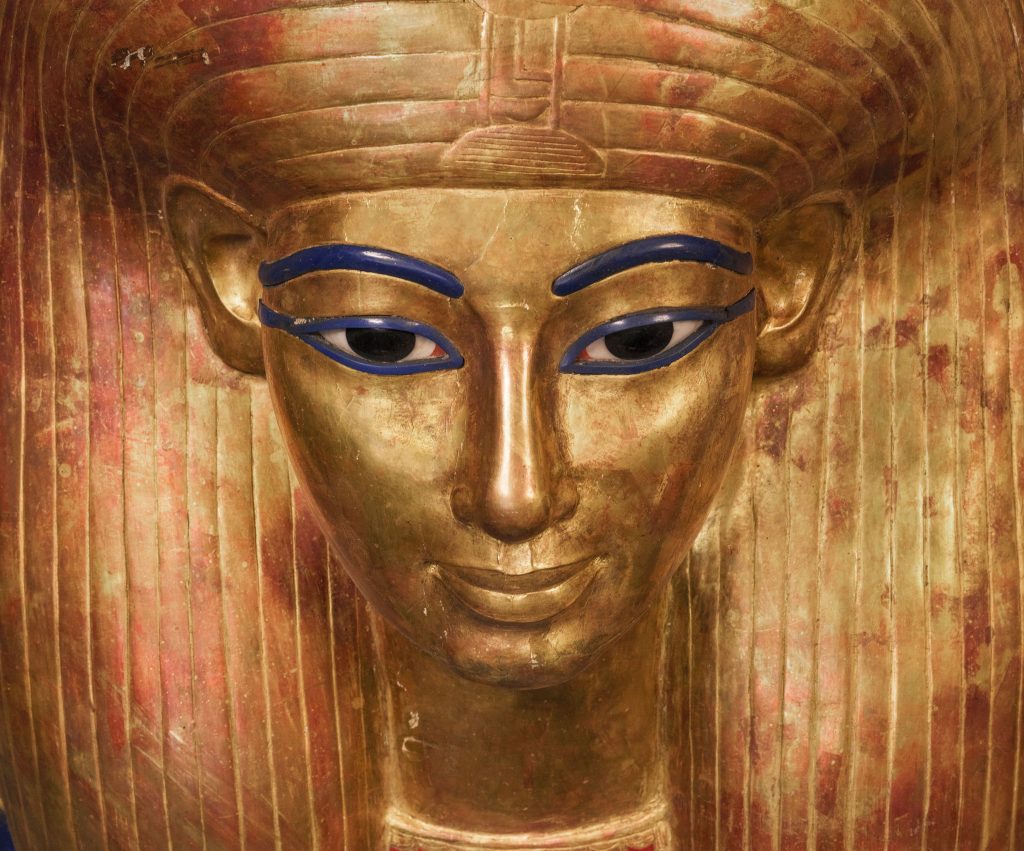
While the show celebrates common people of ancient Egypt—clay sculptures of workers making beer (a common staple of the era) or grinding grain—it lives up to its title, exhibiting royal artifacts among its 130 items, including a gilded wooden coffin lid of Queen Ahhotep II, as well as a necklace with a gilded wooden pectoral made from amber, carnelian, glass, turquoise and lapis lazuli, also from the Eighteenth Dynasty.
Other great discoveries featured in the show are items from Tanis in the northeastern portion of the Nile Delta. Uncovered in the early 19th Century and further excavated by French archaeologist Auguste Mariette in the 1860s, it wasn’t until 1939 that Pierre Montet discovered the royal tombs. It was the most significant find since King Tut 17 years earlier but, with World War II dominating the news cycle, wasn’t properly reported.
Dreyfus, who organized the show in San Francisco following its debut in Rome last year, placed the Tanis treasures in the final gallery. “You’ve got gold, you’ve got lapis lazuli,” she says of the site that’s featured in the classic film, Raiders of the Lost Ark. “Unlike the Valley of the Kings, whose tombs were plundered early on, they were so smart. They put their kings not where everybody knew they were. They put them under the complex of the Temple of Amun right in the city. And so they were found intact.”
Items here include the king’s gold funerary mask as well as an heset ewer, a ritual bronze vessel used for purifying
Most of the objects are on loan from the Egyptian Museum in Cairo, chosen by former director Tarek al-Awadi. “I had the opportunity to install it in the way that I feel mirrors what he had in mind when he came up with these objects,” says Dreyfus. “There are a number of different discoveries in this exhibition which tell us so much about Egyptian art but also show us the splendor and beauty of Egyptian art: the narrative of the kings and those surrounding them, everyday life, death and the afterlife.”